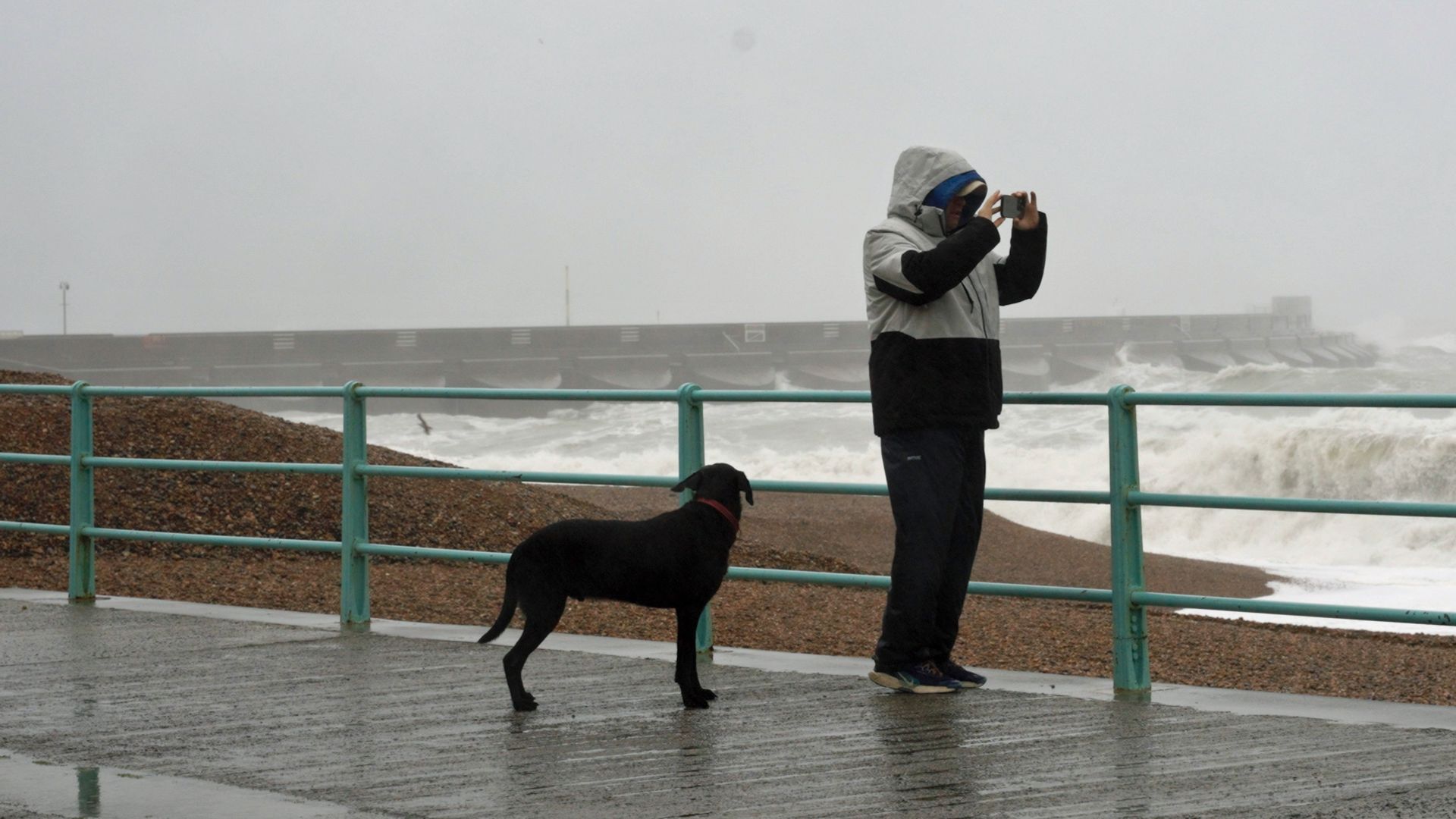
You learn to read the wind long before the weather app changes its icon from a timid rain cloud to a black swirl.
It starts with the front gate. A faint, repetitive metallic click against the latch, rhythmic as a nervous pulse. Then the house plants in the bay window shift slightly, catching a draught you didn’t know existed beneath the sill. By four in the afternoon, the sky over the British Isles doesn't darken so much as it bruises, turning a heavy, swollen purple that presses straight down onto the chimney pots.
Storm Boelo has arrived.
The meteorologists will give you numbers. They will tell you about an atmospheric pressure drop, a deep low-pressure system rolling off the Atlantic, and sustained winds expected to peak at 80 miles per hour across coastal regions and exposed high ground. They will warn of torrential downpours dropping two inches of rain in a single evening, of severe coastal flooding, disrupted rail networks, and cancelled ferries.
Those numbers are real, but they are cold. They do not capture what an 80-mph gust actually sounds like when it tears past your bedroom window at two in the morning.
The Weight of Air
Air is invisible, which makes us foolishly brave. We walk through it every day, pushing through its fluid mass without a second thought. But accelerate that same air to 80 miles per hour, and it ceases to be a background element. It becomes a solid wall moving with the momentum of a freight train.
Consider a hypothetical homeowner—let’s call him Arthur—living on a exposed headland in Cornwall or along the wind-swept ridges of the Welsh coast. Arthur has checked his fence panels. He has tucked the green plastic wheelie bin into the nook beside the shed, weighing the lid down with a spare garden brick. He feels prepared. It is a human instinct, this belief that a single brick can bargain with a kinetic force capable of uprooting a fifty-year-old oak tree.
At 50 miles per hour, wind rattles loose tiles.
At 60, it turns garden furniture into low-flying projectiles.
At 80, it reaches the threshold where structural engineering begins to converse directly with raw physics.
When a gale of that magnitude hits a standard pitch roof, it doesn't just push against the front of the building; it creates a massive vacuum over the top. The house isn't just taking a beating from the outside—it is literally being sucked upward from above. Every beam creaks. The plasterboard in the ceiling groans. In the dark, lying awake while the rain hits the glass like hand-thrown gravel, you realize your home is not a static fortress. It is a ship anchored to the earth, flexing under strain.
The Chemistry of Storm Rain
Rain during a storm like Boelo is not the gentle, rhythmic drizzle that makes a Sunday afternoon cozy. It is lateral. It travels horizontally, driven by the gale until it finds the microscopic flaw in your home’s armor.
Standard house brick is porous. Under normal conditions, rain strikes the surface and drains downward or evaporates. But when 80-mph winds press against a brick wall for eight straight hours, they generate hydraulic pressure. Water gets forced through the micro-cracks in the mortar, creeping past flashing, crawling up under soffits, and pooling in the insulation layers of your attic.
Down in the valleys and town centers, the math gets simpler and far more cruel. Two inches of rain sounds manageable when spread across a month. Spread across six hours on ground already saturated by a damp autumn, it has nowhere to go. River beds become highways. Culverts choke on torn branches and plastic debris.
By midnight, the water isn't just falling from the sky—it is rising from the floorboards, cold and silt-heavy, carrying the sharp scent of damp earth and overflowed drains into living rooms.
The Invisible Network of Vulnerability
We like to think of modern infrastructure as an immovable grid, a permanent backdrop to our daily routines. A severe storm reveals how fragile that grid truly is.
When an 80-mph wind shear strikes a high-voltage power line, it induces dynamic galloping—a phenomenon where the heavy cables wave in massive, rhythmic arcs until the physical stress snaps the connections or forces the pylons to ground. A single fallen tree branch in a rural lane doesn't just block a road; it severs the overhead fiber-optic cable, knocking out mobile towers, plunging three villages into silence, and isolating vulnerable residents who rely on connected telecare alarms.
The disruption trickles downward through the economic arterial lines.
Freight trains carrying morning produce sit idle because fallen timber has triggered automatic track signals. Commuters gather on freezing station platforms under flickering screens displaying a uniform row of red text. Ocean ferries rock violently at their moorings, their engines throbbing against sea walls as captain and crew wait out waves that turn harbor entrances into churning cauldrons of white water.
The national cost of a storm like Boelo isn't just measured in emergency repair bills or insurance claims. It is measured in lost hours, missed shifts, cancelled appointments, and the quiet, pervasive exhaustion of millions of people listening to the gale rage outside, wondering if their morning commute will even exist.
The Human Instinct to Gather
There is a strange, quiet intimacy to a night when the weather turns violent.
Long before electricity, human beings huddled around central hearths while the wind howled through the forest outside. That primal memory lingers in our biology. When Storm Boelo rattles the sash windows and the power flickers once, twice, and dies, the digital noise of the 21st century vanishes.
Out come the mismatched candles stored in the back of the kitchen drawer. The kettle gets boiled on a gas ring if you have one, or water is poured from a thermos prepared earlier. Families retreat to single rooms, drawn together by the simple warmth of shared space.
In those moments, the storm forces a pause. You cannot answer the urgent email because the router is dark. You cannot run the errand because the driveway is flooded. You are left with the immediate reality of four walls, a roof, and the roaring dark outside.
What Remains When the Air Goes Still
By dawn, the atmospheric pressure recovers. The storm center moves east toward the North Sea, leaving behind a sky washed clean—a pale, fragile blue that looks almost apologetic.
Then comes the quiet walking out.
Neighbors who haven't spoken since mid-summer emerge onto damp driveways, clad in heavy coats and wellingtons. They look up at rooflines, checking for missing slate. They inspect the wreckage of fence panels folded like cardboard across lawns. They drag heavy branches out of the middle of the street so the morning milk float or delivery van can squeeze through.
Storm Boelo will leave a trail of statistics in the official record: peak gust velocities, rainfall depth maps, financial estimates of insured losses. But the real story of the storm is written in the small, human acts of resilience—the neighbor offering a hot flask of tea to the tree-surgery crew clearing a fallen beech, the quiet relief of a dry carpet, and the deep, silent appreciation for the simple structure of a home that held firm while the world outside went wild.
The wind always leaves. The house remains. And inside, we turn the lights back on, sweep up the twigs, and begin again.