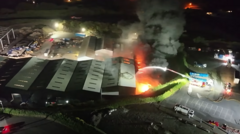
The air didn't smell like woodsmoke. It smelled like the death of a thousand gadgets—the sharp, acrid sting of melting plastic, the metallic tang of vaporized copper, and the heavy, oily scent of burning rubber. When eighty firefighters are called to a single point on a map, the world is no longer functioning as intended. It is breaking.
At the recycling center on the edge of the industrial estate, the day shift had long since gone home. The gates were locked. The machines were silent. But deep within a mountain of discarded electronics and scrap metal, something was breathing. It started as a microscopic spark, perhaps a bruised lithium-ion battery or a short-circuit in a forgotten toy. Heat built. It stayed trapped under tons of debris. Then, it found oxygen.
Chaos.
By the time the first engine arrived, the horizon was a bruised purple, backlit by a violent, flickering amber. This wasn't just a fire. It was a chemical event.
The Anatomy of an Inferno
Firefighters are trained for the predictable physics of a house fire. They understand how timber burns. They can anticipate the collapse of a roof. But a recycling center fire is a different beast entirely. It is a lottery of hazards. Underneath that roiling black smoke, eighty men and women faced a shifting topography of molten aluminum and exploding canisters.
Think of a recycling pile as a library of our modern sins. Every old smartphone we traded in, every broken toaster we meant to fix, and every lithium battery we tossed in the wrong bin becomes fuel. When these items ignite, they don't just burn; they react.
The heat becomes so intense that water—the very thing meant to quench the flames—can sometimes become a problem. In high-temperature metal fires, spraying water can lead to steam explosions or the liberation of hydrogen gas, adding more fuel to the literal fire. The crews didn't just stand there with hoses. They were playing a high-stakes game of thermal chess, using foam, high-volume pumps, and aerial platforms to douse the beast from above while trying to prevent the heat from reaching neighboring warehouses.
The Invisible Toll on the Front Line
Consider a firefighter named Mark. He is a hypothetical composite of the dozens of professionals who spent twelve hours in that heat, but his reality is shared by every person on that scene. Mark isn't thinking about the "recycling process" or "environmental impact." He is thinking about the weight of his breathing apparatus. He is feeling the sweat pool in his boots. He is monitoring the wind direction, knowing that if it shifts, the toxic plume could drift toward the residential blocks three miles away.
The physical exhaustion is absolute. Carrying heavy hoses over uneven, charred ground is like running a marathon in a sauna while wearing a weighted vest. Every breath comes through a mask. Every movement is calculated to avoid a trip that could lead to a fall into a pit of glowing embers.
But the mental strain is what lingers. These crews know that a fire of this scale doesn't just go out. It has to be dismantled. They work alongside heavy machinery operators who use giant claws to peel back layers of the burning mountain, exposing the red-hot core so the water can finally reach it. It is a slow, grinding, dangerous dance. One wrong move by the excavator, and a fresh pocket of oxygen hits a heat source, creating a "flashover" that can engulf a team in seconds.
Why We Should Have Seen This Coming
We live in an era of disposable convenience. We are told that recycling is the solution to our consumption, a magic wand that makes our waste disappear. But we rarely see the middle step. We don't see the massive warehouses where our "out of sight, out of mind" becomes a concentrated mountain of potential energy.
The reality is that our recycling infrastructure is struggling to keep up with the complexity of our trash. Ten years ago, a recycling fire was usually just paper or plastic. Today, it’s a volatile cocktail of rare earth metals and energy-dense batteries. When we talk about "eighty firefighters," we are really talking about the cost of a society that hasn't yet figured out how to safely undo what it has built.
The statistics are sobering. Industrial fires at waste sites have been rising globally, often linked to the "zombie batteries" that end up in general waste streams. These are the small, silver-cased cells found in greeting cards, vapes, and cordless headphones. When they are crushed by a compactor or a bulldozer, they short-circuit. They vent. They ignite.
The Long Morning After
As the sun began to rise over the blackened shell of the facility, the eighty firefighters didn't get to go home and sleep immediately. The "knockdown" of the main flames is only the beginning. Then comes the dampening down. For days, small teams remain on-site, poking at the ruins, looking for the tiny wisps of white smoke that signal a deep-seated hotspot.
The neighborhood wakes up to a different world. The local primary school might be closed due to air quality concerns. The local businesses find their yards covered in a fine, grey ash that feels greasy to the touch. The environmental agency arrives to test the runoff water, ensuring that the millions of gallons used to fight the fire haven't carried heavy metals into the local river system.
The "cold facts" of a news report tell us the number of engines and the time the call came in. They don't tell us about the silence that falls over a crew when they finally take their helmets off, their faces etched with soot and fatigue. They don't tell us about the local shopkeeper who stayed open all night to make sure the crews had coffee, or the realization that the "stuff" burning in that pile was once sitting in our own living rooms.
We see a headline about a fire and we think of it as an accident. But every fire at a recycling center is a symptom. It is a reminder that there is no such place as "away." Everything we discard has to go somewhere, and sometimes, that somewhere tries to burn the sky down.
The orange glow eventually fades, replaced by the dull, depressing grey of charred ruins. The fire engines pack up their hoses, the heavy yellow jackets are stowed away, and the sirens fall silent. But the smell stays. It lingers in the back of the throat for days—a persistent, bitter reminder that our discarded past has a way of catching up with us in the heat of the night.
The true cost of that night wasn't just the millions in property damage or the thousands of man-hours spent by the emergency services. It was the sudden, violent exposure of the fragility of our systems. Eighty people went into the heat so that a city could keep sleeping, unaware that their old laptops and dead batteries had briefly turned into a sun on the horizon.
Next time you hold a dead device in your hand, feel the weight of it. It isn't just plastic and glass. It is a dormant spark, waiting for the right moment to remind us that nothing ever truly disappears.