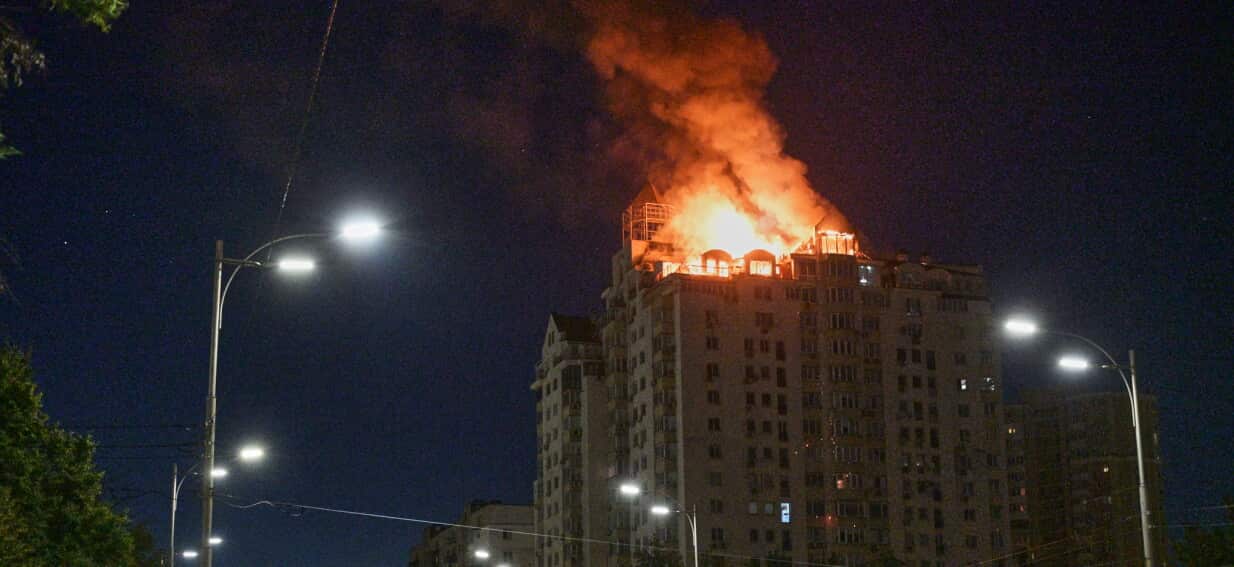
The alarm does not wake you anymore. Not really. It merely drags you from a thin, gray layer of exhaustion into a sharp, cold reality. It is 3:00 AM. The air in the apartment is freezing because the grid is straining, humming like a dying animal. You do not look for your shoes; you already have them on. You do not grab your bag; it has been sitting by the door since November.
Then comes the sound. It is not the low rumble of thunder you grew up with. It is a tearing noise, like canvas being ripped right next to your ear, followed by a pressure wave that thumps against your chest and rattles the teacups in the cupboard.
This was the reality for nearly three million people. The capital faced what officials later called the most massive aerial assault since the early days of the invasion. Over dozens of drones and cruise missiles converged on a single city in a coordinated attempt to blind, burn, and break. By dawn, at least thirteen people were dead.
But numbers are bloodless. They hide the true cost behind a wall of statistics. To understand what happened, you have to look at the glass.
The Geography of Panic
When a missile is intercepted in the sky, it does not simply vanish. The laws of physics remain indifferent to human conflict. What goes up must come down, shattered into jagged, burning fragments of aluminum and high explosives.
Imagine a woman named Olena. She is not real, but she is a composite of three different residents who lived on the fourteenth floor of a high-rise in the Solomyanskyi district. Olena spent two hours in a concrete stairwell, holding her cat, listening to the supersonic geometry of air defense systems tracing targets overhead. When the largest explosion rocked the building, the pressure wave blew the window frames completely out of the brickwork.
When she crawled back into her living room at 6:00 AM, the floor was covered in a glittering, deadly carpet of shards. Her life was reduced to a cleanup operation.
This is the hidden strategy of modern siege warfare. It is designed to exhaust the human spirit by making the domestic sphere entirely unsafe. Your bed is no longer a sanctuary; it is a hazard zone next to a pane of glass that could become shrapnel at any second. The kitchen is no longer where you make coffee; it is where you store buckets of water because the water mains were severed by a strike three miles away.
The sheer scale of the attack required an unprecedented response. Air defense crews worked under blinding pressure, flickering between radar screens and the night sky, knowing that a single missed target meant an entire apartment block could cease to exist. They intercepted the vast majority of the incoming threats. Yet, the debris from those very successes rained down on residential neighborhoods, proving that in a saturated bombardment, even defense carries a heavy toll.
The Anatomy of the Escalation
Why now? The timing of these massive strikes is never accidental. They are calculated psychological operations disguised as military maneuvers.
For months, the city had settled into a fragile, tense rhythm. Restaurants were open. People went to work. The subway ran on time, even if the stations occasionally doubled as bomb shelters. This facade of normalcy is vital for survival, but it is also what the attacker seeks to destroy. By launching an assault of this magnitude, the goal is to shatter the illusion of safety, to remind every citizen that their survival is entirely conditional.
Consider the logistics behind the chaos:
- Simultaneous launches from multiple directions to confuse radar tracking.
- A mix of slow-moving decoy drones designed to drain air defense ammunition.
- Hypersonic and cruise missiles timed to hit just as first responders arrive on the scene.
It is a mathematical puzzle where the variables are human lives.
The physical damage can be measured in craters, charred vehicles, and collapsed roofs. The psychological damage is harder to quantify. It shows up in the way people walk down the street—always looking up, always calculating the distance to the nearest underground crossing. It shows up in the silence of the children who no longer cry when the sirens wail, because they have learned that crying changes nothing.
The Cost of Looking Away
There is a temptation for the outside world to view these events with a sense of routine. Another headline. Another death toll. The brain naturally seeks to protect itself from distant horror by normalizing it.
But there is nothing normal about a capital city being hunted from the air week after week.
When the smoke cleared over Kyiv, the sun rose on a city that refused to look defeated, even as it bled. Neighbors who had never spoken before were suddenly clearing rubble together, passing buckets of broken concrete down a human chain. Volunteers stood on street corners distributing hot tea and plastic sheeting to cover broken windows before the winter wind could claim the interiors.
The true weight of the assault is felt in the quiet moments after the sirens fall silent. It is found in the realization that tomorrow night the sky might tear open again, and once more, millions of people will have to choose between the cold comfort of a basement or the stubborn defiance of their own beds.
A old man sat on a bench outside a damaged apartment building, sweeping a small pile of plaster dust from his shoes with a broken branch. He did not look at the cameras of the arriving journalists. He did not speak to the officials taking notes. He simply kept sweeping, his movements slow and rhythmic, a solitary figure reasserting control over the tiny patch of earth beneath his feet while the sky above remained vast, empty, and indifferent.


