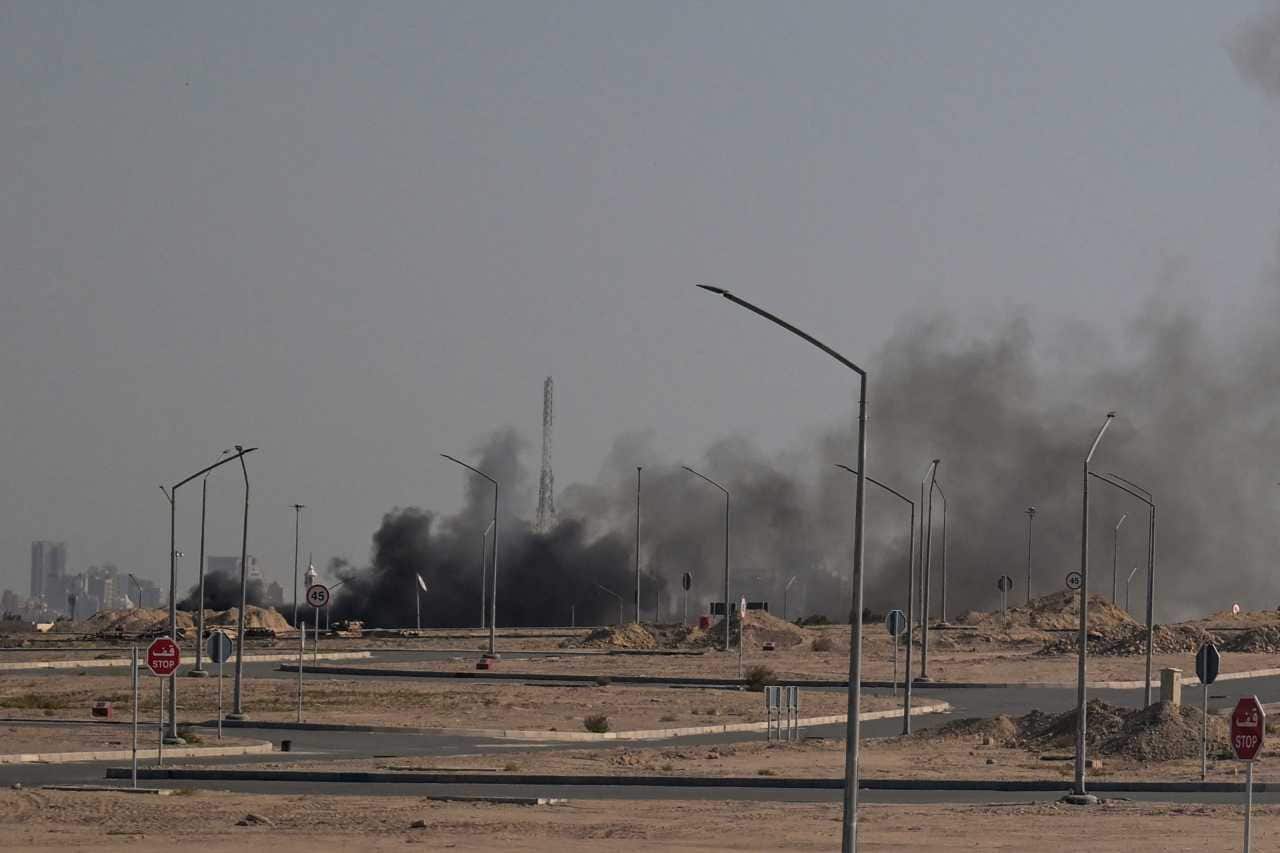
The sirens did not start with a roar. They began as a low, mechanical moan, vibrating through the concrete walls of Salmiya before the sound even registered in the human ear. For those sitting at dinner tables, or tucking children into bed, or driving along the Arabian Gulf Street, that initial frequency was just a glitch in the background noise of a Tuesday evening. Then the sky ripped open.
When an attack of this scale happens, geopolitics dominates the tickers. Analysts talk about regional deterrence, missile trajectories, and strategic retaliation. But on the ground, war is not a chess game. It is the smell of burning rubber, the blinding flash that turns midnight into a sterile, terrifying noon, and the sudden, violent realization that the ceiling above your head has become a weapon.
By morning, the cold arithmetic of the Kuwaiti Health Ministry would finalize the count: sixty-three injured, one dead.
Numbers like that are easy to read and easier to forget. They fit neatly into a social media post or a news crawl. But sixty-three is not just a statistic. It is sixty-three separate lives interrupted in a single, chaotic instant. It is sixty-three families rushing toward hospital corridors that smell of antiseptic and panic. And that single digit—the one person who did not survive—leaves behind a permanent, echoing silence in a home that was safe just hours before.
The Anatomy of an Instant
Consider what happens to an ordinary room when a missile strikes nearby.
The shockwave arrives first. It moves faster than the sound of the explosion itself, an invisible wall of compressed air traveling at thousands of meters per second. When it hits a residential building, the glass does not merely break. It atomizes. Millions of microscopic shards fly inward, turning living rooms into vortexes of flying knives.
This is how most of the sixty-three injuries occurred. People were not hit by direct fire; they were wounded by their own homes.
Walk into the emergency ward of any major hospital in Kuwait City in the wake of the strike, and the sensory overload is staggering. The triage system is a brutal, necessary sorting mechanism. Crimson tags go to the critical, yellow to the stable, green to the walking wounded. Doctors and nurses, many of whom had just finished grueling twelve-hour shifts, found themselves running back into the bays, their scrubs quickly stained with the dust and blood of strangers.
The injuries tell a story of domestic routine violently disrupted. Deep lacerations from shattered window panes. Concussions from falling drywall. Severe burns from ruptured gas lines. A mother who threw her body over her toddler, her back now a map of embedded glass. An elderly man who fell from his bed as the floor bucked beneath him, his hip fractured by the tremor of the earth.
We often view conflict through a panoramic lens, looking at maps and borders. But the true cost of an escalation between regional powers is always paid in the currency of civilian blood. Kuwait, a nation that has spent decades cultivating a role as a diplomatic mediator, a sanctuary of relative calm, suddenly found its sovereignty pierced by fire.
The Long Shift
Medical professionals understand a truth that politicians often overlook: the physical wound is only the beginning of the trauma.
A surgeon operating on a severed artery can repair the vessel in an hour. They can stop the bleeding, stitch the tissue, and stabilize the blood pressure. But they cannot stitch the psyche. The sixty-three people who filled the emergency rooms are now carrying an invisible, psychological shrapnel that will persist long after the scars fade.
Every sudden sound—a slamming door, a car backfiring, a thunderstorm rolling over the Persian Gulf—will now trigger an involuntary spike of adrenaline. The heart races. The palms sweat. The mind immediately flashes back to the moment the sky turned white.
Then there is the family of the sole casualty.
In the grand calculus of military conflict, a single death is often dismissed as minimal collateral damage. To the strategists, a strike that leaves only one dead is considered a failure of execution or a triumph of air defense. But for that specific family, the loss is total. It is 100% of their world gone. The empty chair at the breakfast table cannot be mitigated by the fact that sixty-two others survived. Their grief is absolute, insulated from the broader political context.
The Fragile Illusion of Safety
We live our lives under a comforting illusion of permanence. We assume the roof will hold, the lights will stay on, and the morning will arrive exactly like the day before. Events like the strike on Kuwait shatter that illusion instantly.
The true terror of modern regional warfare is its arbitrary nature. The victims were not combatants. They were not guarding installations or planning campaigns. They were simply existing in the wrong latitude when a missile, launched from hundreds of kilometers away, reached the end of its trajectory.
The response from the Kuwaiti healthcare system was a testament to years of quiet preparation. Sirens wailed across the capital as ambulances wove through traffic, creating a makeshift conveyor belt of survival from the strike zone to the trauma centers. Blood donation banks filled within hours as citizens and residents lined up, offering the only thing they could to counter the violence: their own lifeforce.
Yet, as the physical debris is swept from the streets and the broken glass is replaced, the heavy atmosphere remains. The attack represents a crossing of lines, a signal that the geographical buffers of the past offer little protection in an age of long-range precision weaponry.
The ambulances have turned off their lights. The emergency rooms have returned to their daily cadences of chronic illnesses and traffic accidents. But the collective consciousness of a city has shifted. People look at their windows differently now. They listen to the night sky with a new, sharp attention.
The statistics will remain in the government archives, a dry record of a violent night. But the true narrative lives on in sixty-three hospital beds, in a quiet funeral, and in the lingering, unspoken question that hangs over every home in the city: what happens when the sirens sound again?