Silence.
In Washington, D.C., silence is never an accident; it is an engineered state of grace, purchased through concentric rings of radar, restricted airspace zones, and men in dark suits who do not blink when the wind shifts. You do not hear commercial airliners roaring low over the National Mall. You do not see twin-engine jets banking hard above the Washington Monument while tourists hold up melting ice cream cones. When an engine screams over the District of Columbia, people look up with a specific, inherited reflex—a muscle memory carved into the collective spine of the city on a Tuesday morning in September 2001. Read more on a similar issue: this related article.
Now picture a crisp October evening in 2020. It is Halloween. Down on the South Lawn of the White House, the air smells like damp leaves, caramel apples, and diesel exhaust from idling press vans. Children dressed as miniature astronauts, princesses, and caped superheroes are clutching plastic pumpkins, waiting for the President and First Lady to hand out boxed presidential M&Ms. The atmosphere is orchestrated whimsy, a rare night when the fortress at 1600 Pennsylvania Avenue pretends to be a neighborhood porch.
Then, the sound hits. Additional journalism by NBC News highlights similar perspectives on the subject.
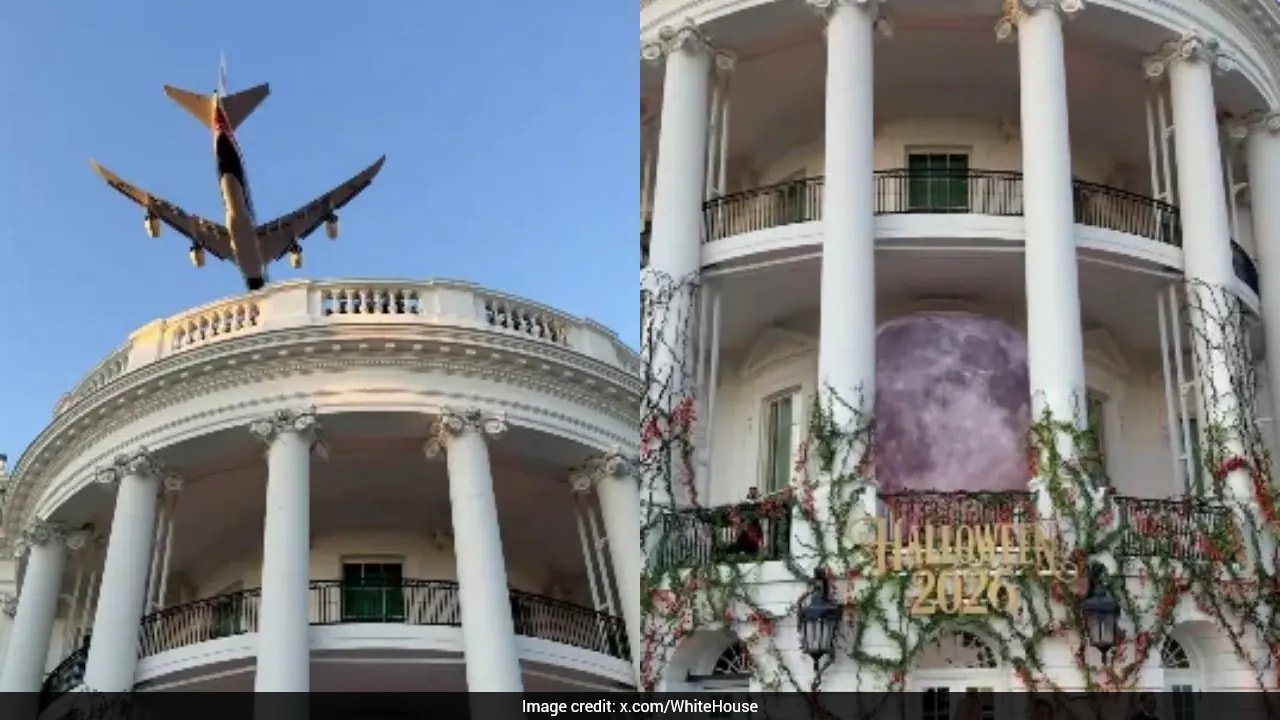
It is not the familiar, rhythmic thump-thump-thump of Marine One settling onto the grass. It is a heavy, turbine-driven roar—the unmistakable acoustic signature of a Boeing VC-25A, the customized 747-200B better known to the world as Air Force One. For a few heart-stopping seconds, captured on grainy smartphone video that would soon ignite a firestorm across social media, the massive blue-and-white fuselage appears to skim dangerously close to the White House roof, banking low against the twilight sky.
Panic.
That single, six-second clip turned a routine aviation maneuver into a viral fever dream. Watching it on a phone screen, stripped of depth perception and radar telemetry, your stomach drops. It looks like a breach. It looks like a mistake. It looks like the opening frame of a disaster movie.
To understand what actually happened in the skies above Washington that Halloween night, you have to step away from the frantic comment sections and stand inside the glass-walled control rooms of the National Capital Region—and inside the cockpit of the most scrutinized aircraft on Earth.
The Architecture of Invisible Walls
Most people imagine airspace as an empty ocean where pilots steer by sight, like captains navigating a harbor. In reality, the sky above Washington is closer to a labyrinth of invisible glass corridors, stacked like floors in a skyscraper, where every inch is watched by overlapping eyes.
Consider a hypothetical controller—let us call her Elena—sitting in the darkened room of the Potomac Consolidated Terminal Radar Approach Control in Warrenton, Virginia. On a normal shift, Elena’s universe consists of glowing green blips representing commercial flights arcing smoothly into Reagan National Airport (DCA), located just across the Potomac River. The flight path into Reagan National is already one of the most demanding in commercial aviation. Pilots must follow the "River Visual" approach, winding down the curves of the Potomac like a car hugging a mountain road, keeping strictly clear of Prohibited Area P-56—the inviolable cylinder of sky shielding the White House, the Capitol, and the Naval Observatory.
Cross that line without clearance, and the sky turns hostile. Fighter jets scramble from Joint Base Andrews. Warning lasers flash red and green into your cockpit windows. In 2005, when a stray Cessna wandered into P-56, Capitol Police evacuated the building in seconds while panic rippled through the streets. The rules are written in iron.
Except when the aircraft belongs to the President of the United States.
Even then, Air Force One does not simply wander wherever its pilots please. Every movement of the 89th Airlift Wing—the elite Air Force unit based at Joint Base Andrews in Maryland that operates the presidential fleet—is choreographed down to the second. When Air Force One departed Andrews on that October evening, or returned from a campaign swing, its flight path intersected with one of the tightest geographic bottlenecks in modern aviation.
Look at a map of Washington, D.C., and you see the problem immediately. Joint Base Andrews sits roughly ten miles southeast of the White House. Reagan National Airport sits less than three miles south of the White House. Between them lies the Anacostia River, the Potomac River, and a dense web of restricted zones. When winds dictate a northerly approach or departure, heavy aircraft flying to or from Andrews routinely pass along the river corridors just south and east of the monumental core.
From the ground, watching a 400-ton jumbo jet slice across the horizon behind the White House tree line, the geometry plays a cruel trick on the human eye.
The Optical Illusion of Doom
I have stood on the Ellipse just south of the White House lawn when a heavy transport jet banked over the Potomac, and the sensation is visceral—your brain refuses to believe the wings will clear the treetops. The roar vibrates in your molars before the aircraft even comes into view, and when it does, its sheer scale obliterates your sense of distance.
This is the tyranny of telephoto compression and flat-screen video.
When an observer standing near the White House or along the National Mall points a smartphone upward, the camera flattens three-dimensional space into a two-dimensional postcard. An aircraft flying two miles away over the Potomac River at an altitude of 1,500 or 2,000 feet appears, through a smartphone lens, to be hovering directly above the White House chimney. Because a Boeing 747 stretches 231 feet from nose to tail—roughly two-thirds the length of a football field—our brains subconsciously assign it the size of a normal twin-engine commuter plane. When it looks huge in the frame, our survival instincts scream one conclusion: It is way too close.
Let us strip away the optical illusion and look at the actual physics of what transpired during that Halloween flight.
First, the aircraft never violated Prohibited Area P-56. Had Air Force One crossed into the restricted airspace directly over the Executive Mansion at low altitude, automated alarms would have detonated across the Secret Service’s Joint Operations Center, the FAA’s Domestic Events Network, and NORAD’s Eastern Air Defense Sector. Even for the presidential aircraft, flying directly over the White House roof is prohibited under standard operating procedures precisely because of wake turbulence, engine-out contingencies, and security protocols.
Second, what viewers saw on the viral video was a standard visual arrival or departure corridor over the Potomac River, combined with a steep, deliberate bank angle required to keep the aircraft inside civilian-free airspace while transitioning between Andrews and its cruising altitude.
Think of it like watching a massive cruise ship pass through a narrow canal from a hillside balcony a mile away. From your vantage point, the ship’s smokestacks appear to scrape the roofs of the houses lining the opposite shore. Down on the water, however, the captain has hundreds of yards of clearance on either side, guided by sonar, GPS, and harbor pilots who have run that exact channel a thousand times.
Still, knowing the geometry does not erase the chill people felt watching the clip. And there is a very real historical reason why low-flying jumbo jets near American landmarks trigger instant dread.
Ghosts in the Flight Path
April 27, 2009.
If you want to understand why the White House press corps, aviation watchdogs, and ordinary citizens react with hair-trigger alarm whenever Air Force One dips low near a major city, you have to remember that morning in Lower Manhattan.
Under clear spring skies, one of the presidential VC-25A jets—accompanied by an Air Force F-16 fighter—swooped low over New York Harbor and the Hudson River, circling the Statue of Liberty and banking past the skyscrapers of Lower Manhattan. The mission was a publicity photo shoot ordered by the White House Military Office to update stock photographs of the presidential plane against iconic American backdrops.
The problem? Nobody told the public.
Thousands of office workers in New York and New Jersey looked out their windows and saw a massive commercial-style airliner flying dangerously low toward the skyline, tailed by a fighter jet. Less than eight years after the World Trade Center collapsed into ash, terror seized the streets. Buildings self-evacuated. People ran weeping down Broadway. Wall Street traders froze at their desks. The political fallout was swift and brutal: the director of the White House Military Office resigned, the Pentagon issued a formal apology, and the rules governing low-altitude presidential flyovers were rewritten in blood and embarrassment.
That scar never fully healed.
Whenever a video surfaces showing Air Force One at low altitude near a recognizable monument, the collective memory of 2009—and the deeper, darker trauma of 2001—rushes back into the room. We do not watch the video objectively. We watch it through the lens of everything we have survived.
On Halloween night in 2020, that emotional static collided with an already charged political atmosphere. Just three days before a fiercely contested presidential election, every image emanating from 1600 Pennsylvania Avenue was instantly weaponized, scrutinized, and stripped of nuance. To critics, the low pass looked like reckless showmanship—a pilot flexing muscle over the capital for dramatic effect. To supporters, it was a thrilling display of American power framed against an autumn sunset.
Both interpretations missed the mundane, disciplined reality inside the flight deck.
Inside the Cockpit of VC-25A
Who actually flies Air Force One? Not hotshots looking to buzz the boss’s house on a holiday evening.
The pilots of the Presidential Airlift Group are hand-picked senior officers with thousands of hours of heavy-jet command experience, spotless safety records, and psychological profiles built around extreme compartmentalization. When you sit in the left seat of a VC-25A, you are flying a one-of-a-kind, heavily modified aircraft packed with hardened communications suites, defensive countermeasures, mid-air refueling hardware, and classified command-and-control systems. There are only two of these airframes in existence—tail numbers 28000 and 29000—and they have been flying since the George H.W. Bush administration.
Inside that cockpit, nothing is improvised. Every turn, every altitude change, and every airspeed adjustment over the National Capital Region is pre-briefed, coordinated with Potomac TRACON, and logged on digital flight data recorders.
Consider what happens in the flight deck during a low-altitude transition near Washington:
- Terrain and Obstacle Avoidance: Even in clear visual conditions, the aircraft’s Enhanced Ground Proximity Warning System (EGPWS) continuously maps the terrain and man-made structures ahead—including the 555-foot marble obelisk of the Washington Monument. Any genuine deviation toward unsafe proximity triggers booming synthetic voice alerts inside the cockpit headsets long before an observer on the ground would notice anything unusual.
- Airspace Deconfliction: Before Air Force One enters the terminal airspace around D.C., air traffic controllers freeze intersecting traffic patterns at Reagan National Airport. Commercial departures are held on the ground; incoming flights are vectored into holding patterns miles away. For a brief window, the sky belongs exclusively to the presidential mission.
- The Visual Illusion of Bank Angle: Because a 747 has a wingspan of nearly 196 feet, even a standard 25-to-30-degree bank turn makes the inboard wingtip dip dramatically toward the horizon. From below, that sweeping wing appears to point straight down at the rooftops, creating the illusion of a steep dive when the aircraft is actually maintaining level altitude or climbing steadily.
When the Halloween video went viral, aviation analysts, former military pilots, and flight-tracking enthusiasts quickly cross-referenced the timestamp of the footage against publicly available ADS-B transponder data and air traffic control audio archives. The verdict was unambiguous: the aircraft was flying along an established corridor, well outside the prohibited inner ring, executing a completely normal maneuver under positive radar control.
No alarms sounded. No protocols were broken. No lives were placed at risk.
Why We Fall for the Frame
Yet the story lingered, shared millions of times with breathless captions claiming Air Force One had nearly clipped the White House roof. Why are we so eager to believe the terrifying version of a six-second video?
Because modern information travels faster than context.
A smartphone clip stripped of metadata is an emotional Rorschach test. When you hear the visceral roar of four General Electric CF6 engines reverberating off limestone buildings and see a giant blue-and-white jet banking sharply behind the White House trees, your nervous system reacts before your analytical brain can check a flight tracker. Fear is immediate; geometry requires homework.
Imagine a hypothetical viewer—say, Marcus, a commuter scrolling through his phone on a train in Chicago that night. Marcus sees the video, feels a jolt of adrenaline, and shares it with his group chat with three words: What is happening? Within ten minutes, forty people have seen it. None of them know where the camera was standing—whether it was on the North Lawn, across the Potomac in Rosslyn, or near the Lincoln Memorial. None of them know the focal length of the lens, the wind direction at Reagan National, or the altitude readout on the pilot's altimeter. They only know what their eyes tell them: a massive plane looks dangerously close to the most famous house in the world.
This gap between visual perception and physical reality is where modern misinformation thrives—not always out of malice, but out of sheer human instinct. We are wired to spot predators in the tall grass, to flinch at sudden shadows overhead, to treat an unusual silhouette in the sky as an existential threat until proven otherwise.
And in Washington, D.C., that instinct is sharper than anywhere else on Earth.
The Weight of the Quiet Sky
Walk along the National Mall at dusk on any ordinary evening, and you will feel the invisible architecture holding the city together.
Above the reflecting pool, the air is remarkably still. Far to the south, you can watch the blinking white landing lights of commercial jets lining up like pearls on a string as they descend along the Potomac toward Reagan National, obediently hugging the river’s curve so they never stray toward the white dome of the Capitol or the columns of the Executive Mansion. Every pilot in that line knows the boundary. Every controller in that dark room in Virginia watches the line.
That quiet is a covenant. It is the silent promise that the skies over the capital are watched, measured, and controlled down to the foot.
When Air Force One passes near that boundary on a crisp October evening—its polished aluminum belly catching the last bruised purple light of sunset while children on the lawn below hold plastic pumpkins full of candy—it briefly breaks the illusion of stillness. For a few seconds, the sheer physical reality of American power becomes loud, heavy, and impossible to ignore.
The jet banks smoothly over the river, its wingtips slicing clean through the twilight, and climbs away into the darkening east. Down on the ground, the roar fades into the rustle of autumn leaves, the laughter of costumed kids, and the quiet hum of a city returning to its guarded, watchful peace.