Salt crusts the windshield of a container truck idling near the docks in Jebel Ali, glowing amber under the harsh glare of high-intensity sodium lamps. It is three in the morning. Normally, this corridor hums with the relentless mechanical breathing of global capitalism—cranes groaning overhead, diesel engines shaking the asphalt, stacks of steel boxes shifting like building blocks in the dark.
Tonight, the silence is heavy. It presses against the glass.
Drivers sit on the hoods of their cabs, smoking silently, staring at phones that keep refreshing against weak signals. Thousands of miles of open blue water separate the Persian Gulf from the roaring engines of international trade, but right now, that water feels like a tripwire.
Hours earlier, the horizon tore open.
Tehran fired ballistic missiles toward the Gulf state, a flash of white-hot propellant arcing across a starry night sky before air defense batteries answered with jagged streaks of fire. The sirens wailed through sleek commercial districts and quiet coastal towns alike. Glass didn't shatter everywhere, but certainty did.
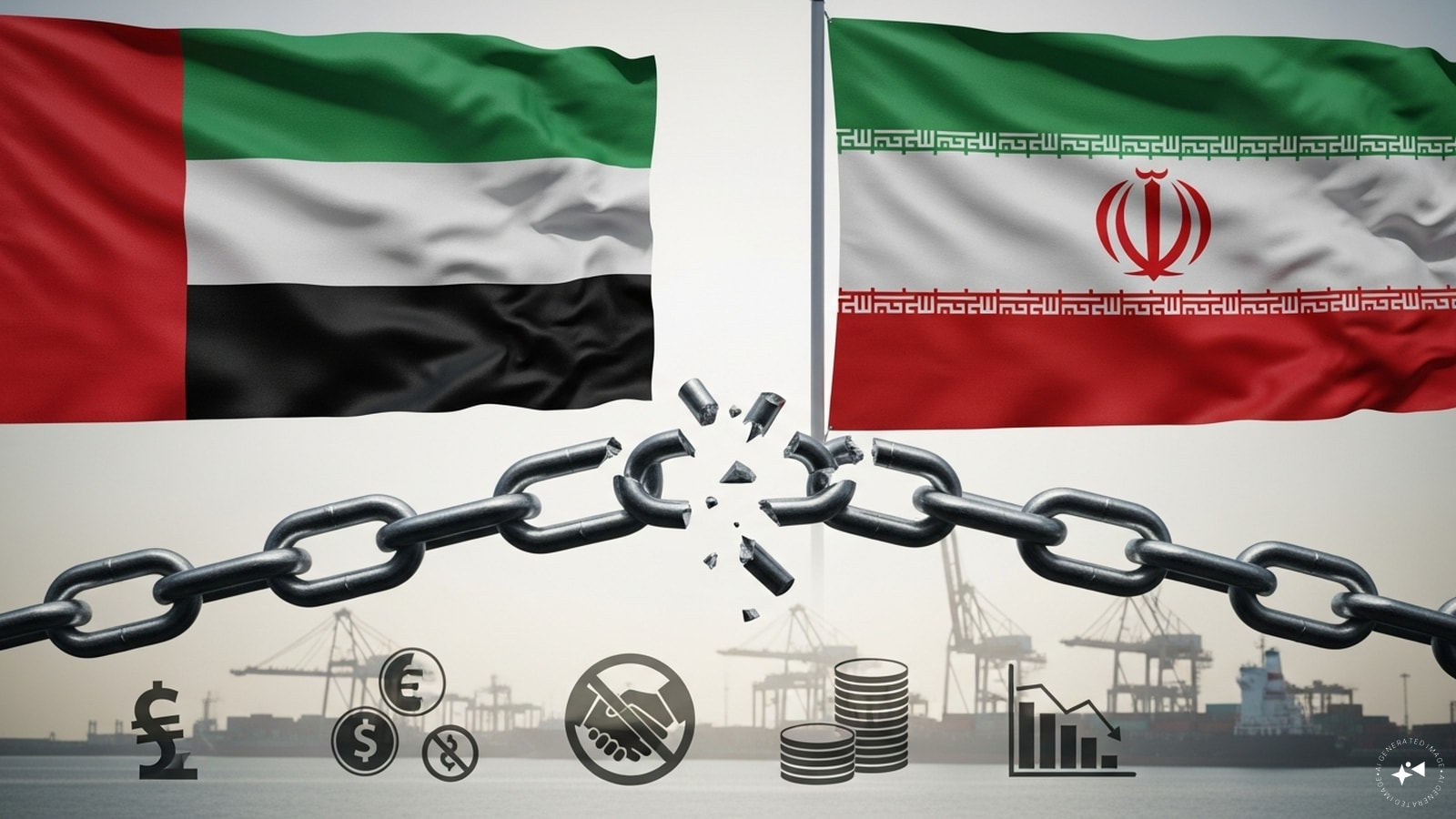
By sunrise, the diplomatic cables were burning. The United Arab Emirates suspended trade with Iran, drawing a sharp, immovable line in the sand where economic partnership once stood.
To read the ticker tape on a financial terminal, the news is simple: borders closed, transactions frozen, ports restricted. Numbers adjust. Stock indices twitch. Analysts write measured summaries about supply chain diversification.
They are missing the pulse.
Trade is not an abstract spreadsheet. Trade is a perishable tomato rotting in a cargo hold because customs clearance vanished overnight. Trade is an Iranian textile merchant in Dubai’s old spice souk walking past a shuttered storefront he has unlocked for twenty consecutive years, wondering if he will ever turn the key again. Trade is the sudden, terrifying realization that geography is a cage, and the lock has just been thrown.
Consider what happens when a corridor shared by millions of lives shuts down in a single afternoon.
For generations, the narrow waters of the Gulf have functioned as a crowded, high-stakes highway. Dhows carrying dates, carpets, and household goods have crisscrossed these currents for centuries, long before radar screens or satellite feeds. Modern container ships simply scaled up a very old human habit: trading across the water because your neighbor has what you need, and you have what they want.
That architecture of mutual dependence took decades to build. It takes minutes to burn to ash.
When ballistic missiles arc through the stratosphere, they carry a payload far heavier than high explosives. They carry total disruption. Trust is the invisible currency of every port city. Once missiles fly, trust evaporates faster than seawater on a July asphalt road.
In a quiet logistics office overlooking the harbor, a shipping manager named Tariq—a hypothetical man standing in for thousands caught in the machinery of statecraft—looks at a shipping manifest that has just become illegal to fulfill. His screen displays forty containers bound for Bandar Abbas. Machinery parts, electrical components, raw materials destined for factories that may now go dark.
He doesn't curse the politicians. He just reaches for his phone to call a client, his voice flat with a fatigue that predates the sunrise.
"The port authority just updated the manifest rules," he says into the receiver. "Nothing moves. We are holding everything."
There is a long pause on the other end of the line. Just static and the distant hum of a city trying to wake up to a new reality.
This is the hidden cost of geopolitical friction. We talk about sanctions and suspensions as if they are chess pieces sliding smoothly across a polished board. We forget the friction burns. We forget the small business owners whose cash flow is instantly halved, the families waiting on remittances, the dockworkers whose shifts are canceled before they even punch the clock.
The suspension of trade between the UAE and Iran is not just a diplomatic pivot. It is a violent severing of economic arteries that have pulsed through times of war, peace, boom, and bust.
History shows us that trade finds a way through the cracks, or it dies in the dark. During past crises, cargo found alternative ports, intermediaries stepped in, papers were stamped with different ink. But ballistic missiles change the calculus. They cross a threshold from economic competition into existential survival. When sovereignty is threatened from the skies above, commercial ties on the ground become immediate casualties.
The container trucks in Jebel Ali remain parked. The drivers have turned off their engines to conserve fuel.
Dawn breaks over the Gulf, washing the sky in pale gold and bruised purple. The water looks calm, mirroring the morning light with deceptive tranquility. But beneath the surface, the currents have shifted completely, leaving a vast emptiness where a bridge used to stand.