The Persian Gulf at three in the morning is a liquid void. It is a heavy, oil-slicked darkness that feels less like water and more like a physical weight pressing against the hull of a ship. For the crew of a merchant vessel, this is the hour of ghosts. You hear the creak of the bulkheads and the distant, rhythmic thrum of the engines, and you pray for a boring watch.
Boring is safe. Boring means you get to see your family again.
But on this particular night, the silence didn't last. The air didn't just carry the smell of salt and diesel; it carried the static electricity of an impending collision between two worlds. When the first flashes of light cut through the haze, they weren't the rhythmic pulses of a lighthouse. They were the jagged, angry bursts of tracers.
The Iron Guard of the Strait
The U.S. Navy destroyer moved through the water with a predatory grace that belies its massive weight. These ships are masterpieces of engineering, floating cities of steel and silicon designed to project power across thousands of miles of ocean. To the sailors on deck, the mission is often abstract—protecting "freedom of navigation" or "securing global supply chains." These are phrases found in white papers and policy briefings.
They don't feel real until the radar starts screaming.
Consider a young sonar technician, perhaps twenty-one years old, sitting in the blue-lit hum of the Combat Information Center. To them, the Iranian-flagged cargo ship isn't a political statement. It’s a green blip on a screen moving at a speed and heading that defies the standard protocols of the sea. There is a tension in the room that no amount of training can fully simulate. It’s the feeling of a spring being wound too tight.
The order comes down. It is crisp. Final.
The destroyer's deck guns roared, spitting fire into the humid night. This wasn't a warning whispered in a diplomat's ear; it was a shout that echoed across the waves. The shells weren't aimed to sink—not yet—but to halt. They were a violent punctuation mark at the end of a long, tense sentence.
A Ghost Ship in the Crosshairs
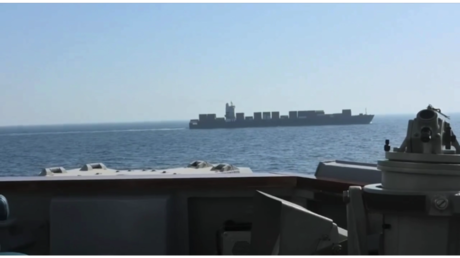
On the other side of the trajectory sat a cargo vessel flying the Iranian flag. From a distance, these ships look like tired pack animals, rusted and salt-stained, carrying the lifeblood of global trade. But in the volatile waters of the Gulf, a cargo ship is rarely just a cargo ship. It is a piece on a chessboard.
Imagine the captain of that vessel. Whether they are a willing participant in a geopolitical game or a merchant caught in a storm of someone else’s making, the reality is the same: the vibration of a heavy-caliber shell hitting the water nearby is a sound that vibrates in your marrow. It is the sound of an empire saying "no."
The reports are often dry. They say "the vessel failed to respond to radioed warnings." They say "maneuvers were deemed provocative." What they don't say is that for a few minutes, several dozen human beings on both sides were staring into the abyss. They were waiting to see if the next flash would be the one that turned their world into a fireball of twisted metal and seawater.
The U.S. Navy maintains that the ship was operating in a manner that threatened the security of the region. They point to the history of the IRGC (Islamic Revolutionary Guard Corps) using civilian-looking vessels for unconventional warfare, laying mines, or transporting illicit cargo. It is a game of shadows where the rules are written in blood and oil.
The Invisible Stakes of a Cold Ocean
Why does this matter to someone sitting thousands of miles away, drinking a coffee or scrolling through their phone?
The answer is in the cup. The answer is in the phone.
The Persian Gulf is a bottleneck. It is a narrow throat through which a staggering percentage of the world's energy and goods must pass. When a destroyer fires on a cargo ship, the ripples travel much further than the wake of the vessels. They travel into the global markets. They travel into the boardrooms of insurance companies.
Every time a shot is fired in these waters, the cost of living for a family in Ohio or a factory worker in Berlin shifts. We like to think of our modern world as a digital, ethereal thing, but it is built on the backs of these steel giants. If the throat is squeezed, the whole world gasps for air.
But the real cost isn't measured in barrels or cents. It’s measured in the psychological toll of a perpetual brinkmanship. We have lived in a state of "almost war" for so long that we have become numb to the headlines. We read "U.S. Destroyer Fires" and we move on to the sports scores.
We forget that every one of those "incidents" is a moment where a single nervous finger on a trigger could have changed the course of history.
The Language of Violence
Diplomacy is a language of nuance, of "deep concern" and "carefully considered responses." But on the high seas, the language is much more primal.
When the radio goes silent and the warnings are ignored, the only thing left is the kinetic. The Navy calls it "deterrence." The other side calls it "aggression." In reality, it is a desperate attempt to maintain a status quo that is crumbling at the edges.
The video footage of the encounter is grainy and haunting. You see the infrared heat signatures, the white-hot blossoms of the muzzle flashes against the ghostly gray of the sea. There is no sound in the video, which makes it even more terrifying. It looks like a silent film from a nightmare.
You see the cargo ship veer. You see the spray of the water where the shells landed. You see the moment where the bravado breaks and the reality of a 5-inch gun takes over.
The Morning After
When the sun finally rises over the Gulf, the heat begins to shimmer off the water, and the events of the night feel like a fever dream. The destroyer resumes its patrol. The cargo ship, chastened or perhaps just waiting for its next chance, limps toward its destination.
The official statements are released. They are polished. They use terms like "proportional response" and "maritime stability." They are designed to make you feel like the world is under control, that there is a steady hand on the tiller.
But if you look closely at the sailors coming off watch, you see the truth. You see it in the way their hands shake as they light a cigarette. You see it in the way they look out at the horizon, searching for the next shadow in the dark.
We are not living in a time of peace. We are living in the pauses between the shots.
The ocean is vast, and it is very good at hiding its secrets. It swallows the brass casings of the shells and the echoes of the sirens. It washes away the tension and the fear, leaving only the endless, rolling blue. But the men and women who were there—the ones who saw the fire in the dark—they know. They know that the line between a routine patrol and a global catastrophe is thinner than the steel of a hull.
And that line is being tested every single night.
The video ends. The screen goes black. But out there, in the heavy salt air, the engines are still turning, and the guns are still hot to the touch.