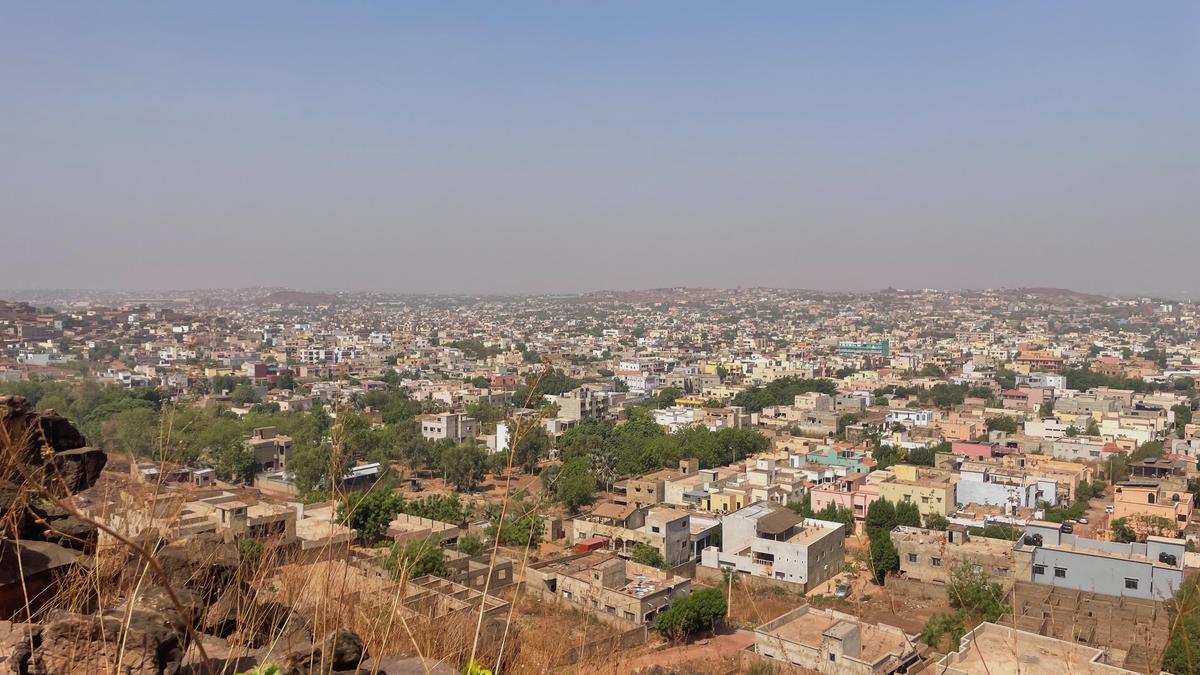
The dust in Mali doesn't just settle. It teeth-grinds. It finds the gaps in your window frames and the pores of your skin until you are the same color as the earth you walk on. On a Monday that should have been defined by the mundane struggle of the harvest, the dust turned into a shroud. It wasn't a single explosion. It was a symphony of them.
Across the sprawling, arid expanse of Mali, the ground shook in a synchronized assault that defied the usual chaos of desert warfare. From the ancient crossroads of the north to the volatile heart of the center, the silence was shattered. Islamic militants and ethnic separatists—two forces often at odds—seemed to find a bloody rhythm at the exact same moment.
To understand what happened, you have to look past the maps with their neat little pins. You have to look at the people standing in the shadow of the Niger River, wondering if the uniform approaching them is there to protect them or to provide their final memory.
The Sound of Falling Glass
In Gao, the air carries the scent of dry grass and diesel. When the first detonation ripped through the morning, it didn't sound like the movies. It was a dull thud that you felt in your marrow before you heard it with your ears. Then came the rattle. Every pane of glass in the vicinity became a weapon.
Witnesses spoke of the sheer coordination. This wasn't a lone wolf or a desperate band of outliers. These were tactical strikes. Militants linked to Al-Qaeda and the Islamic State, alongside separatist groups like the CSP-DPA, launched a wave of offensives that targeted military outposts and strategic hubs simultaneously.
Consider the logistics required for such a feat. In a region where communication is patchy and the terrain is a labyrinth of shifting dunes and rocky plateaus, timing several attacks to hit at once is a statement. It says to the government in Bamako: We are everywhere. You are nowhere.
The human cost of this coordination is measured in the wide-eyed stare of a soldier realizing his backup isn't coming because they are fighting their own fire three hundred miles away. It is measured in the local shopkeeper who sees the smoke on the horizon and knows the supply trucks will not arrive tomorrow. Or the day after.
The Invisible Borders
Mali is a country of invisible lines. There are the official borders drawn by colonial pens, and then there are the real ones—the ones dictated by where the jihadists roam and where the Tuareg rebels claim their ancestral right.
The recent surge in violence isn't just about territory. It is about the collapse of a fragile equilibrium. For years, international forces and local militias danced a dangerous tango, keeping the worst of the bloodshed at bay. But the departure of UN peacekeepers and the shift toward Russian paramilitary partnerships have recalibrated the scales.
The separatists, primarily ethnic Tuaregs, want an independent state they call Azawad. They are secular, motivated by identity and historical grievances. The militants, on the other hand, are fueled by a different fire—the desire to impose a strict, fundamentalist order across the Sahel.
Usually, these two groups are like oil and water. They clash. They compete for the same meager resources. But on this day, their interests aligned. They didn't necessarily shake hands in a dark room; they simply realized that if the state is busy fighting one, it cannot possibly stop the other.
A Landscape of Ghost Towns
When the fighting moves through a village, it leaves behind a specific kind of silence. It is the silence of a home where the tea is still warm on the table but the occupants are gone.
Mali is currently witnessing a mass exodus. Thousands are moving toward the borders of Mauritania and Algeria, carrying nothing but what fits in a burlap sack. These aren't just statistics on a UN refugee report. These are families who have farmed the same patch of dirt for five generations.
The tragedy of the Sahel is that the world often only looks at it through the lens of counter-terrorism. We talk about "neutralizing targets" and "securing perimeters." We rarely talk about the psychological toll of living in a state of permanent "almost."
Almost safe.
Almost fed.
Almost at peace.
One local teacher, who we will call Adama to protect his life, described the feeling of watching the horizon every evening. He doesn't look for the rain, though the crops desperately need it. He looks for the dust clouds kicked up by motorcycles. In the Sahel, motorcycles are the harbingers of the end. They move fast, they are nimble, and they carry men with Kalashnikovs who don't ask for identification before they open fire.
The Wagner Variable
The shift in Mali’s defense strategy has added a jagged edge to an already sharp situation. After the military juntas took power, they pivoted away from Western alliances, specifically France, and welcomed the Russian Wagner Group—now rebranded under various state-controlled banners.
The promise was simple: "We will do what the Europeans couldn't. We will win."
The reality is more complicated. While the Russian mercenaries have been aggressive, their presence has also been a recruitment tool for the militants. Every civilian casualty reported during a "clearing operation" is a gift to the jihadists. They use the trauma as a bridge. They tell the grieving father that the state has abandoned him to foreign mercenaries, and the only way to seek justice is through the insurgency.
The attacks this week prove that the "iron fist" approach hasn't broken the back of the rebellion. Instead, it may have simply hardened it. The militants are not retreating into the desert to die. They are evolving. They are learning how to strike the heart of the machine.
The Weight of the Niger
The Niger River is the lifeblood of the nation, a silver thread winding through the scorched earth. But rivers can be blockaded. They can be turned into traps.
In the wake of the simultaneous attacks, the flow of goods has stuttered. Prices for basic grain in Bamako have spiked. In the north, the cost of a gallon of fuel is now a king’s ransom. This is how a country breaks—not just through bullets, but through the slow, agonizing squeeze of economic strangulation.
The militants know this. They don't need to capture every city. They just need to make the roads between them impassable. They just need to make the cost of governing higher than the state can afford to pay.
There is a profound sense of weariness in the voices of those who remain. It is a fatigue that transcends politics. It is the exhaustion of being a pawn in a game where the players change their uniforms but the rules of the slaughter stay the same.
The international community watches from a distance, issuing statements of "grave concern" that carry as much weight as a handful of dry sand. Meanwhile, the people of Gao, Mopti, and Timbuktu wait for the next dawn, wondering if the symphony of explosions was the climax or merely the opening movement.
The sun sets over the Sahel, casting long, distorted shadows across the scrubland. The heat lingers, trapped in the earth, refusing to let go. In the distance, a single motorcycle engine revs, its high-pitched whine cutting through the stillness.
Somewhere, a mother pulls her children closer. Somewhere, a soldier checks his magazine and finds it half-empty. The dust rises again, thick and suffocating, erasing the footprints of those who tried to run.
The desert doesn't care about claims of victory or manifestos of revolution. It only knows the weight of the bodies it eventually claims. And tonight, the desert is heavy.