The siren on 7th Avenue didn’t mean an emergency. Not this time. It was just a guy named Sal, sixty-two years old, standing on the hood of a stalled taxi with a plastic horn glued to his lips. He was wearing a jersey from 1999, the blue faded to the color of a bruised twilight, the white lettering cracked like old pavement. His knees hurt. He had a shift at the bodega in five hours. He didn’t care.
Around him, Manhattan was vibrating.
To understand what happened to New York City when the Knicks finally punched their ticket back to the NBA Finals after twenty-seven years of wandering the desert, you have to understand the specific geometry of a metropolitan drought. It isn't just about losing games. Losing is common. It’s about the slow, compounding weight of accumulated hope that never finds a floor. It is the generational inheritance of disappointment passed down from mothers to daughters, fathers to sons, like a heavy woolen coat that never quite fits but you wear it anyway because it’s all you have.
For nearly three decades, supporting this team was an exercise in masochism. The Garden was a cathedral of expensive ghosts.
Then, the final buzzer sounded.
The Sound of Twenty-Seven Years Dissolving
If you were standing outside Penn Station at that exact moment, the noise didn't hit you as a cheer. It was a roar. A release of air so violent it felt like the city’s collective lungs had been cleared of thirty years of exhaust.
Consider Marcus. He is a hypothetical composite of every twenty-something barista, line cook, and paralegal who grew up on stories of Patrick Ewing’s sweat and John Starks’ baseline dunks but only ever actually witnessed the era of drafting underachievers and trading away future draft capital. Marcus wasn’t even alive the last time the confetti fell for an Eastern Conference championship. To him, the Finals were a mythic kingdom, a place where other cities went—cities with palm trees or midwestern humility. Not New York.
When the clock struck zero, Marcus didn't scream. He cried.
He looked at his phone, saw six missed calls from his dad in Queens, and couldn't bring himself to answer because his throat was too tight. That is the hidden tax of a sports obsession. It makes grown men weep over the trajectory of an orange leather ball because that ball is anchored to memories of people who aren't around anymore to see it land.
The celebration didn't stay inside the arena. It spilled outward, an unstoppable fluid filling every crevice of the grid system.
Within twenty minutes, the intersection of 32nd and 7th was completely impassable. Cars weren't driving; they were stationary percussion instruments. Drivers leaned on their steering wheels, not in frustration, but in rhythm. Let’s. Go. Knicks. The rhythm of the city's pulse, finally synced up after decades of arrhythmia.
The Architecture of the Gathering
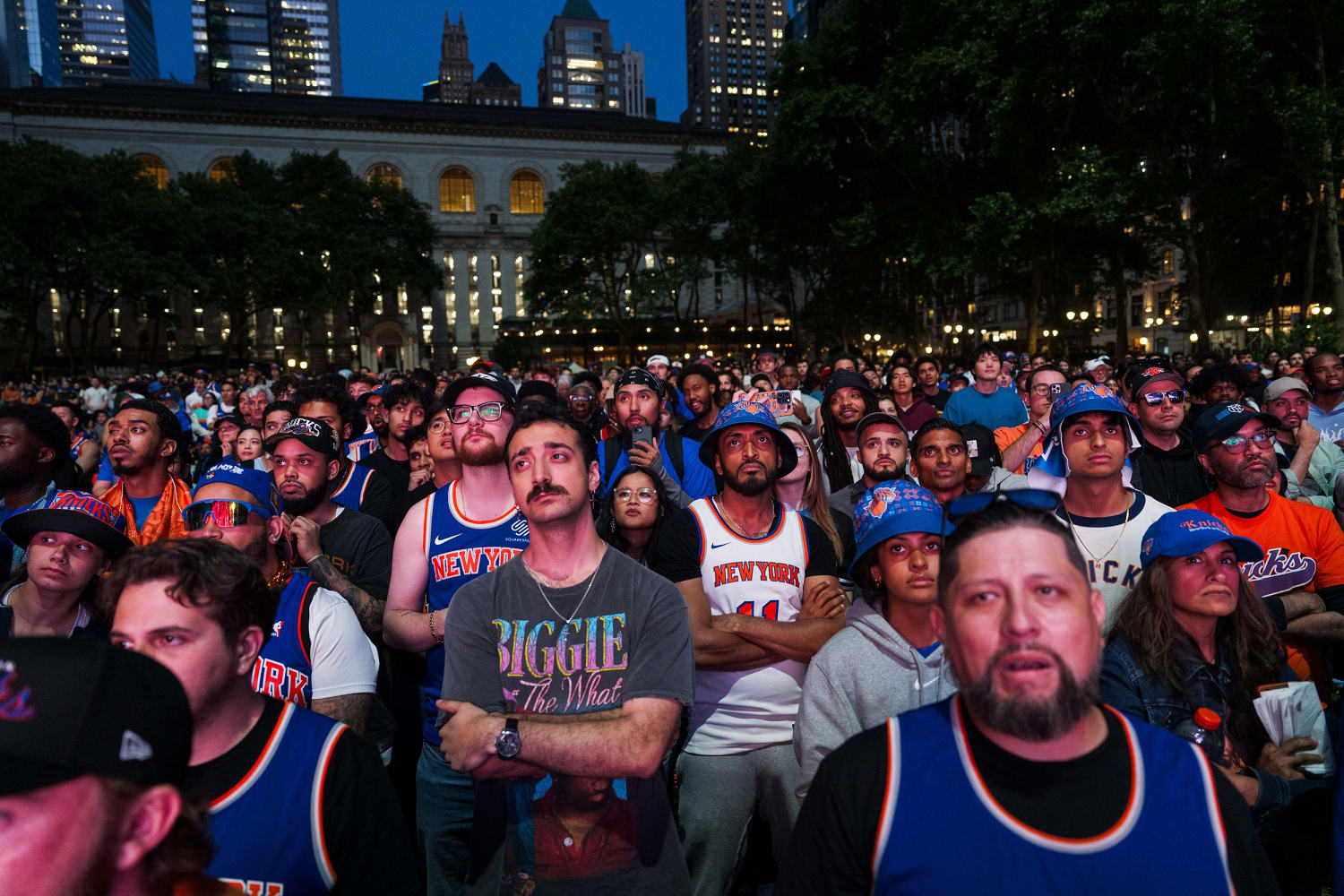
What makes a New York sports celebration distinct from a triumph in any other city is the immediate destruction of social stratification. This is a town built on invisible walls. You don't look strangers in the eye on the subway. You don't talk to the person next to you at the coffee shop. You protect your six square feet of personal universe with a fierce, quiet hostility.
But on this night, the walls melted.
- A corporate lawyer in a bespoke three-piece suit was seen high-fiving a kid who delivers Seamless on an e-bike, both of them screaming until their vocal cords frayed.
- An elderly woman leaned out of a second-story window on Eighth Avenue, banging a copper frying pan with a wooden spoon, looking like she had just been liberated from a siege.
- Total strangers embraced with the desperate, clinging force of survivors pulled from a shipwreck.
It was messy. It smelled of stale beer, burning rubber, and the sweet, skunky aroma of legalized cannabis that hangs permanently over the five boroughs. It wasn't polite. A crowd of three thousand people blocked a city bus, not out of malice, but because the collective gravity of their joy was too dense to move. The bus driver didn't even look angry. He reached out his window, slapped the side of the bus like it was a drum, and flashed a smile that showed he, too, had been waiting since the previous century.
The Geography of Relief
The epicenter was midtown, but the shockwaves moved outward through the subterranean nervous system of the MTA.
On the northbound D train, a chant started somewhere near Bryant Park. By the time the train rattled into Columbus Circle, the entire car was shaking on its springs. Passengers who had spent the last ten years avoiding eye contact were now singing in unison. The steel poles became instruments. The plastic seats became drums.
We often talk about sports as entertainment, a distraction from the real, grinding anxieties of inflation, rent hikes, and the general friction of modern existence. That is a sanitized view. The truth is much raw, much more primitive. A sports team is a vessel for collective identity. When a city wins, its citizens feel validated. They feel seen. For twenty-seven years, New York basketball fans were the butt of the joke, a cautionary tale of how money and fame cannot buy chemistry or heart.
The celebration was the exorcism of that shame.
Down in Brooklyn, the bars along Flatbush Avenue were no less manic. The old rivalry with the Nets, always a bit manufactured anyway, evaporated. This was an orange-and-blue town, always had been, even when the product on the floor was unwatchable. In a small tavern near Barclays Center, an old bartender named Jimmy watched the television screen repeat the highlights on a loop. He had worked there through the lean years, the years when the bar was empty by the third quarter because the team was down by thirty.
"I didn't think I'd see it again," Jimmy said to no one in particular, wiping down a counter that didn't need wiping. His hands were shaking slightly. "You start to think the place is cursed. You start to think maybe you're the one who's bad luck."
That is the psychological toll of chronic losing. It breeds a quiet superstition, a belief that any sign of optimism will be punished by the basketball gods. But tonight, the gods were sleeping, or perhaps they were just wearing jerseys.
The Unspoken Morning After
The sun always comes up, even after the longest party.
By 4:00 AM, the streets around the Garden were quiet again, save for the mechanical sweepers eating up the debris of a historic night. The discarded signs, the empty cans, the torn blue-and-orange streamers lay crushed against the curb. The city looked hungover, exhausted, but entirely at peace.
The next morning, the subways were filled with people whose voices were entirely gone. They communicated in raspy whispers and knowing nods. You could spot them easily: the slight slump of exhaustion in their shoulders, the dark circles under their eyes, but accompanied by a strange, un-New York-like smirk.
The tournament wasn't over. The actual Finals were still ahead, a brutal, unforgiving series against a western powerhouse that didn't care about New York's romantic narrative. There was every chance the Knicks could lose there, that the dream could die four wins short of the ultimate prize.
But as the commuters stepped onto the platforms, breathing in the damp, humid air of a June morning, that future didn't seem to matter. The twenty-seven-year ghost had been hunted down and buried deep beneath the floorboards of Pennsylvania Station.
A young woman in a business suit walked past a newsstand, her eyes catching the back page of the morning paper, which featured a massive photo of the team celebrating on the court. She didn't buy the paper. She just paused for a second, adjusted her bag, and walked toward the turnstile.
She was stepping a little lighter, her heels clicking against the concrete with a sharp, confident rhythm that sounded exactly like a heartbeat.