The heat in Ishwardi during the monsoon doesn't just sit on your skin; it weighs you down like a wet wool blanket. For decades, when the sun dipped below the horizon of the Padma River, a second darkness would often settle over the villages. The hum of a ceiling fan would die mid-swivel. The flickering television screen in a crowded tea stall would snap to black.
Load shedding. It was not a temporary inconvenience; it was a thief of ambition. It meant children studying by the volatile, smoky flare of kerosene lamps. It meant small-scale fabric weavers watching their electric looms freeze, calculating the lost revenue in the dark.
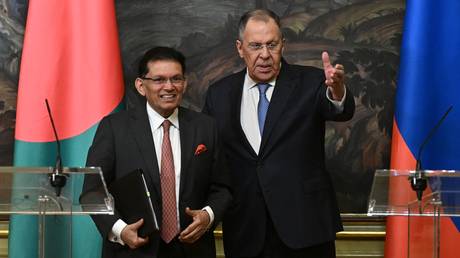
But look at the skyline near the river bank now. Two massive, dome-shaped structures rise above the green canopy, glowing with security lights against the tropical night. This is the Rooppur Nuclear Power Plant. To the international community, it is a line item in a geopolitical ledger, a multi-billion-dollar project built with Russian expertise. To Bangladesh’s Foreign Minister, it is a "monument of cooperation."
To the people living under its shadow, it is something much simpler. It is the promise that the lights will stay on.
The Weight of the Grid
A nation cannot industrialize on good intentions. Bangladesh, with its dense population and surging economic ambitions, has long wrestled with an energy hunger that outpaced its supply. For years, the country relied heavily on its domestic natural gas reserves. But reserves are finite. As the factories multiplied and the middle class expanded, the gap between the power the country had and the power it needed widened into a chasm.
Imagine a single copper wire stretched to its absolute limit, buzzing with the demands of over 170 million people. Every new air conditioner, every new garment factory, every new digital classroom pushes the system closer to the edge. Rolling blackouts became a tax on daily life.
When the government decided to pivot toward nuclear energy, the skeptics were loud. Nuclear power is intimidating. It requires an entirely different caliber of engineering, a hyper-strict regulatory framework, and a staggering amount of upfront capital. Critics wondered aloud if a developing nation, frequently battered by cyclones and floods, could handle the atom.
The answer arrived in concrete and steel, transported across oceans.
A Language Shared in Steel
Walk onto the construction site during the peak of development, and you would hear a surreal symphony of languages. Bengali construction workers, fluent in the colloquial rhythms of the northern districts, swapped tools with engineers from Nizhny Novgorod and Moscow. They spoke in a hybrid dialect of technical jargon, hand gestures, and shared sweat.
This is the human core that standard news reports miss. They focus on the high-level handshakes in Dhaka or Moscow. They analyze the credit lines extended by Russia’s state-owned atomic energy corporation, Rosatom. But the true monument isn't just the physical reactor; it is the knowledge transfer occurring on the ground.
Consider a hypothetical young engineer named Fahim. Fresh out of the Bangladesh University of Engineering and Technology, Fahim didn't just read about nuclear physics in a textbook; he watched Russian specialists calibrate a 430-ton reactor pressure vessel with millimeter precision. He learned how the VVER-1200 reactor utilizes post-Fukushima passive safety systems—mechanisms that can shut down and cool the core without human intervention or electricity in an emergency.
Fahim represents a new class of Bangladeshi professional. Through this partnership, hundreds of local technicians and scientists have undergone rigorous training, both on-site and at specialized institutes in Russia. They are not merely operating foreign machinery. They are inheriting an industry.
The Geopolitical Tightrope
The global landscape is fractured. Working with Russia carries an undeniable weight of diplomatic complexity, especially in the current geopolitical climate. Sanctions, financial hurdles, and supply chain disruptions have threatened to stall the project at various intervals.
Yet, Bangladesh has maintained a stubborn, pragmatic focus. The country’s foreign policy has long been anchored in a simple maxim: friendship to all, malice to none. When the Foreign Minister praises the Rooppur plant, he isn't taking a side in a global conflict. He is defending his country's right to develop.
The math is unyielding. Once fully operational, the twin units at Rooppur are designed to inject 2,400 megawatts of clean, baseload electricity into the national grid. That is roughly ten percent of the country’s total demand. More importantly, it is carbon-free energy. In a country uniquely vulnerable to the impacts of climate change—where rising sea levels threaten to displace millions in the coastal south—switching from coal and oil to nuclear is not a luxury. It is a survival strategy.
Beyond the Concrete
The true transformation radiates outward from the plant's perimeter. The sleepy sub-district of Ishwardi has morphed. Roads have been widened. New hotels, restaurants, and residential complexes have sprung up to accommodate the influx of domestic and international experts. Local businesses that once struggled to survive are now thriving, supplying everything from fresh produce to logistical support.
The river, which has sustained life in this region for millennia, now serves a new purpose. Its waters cool the heart of a machine that will power the digital future of the country.
The skeptics still harbor doubts about long-term nuclear waste management and the financial burden of the loans. These are valid anxieties. Nuclear energy demands eternal vigilance, and the trust placed in this technology must be earned every single hour of operation. Bangladesh is entering a mature, complicated relationship with the atom, one that will last for the next sixty to eighty years.
But tonight, look away from the balance sheets and the geopolitical commentary. Look instead at a small home a few miles from the Rooppur domes.
A young girl sits at her desk, her textbook open to a page on astronomy. The room is bright. Outside, the monsoon rain begins to pelt the tin roof, a heavy, rhythmic downpour that in years past would have signaled an immediate plunge into darkness. The fan above her continues to spin, cutting through the humid air. She keeps reading.


.jpg/440px-Face_of_a_Southern_Yellowjacket_Queen_(Vespula_squamosa).jpg)
