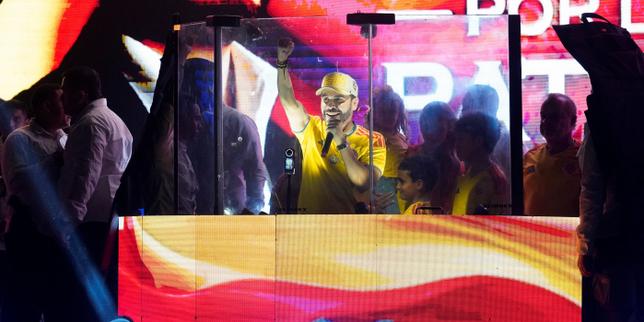
The neon signs of Bogotá’s Chapinero district usually blur into a familiar backdrop of Friday night reggaeton and the hiss of street-side empanada fryers. But last Sunday, the air felt different. It was heavy. Cold. The kind of chill that creeps into your bones not from the Andean altitude, but from collective hyperventilation.
In a small, brightly lit café, an old man named Mateo—a fictional composite of three different generations of Colombians I spoke with this week—stared into his black coffee. His hand shook slightly, rattling the porcelain cup against its saucer. On the mounted television above the counter, the numbers flashed in stark, unforgiving digital font.
Abelardo de la Espriella had just won the first round of the presidential election.
For outside observers, it is a headline. A data point in a global trend of populist upheaval. But for those who walk these cracked pavements, it is a seismic shift that threatens to redraw the psychological map of a nation. Colombia, a country that has spent the last decade trying to heal from a half-century of civil conflict, just looked into the mirror and chose a radical, uncompromising reflection.
The Sound of the Fracture
To understand how a flamboyant, hard-right lawyer with a penchant for bespoke Italian suits, pocket squares, and unyielding rhetoric captured the top spot, you have to understand the exhaustion.
Colombia is tired.
Walk through the bustling markets of Medellín or the humid ports of Buenaventura, and you hear the same underlying melody. It is a song of weariness. The promise of the 2016 peace accords with the FARC was supposed to usher in an era of tranquility. Instead, for many, it felt like opening a vacuum that was quickly filled by dissident groups, criminal syndicates, and a biting sense of lawlessness. Inflation squeezed the middle class until it gasped. Street crime made the simple act of holding a smartphone at a bus stop feel like a game of Russian roulette.
Enter De la Espriella.
He did not speak in the measured, diplomatic tones of the traditional political elite. He spoke in thunderclaps. His campaign was not a policy debate; it was a crusade against corruption, insecurity, and what he termed the moral decay of the republic. Where previous politicians offered complex socio-economic theories to fix crime, he offered handcuffs and an iron fist.
Imagine a room that has been growing progressively hotter for years. The thermostat is broken, the windows are jammed, and the politicians inside are arguing about the architectural history of the building. Abelardo de la Espriella did not join the argument. He picked up a sledgehammer and smashed the window.
It did not matter to the voters if the glass cut some people on the way out. They just wanted to breathe.
The Courtroom as a Stage
The rise of this right-wing phenomenon is not an accident of history. It is a masterclass in modern political theater. Before he was a political savior to millions, De la Espriella was Colombia’s most famous defense attorney, representing high-profile figures, celebrities, and controversial political powerhouses. He understands the power of a spectacle. He knows that in the court of public opinion, emotion beats logic every single time.
During his campaign rallies, the atmosphere resembled a cross between a rock concert and a religious revival. He would stand before thousands, his voice booming through massive speakers, promising to restore a lost golden age of safety and national pride.
But beneath the spectacle lies a deep, polarizing divide.
The country is now split cleanly down the middle, severed by a blade of mutual fear. On one side are those who view him as the only man strong enough to save Colombia from sliding into chaotic lawlessness. On the other side are those who look at his platform and see the ghosts of authoritarianism waiting to be unleashed.
Consider the reality of Colombia's fragile democracy. The institutions are young. The scars of paramilitary violence and state overreach are still fresh, still tender to the touch. When a candidate suggests that human rights frameworks are sometimes obstacles to national security, a shiver runs down the spine of those who remember the darkest days of the late 20th century.
The Currency of Anger
The establishment media spent months dissecting his proposals, pointing out structural flaws in his economic models and raising alarms over his foreign policy stances. They used logic. They used statistics.
They failed.
They failed because they misunderstood the currency of this election. This cycle was never about spreadsheets. It was about validation. When a mother loses her son to a random act of violence on a Bogotá street corner, she does not want to hear a lecture on structural poverty. She wants justice. She wants anger. De la Espriella mirrored that anger perfectly, validating a pain that millions felt had been ignored by a detached political class.
The first-round results are a blunt instrument. They have shattered the conventional wisdom that Colombia would remain on a progressive path following its recent history. Instead, the nation has pivoted sharply, pivoting toward an uncertain, high-stakes future that will culminate in a breathless second-round runoff.
The Shadow of the Second Round
Now, the calculus changes. The field narrows to two names, and the rhetoric will only sharpen. The political machinery of the traditional parties is frantically trying to recalibrate, scrambling to build coalitions to either stop the momentum or ride its coattails into power.
But away from the campaign offices and the strategy rooms, the real impact is felt at the family dinner table. Across Colombia, conversations are fracturing. Parents are arguing with children; lifelong friends are falling silent. The political polarization is no longer just a macro-phenomenon; it has become an intimate, domestic intruder.
The true stakes of this election go far beyond the presidential palace of Casa de Nariño. They touch upon the very definition of what Colombia wants to be. Will it remain a country searching for a difficult, messy peace through reconciliation and institutional reform? Or will it become a nation that embraces an authoritarian paternalism in exchange for the promise of order?
There are no easy answers, and the uncertainty is a heavy weight to bear.
Back in the Chapinero café, the television screen shifted to a commercial, casting a blue glow over Mateo’s face. He finally took a sip of his coffee, found it cold, and set it down. Outside, the rain began to fall, slicking the streets and reflecting the red taillights of cars stuck in the eternal Bogotá traffic. The city moved on, but everything had changed. Colombia had spoken, not with a whisper of consensus, but with a roar of defiance, leaving the rest of the world to watch, wait, and wonder what happens when the echo finally fades.