Late last night, a server farm in Northern Virginia hummed a little louder. You wouldn’t have noticed it from the outside. The building is a windowless slab of concrete, anonymous and grey, sitting quietly next to a highway. But inside, billions of artificial neurons were firing, processing an executive order that effectively rewrites the rules of the American digital frontier.
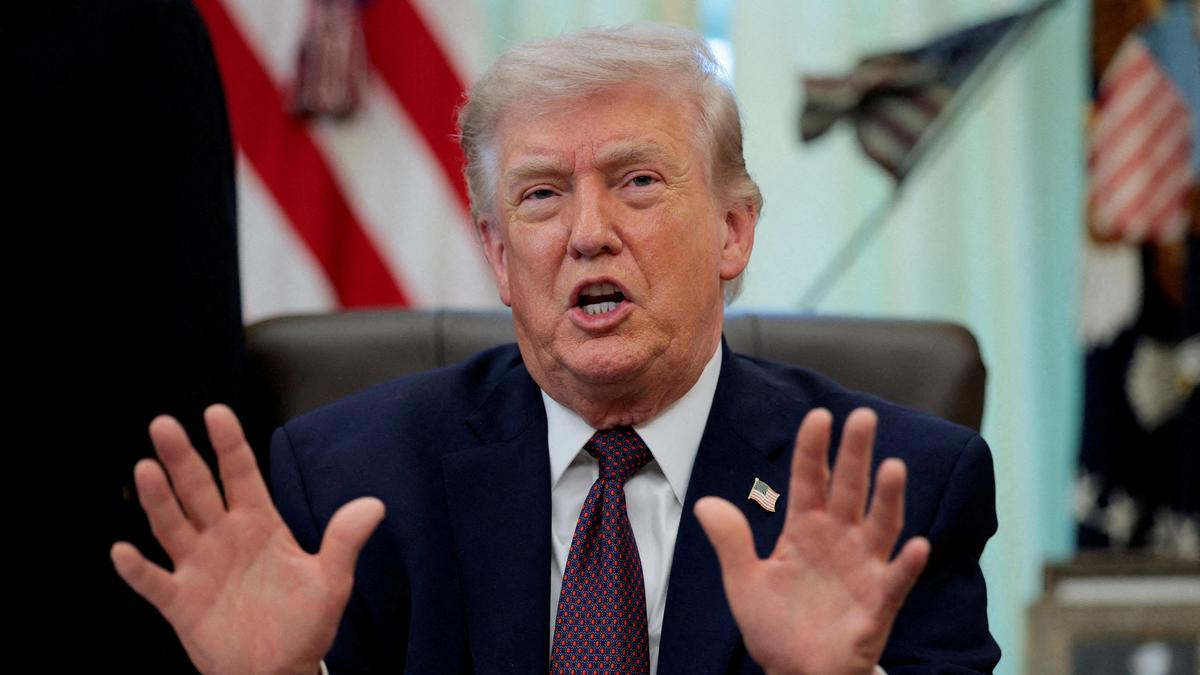
President Donald Trump signed a directive that forces tech companies to hand over the keys to their most advanced artificial intelligence models.
For years, Silicon Valley operated like a sovereign nation. Founders built massive, opaque systems behind closed doors, treating their source code like the formula for Coca-Cola. They argued that secrecy was the only way to stay ahead of foreign rivals. Government regulators watched from the sidelines, clutching outdated laws, always three steps behind the breakneck pace of technological evolution.
That era is over. With a single stroke of a pen, the state has entered the server room.
The Ghost in the Machine
To understand what just happened, we have to look past the dense legalese of Washington and into the actual architecture of these machines.
When a company like OpenAI or Google trains a massive AI model, they aren't just writing code. They are building a digital mind. Imagine a vast, interconnected web of billions of virtual dials. Every time the AI reads a piece of text, it tweaks those dials. Eventually, after burning millions of dollars in electricity, the dials settle into a configuration that can write poetry, diagnose diseases, or write software.
These settled configurations are called "weights." They are the crown jewels of the tech industry. If you have the weights, you have the brain.
Until now, those weights were guarded more closely than bank vaults. Now, under the banner of national security and public safety, the federal government has granted itself the authority to audit them, test them, and demand access before they are ever released to the public.
Consider a hypothetical engineer named Sarah. For eighteen months, Sarah has slept under her desk at a San Francisco startup, drinking stale coffee and tuning a model designed to optimize logistics networks. It is her life’s work. Under the old rules, Sarah’s company would launch the product, iterate based on user feedback, and grow. Under the new executive order, before Sarah can push her code to the cloud, a government bureaucrat—someone who might not know the difference between Python and a reptile—gets to review the blueprints.
The friction this introduces isn’t just bureaucratic. It is psychological.
The Fear of the Invisible
Why the sudden, aggressive intervention? The answer lies in a deep-seated anxiety that has quietly infected the highest levels of government. It isn't the fear of killer robots or sci-fi dystopias. It is the fear of the invisible.
A senior defense official once told me, off the record, that what keeps him up at night isn't a missile. It is a piece of software that can automate cyberattacks at a scale humans cannot comprehend. Imagine a virus that mutates in real-time, learning from every firewall it hits, rewriting its own code on the fly to breach power grids or water treatment plants.
That is what these frontier models can do if pushed in the wrong direction. They are dual-use technologies, just like nuclear energy. The same system that can synthesize a life-saving molecule can be inverted to map out a novel nerve agent.
The administration’s argument is straightforward: we do not let private companies build enriched uranium facilities without oversight. Why should we let them build digital infrastructure that possesses equivalent disruptive power?
But here is where the certainty cracks. When we audit a nuclear facility, we know what we are looking for. We count the centrifuges. We measure the isotopes. AI does not work that way.
Even the people who build these models do not fully understand how they arrive at their conclusions. It is a phenomenon known as the "black box." You give the machine an input, it spins the billions of dials, and it spits out an answer. If the creators cannot entirely explain the internal logic of their own creation, how can a government inspector general hope to verify its safety?
The Splintered Frontier
We are witnessing the birth of a fractured digital world.
For decades, the internet thrived on a philosophy of permissionless innovation. You built something cool, you put it online, and the world decided if it had value. That openness was a magnet for global talent. The brightest minds from Delhi, Beijing, and Berlin packed their bags and moved to California because it was the only place where you could build the future without asking for a permit.
Now, the borders are closing in.
By forcing tech giants to share their most powerful models with Washington, the government is drawing a thick line in the sand. On one side is "aligned" technology—software that has been vetted, stamped, and approved by the state. On the other side is the wild wild web, a space that is suddenly looking much smaller and more dangerous.
What happens to the open-source community? This is the real casualty of the new order. Thousands of independent developers globally collaborate on free, open AI models. They don't have compliance teams. They don't have Washington lobbyists. If the legal threshold for developing AI requires a direct pipeline to a government agency, the independent innovator is effectively priced out of existence.
The power consolidates. The big get bigger because only the giants can afford the tax of compliance.
The Cost of Compliance
Step into a different room. This one is in Washington, D.C., down a long, carpeted hallway where the air smells faintly of old paper and industrial carpet cleaner. A team of lawyers sits around a mahogany table, looking at a stack of compliance documents three feet high.
This is the immediate aftermath of the executive order.
Tech companies will now spend tens of millions of dollars not on faster chips or better algorithms, but on legal defense. They will build massive internal apparatuses designed to prove to the government that their models are safe, stable, and patriotic.
The danger is that we mistake compliance for security.
History shows us that when governments try to regulate fast-moving technology, they often end up locking in the status quo. They protect the incumbents from competition while failing to stop the actual bad actors. A rogue hacker group in eastern Europe or a state-sponsored lab in Asia isn't going to fill out the paperwork. They aren't going to let an inspector check their weights.
We risk creating a system where American innovators are bound by heavy chains, while the rest of the world runs completely free.
The Uncharted Map
It is easy to view this through a lens of pure cynicism, to see it as a power grab by an administration hungry for control over the most lucrative industry on earth. But that ignores the genuine dilemma facing our generation.
We are building tools that surpass human capability in specific, critical domains. We are doing it faster than we have ever adopted any other technology in human history. Electricity took decades to blanket the globe. The smartphone took a generation. AI is scaling in months.
To do nothing, to simply cross our fingers and hope that profit-driven corporations will always act in the best interest of human survival, is a form of collective madness. Some level of oversight is inevitable.
But as the ink dries on this latest order, the tension in the air is palpable. We have traded one kind of risk for another. We used to worry about the unpredictable brilliance of unchecked tech founders. Now, we have to worry about the heavy, slow-moving hand of the state steering the vehicle of human progress.
The servers in Northern Virginia will keep humming tonight. They will process billions of words, write millions of lines of code, and continue their quiet, exponential climb. But the atmosphere inside those concrete walls has shifted permanently. The machines are no longer just property; they are now matters of state, watched over by an anxious government that realizes, perhaps too late, that the future cannot be contained by a border, a law, or a wall.


