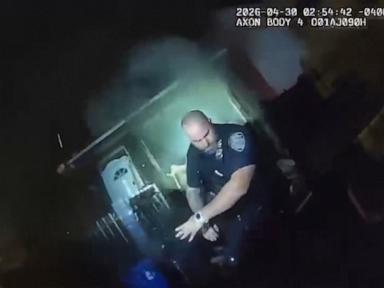
Body cameras don't just capture evidence for a courtroom. Sometimes, they record the exact moment a person decides to ignore their own survival instincts. In a recent New York house explosion, we saw exactly that. While most people instinctively run away from a blast that levels a building, a group of local police officers did the opposite. They ran toward the smoke. This wasn't a calculated tactical move. It was a raw, split-second choice to save lives before the fire department could even hook up a hose.
When a residential home in New York turned into a pile of splinters and glass, the shockwave was felt blocks away. Neighbors reported a sound like a bomb going off. Within minutes, the first police units were on the scene. They didn't wait for backup. They didn't wait for a "clear" signal from the fire marshal. They jumped into the debris.
Why Speed Matters More Than Safety in a Blast Zone
In the world of emergency response, there's a concept called the "Golden Hour," but in a structural collapse caused by an explosion, you don't have an hour. You have seconds. Fire spreads fast. Oxygen disappears. If someone is trapped under a collapsed roof, they're likely breathing in toxic dust and smoke that can kill them long before the flames reach their body.
These New York officers understood the stakes. The footage from the scene shows them climbing over jagged lumber and twisted metal. It’s chaotic. It’s loud. You can hear the popping of electrical wires and the roar of a growing fire. These aren't just "first responders" in a generic sense. These are people who probably have families and mortgages, yet they risked it all for a stranger buried under a pile of drywall and 2x4s.
Honestly, the term "hero" gets tossed around too much lately. We use it for athletes who hit a home run or celebrities who donate a fraction of their wealth. But watch these officers drag a survivor out of a burning basement, and you'll realize what the word actually means. It means acting despite the terror.
The Brutal Reality of a Gas Explosion
Most house explosions in residential New York neighborhoods stem from natural gas leaks. When gas builds up in a basement or crawlspace, all it takes is a single spark—a light switch, a refrigerator motor, or a pilot light—to ignite the entire volume of air. The result is a pressure wave that pushes walls outward and drops the roof straight down.
When officers arrived at this specific New York house explosion, they weren't dealing with a simple fire. They were dealing with a "pancake collapse." This is the most dangerous environment for any rescuer. One wrong move or one heavy footstep can cause the remaining structure to shift, crushing both the victim and the savior.
The Physical Toll on First Responders
People forget that police officers aren't equipped like firefighters. They don't have Nomex suits. They don't have oxygen tanks. They have a standard-issue uniform and a Kevlar vest that offers zero protection against heat or smoke inhalation.
- Smoke Inhalation: Without respirators, officers breathe in vaporized lead paint, insulation, and plastic.
- Adrenaline Overload: The "fight or flight" response keeps them moving, but it also causes a massive crash later.
- Physical Injury: Navigating a debris field in standard boots often leads to torn ligaments or puncture wounds from rusted nails.
These guys were coughing and gasping as they pulled the residents to safety. They kept going anyway. That’s the difference between a job and a calling.
What Neighbors Experienced During the Blast
The impact wasn't just limited to one property. Nearby homes had windows blown in. Car alarms were screaming for blocks. One neighbor mentioned that the ground shook so hard they thought it was an earthquake. This is a common phenomenon with gas-related incidents. The force is directional and incredibly violent.
Witnesses described seeing the officers arrive before the dust had even settled. Usually, there's a delay. A 911 call goes out, dispatch processes it, and units move in. Here, the response was nearly instantaneous. That speed saved a life. If those officers had waited an extra three minutes for the "all clear," we’d be talking about a recovery mission instead of a rescue.
How Local Communities Can Stay Safe
You can't always predict a freak accident, but you can certainly reduce the risk. This New York house explosion should be a wake-up call for anyone living in an older home with aging gas lines.
Basically, if you smell something like rotten eggs, don't ignore it. That’s mercaptan. It's a chemical gas companies add to natural gas because, in its natural state, the stuff is odorless. If you smell it, don't turn on a light. Don't use your phone inside the house. Get out and call the authorities from the sidewalk.
Essential Safety Checks for Homeowners
- Install Gas Detectors: Most people have smoke alarms and carbon monoxide detectors, but few have dedicated combustible gas alarms. Get one.
- Inspect Your Lines: If your house is more than 30 years old, have a professional check the integrity of your gas pipes.
- Know Your Shut-Off: You need to know exactly where your main gas shut-off valve is located and how to use a wrench to close it.
Heroism Isn’t About Being Fearless
We like to think of heroes as people who aren't afraid. That's a lie. The officers involved in the New York house explosion rescue were definitely afraid. You can hear it in their voices on the radio. You can see the tension in their movements.
Heroism is doing the work while your heart is hammering against your ribs. It’s the willingness to put your own life on the line because you know that if you don't act, someone else dies. New York is a big place. It’s easy to feel like just another face in the crowd. But when the world literally falls apart, it's the people in uniform who remind us that we aren't alone.
The survivors of this blast are alive because a few cops decided that a burning building was exactly where they needed to be. They didn't wait for a trophy. They did the work, got the job done, and went back to their shifts. That’s the reality of modern policing that rarely makes the evening news.
Check your detectors today. Don't wait until you hear a bang. If you see an officer in your neighborhood, maybe give them a nod. They might be the one running into your house when everyone else is running out.