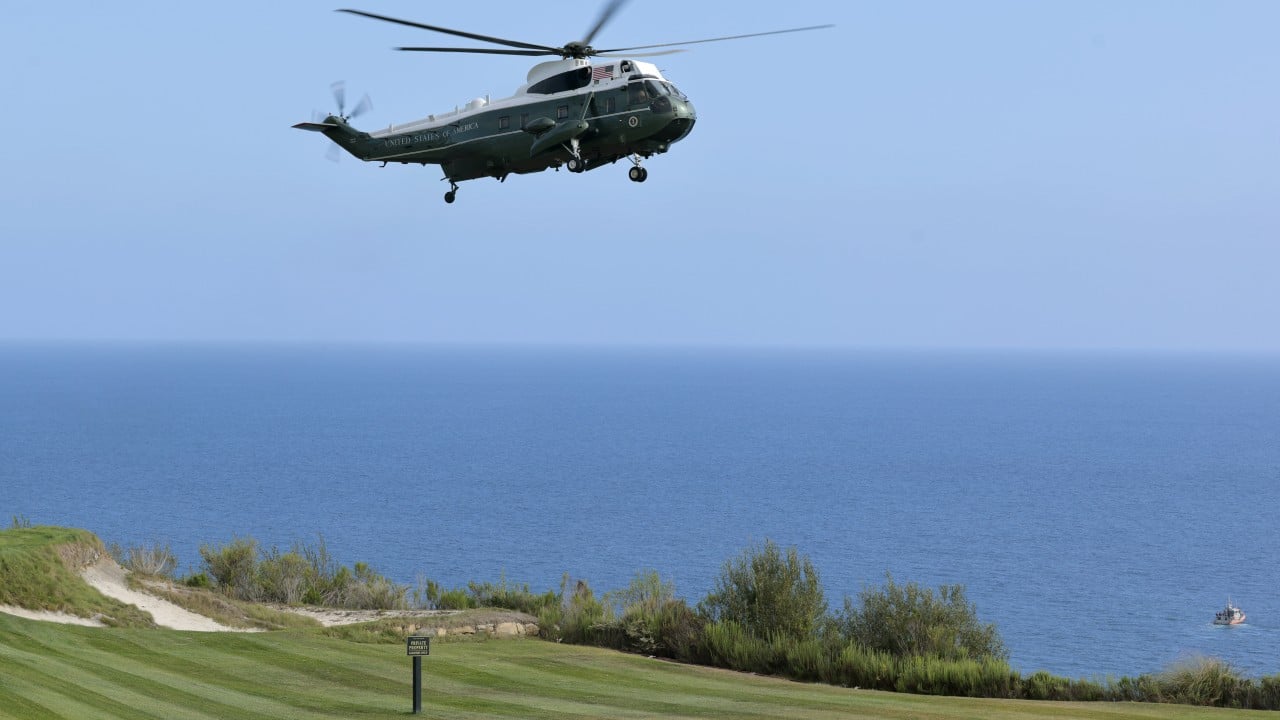
A helicopter carrying Donald Trump experienced a dangerous proximity event with a commercial passenger jet while departing from a regional airfield, bringing sharp focus back to the compounding vulnerabilities of American airspace. When two aircraft cross paths with uncomfortably thin margins of separation, the public usually hears a brief news cycle about a close call before the story dissolves into partisan noise. Beneath the political personalities involved lies a far more systemic narrative. Our national aviation infrastructure is operating under unprecedented strain, burdened by chronic controller shortages, outdated automation, and a relentless surge in air traffic volume that tests the limits of safety protocols daily.
The incident involving the former president's charter helicopter and the commercial airliner is not an isolated anomaly. It serves as a flashing warning light on a dashboard that has been blinking red for years. Aviation safety in the United States relies on a delicate balance of radar monitoring, pilot vigilance, and procedural discipline. When any single link in that chain frays, the margin for error evaporates in seconds.
The Anatomy of a Close Encounter
To understand how a helicopter and a commercial jet can come close enough to trigger airborne collision avoidance systems, one must look at the mechanics of shared airspace around busy regional hubs. Helicopters operate in a low-altitude regime characterized by variable speeds, flexible routing, and distinct flight dynamics compared to heavy commercial jets climbing out on instrument departure procedures.
Air traffic control manages this complex choreography by establishing strict lateral and vertical separation standards. Yet, these standards assume a level of predictability that modern skies increasingly fail to provide. When a VIP movement enters the mix, additional security vectors and temporary flight restrictions often complicate an already congested flow. Controllers must suddenly vector surrounding traffic around restricted zones, compressing other aircraft into tighter corridors.
In the case of the Trump helicopter event, the operational footprint involved standard departure paths intersecting with arrival or departure streams of a scheduled carrier. While initial reports focused heavily on the identity of the passenger, veteran aviation investigators immediately recognized the operational signature of terminal congestion. The primary issue was not who sat in the cabin, but how the airspace was managed during a high-density transition period.
The Controller Shortage Crisis
You cannot talk about near misses without addressing the workforce crisis inside the nation's air traffic control towers. The Federal Aviation Administration operates under a severe deficit of fully certified controllers. Many facilities run well below recommended staffing levels, forcing existing personnel to work mandatory six-day weeks and grueling overtime shifts.
Fatigue is a silent hazard in aviation. A tired controller staring at a radar scope for ten hours straight experiences cognitive degradation, slower reaction times, and diminished situational awareness. When traffic volume spikes, the margin for human error narrows dramatically.
Consider the cognitive load placed on a single local controller during a busy shift. They are issuing takeoff clearances, sequencing landings, coordinating with departure control, monitoring ground traffic, and handling emergency requests simultaneously. Introduce a sudden vector change for a VIP movement, and the mental arithmetic required to maintain safe separation becomes staggering. The system survives on the extraordinary professionalism of its workforce, but professionalism is not an infinite resource. It can be exhausted.
Technological Lag in the Cockpit and Tower
While commercial aviation features state-of-the-art avionics, the foundational infrastructure supporting air traffic management remains anchored to legacy technology. Many radar systems rely on processing architectures that date back decades. Upgrades have rolled out slowly, plagued by bureaucratic delays, procurement hurdles, and integration challenges.
Automatic Dependent Surveillance-Broadcast technology has improved visibility, yet gaps in radar coverage persist, particularly at lower altitudes where helicopters frequently operate. Furthermore, communication between towers and aircraft still relies heavily on analog VHF radio frequencies prone to congestion, stepped-on transmissions, and misinterpretation.
Onboard collision avoidance systems, such as Traffic Alert and Collision Avoidance Systems in commercial jets, act as a vital final line of defense. These systems detect conflicting traffic and issue resolution advisories directly to the pilots, instructing them to climb or descend regardless of air traffic control instructions. In close proximity events, these automated safety nets do the heavy lifting when human oversight falls short. Relying on automated safety nets to catch operational errors on a regular basis indicates a structural failure in primary separation assurance.
The Political Specter Versus Operational Reality
High-profile figures naturally draw intense scrutiny whenever an incident occurs. Public discourse immediately splits along predictable political fault lines, with supporters and critics debating motivations, security protocols, and optics. This noise obscures the hard engineering and operational realities that govern flight safety.
A rotorcraft does not care about political affiliation. A radar screen does not register political polls. Physics remains entirely indifferent to public relations.
When a security-mandated movement alters standard traffic flows, the operational ripple effects impact every aircraft in the vicinity. Air traffic control facilities must juggle the rigid security requirements of protecting high-risk individuals with the fluid demands of keeping hundreds of commercial passengers moving safely. This tension creates operational friction. If security protocols demand rapid repositioning without adequate advanced coordination with terminal controllers, the risk profile escalates immediately.
Rebuilding the Margins of Safety
Addressing the vulnerabilities exposed by incidents like the Trump helicopter event requires more than temporary fixes or public relations statements. It demands a serious, sustained investment in human capital and technological modernization.
First, the Federal Aviation Administration must accelerate hiring pipelines and retention incentives for air traffic controllers. Training a certified professional takes years, meaning current deficits will persist unless aggressive recruitment measures are sustained. Reducing mandatory overtime and improving work-life balance directly correlates with cognitive alertness and safety outcomes in the tower.
Second, airspace design around major metropolitan areas needs comprehensive modernization. As drone deliveries, urban air mobility concepts, and private helicopter charters increase, the lower altitudes of our skies are becoming crowded corridors. Implementing dynamic airspace management tools driven by advanced data analytics can help automate routine conflict detection, relieving cognitive pressure on human controllers.
Third, procedural coordination between law enforcement security details and aviation authorities must tighten. VIP movements should be integrated into traffic management algorithms well before wheels up, ensuring that unexpected vector changes do not surprise controllers managing heavy arrival and departure banks.
The close call involving the former president's helicopter should serve as a wake-up call for lawmakers and industry leaders alike. We cannot rely on luck and automated collision avoidance systems to preserve the safety of our skies. The margins are already too thin, and the cost of failure is measured in lives.