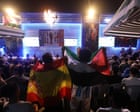
International sports reporting loves a tidy sentiment. When pictures of fans in Gaza celebrating Spain’s World Cup victory made rounds, the mainstream narrative wrote itself: sports acting as a universal elixir, bridging divides, bringing pure, apolitical joy to an isolated populace.
It is a warm, comfortable narrative. It is also entirely wrong.
Treating the Palestinian affinity for international football as a simple story of escapism misses the real mechanics at play. Fans under blockade do not watch international tournaments to forget their geopolitical reality. They watch to project themselves into it. Choosing a foreign team to champion in a region severed from global movement is not passive entertainment. It is a deliberate, highly calculated act of identity alignment.
The Illusion of Apolitical Escapism
Mainstream outlets often reduce marginalized fandom to a emotional coping mechanism. They paint pictures of crowded cafes in Gaza City as mere sanctuaries from daily hardship. This framing treats the audience as passive consumers who simply absorb whatever spectacle global broadcasting provides.
That perspective ignores how fandom operates in isolated environments. When local infrastructure faces severe restrictions and international travel remains virtually non-existent, sports fandom becomes proxy participation in the global order.
Cheering for a nation like Spain—or Argentina, or Brazil—is an exercise in agency. It allows fans to stake a claim in an international event where their own national team is structurally disadvantaged from competing on equal footing. Fandom here is not a retreat from reality; it is an active insistence on belonging to the world.
Why Spain and Latin America Dominate local Fandom
The affinity for specific European and South American teams throughout the Middle East is rarely accidental. It relies on two primary pillars: tactical accessibility and political alignment.
1. Broadcasting Accessibility and Club Culture
For decades, La Liga mastered international distribution across the Middle East and North Africa. European club football—specifically the rivalry between Real Madrid and FC Barcelona—built deep cultural foundations long before national team tournaments kicked off. When fans cheer for the Spanish national team, they are largely cheering for the familiar tactical identity built by the clubs they watch every week.
2. The Subtext of Solidarity
Global sports diplomacy often pretends that politics stops at the sideline. The audience knows better. Historical stances taken by foreign governments, public statements by individual athletes, and fan movements in European stadiums heavily influence which teams gain local traction. Support for La Roja is rarely just about passing precision; it is tied to perceived cultural proximity and historical ties that resonate far more deeply than standard sports coverage acknowledges.
"To view fandom in blockaded regions as simple escapism is to strip the spectators of their agency. Choosing who to root for is one of the few global votes people are allowed to cast."
The Flawed Premise of Universal Sports Diplomacy
The standard media narrative insists that sports unify the world on equal terms. That is a comforting lie sold by broadcasting networks and international federations to maximize sponsor appeal.
International sports tournaments operate on immense structural inequality. Access to training facilities, global travel, broadcasting rights, and athletic infrastructure are heavily concentrated in wealthy nations. To suggest that a 90-minute match creates a level playing field between an isolated population and the rest of the world ignores the material realities governing global athletics.
When fans in Gaza celebrate a victory by a Western nation, they are not endorsing the global status quo. They are temporarily hijacking a global platform to demonstrate their presence in a world that routinely ignores them.
The Real Drivers of Fandom in Isolated Regions
To understand how global sports operate in constrained environments, you have to look at the practical factors shaping audience loyalty:
- Tactical Familiarity: Years of consuming European club football build deep emotional investments in specific playstyles and star athletes.
- Symbolic Projection: Supporting a dominant, winning team offers a psychological sense of victory and global integration that daily life denies.
- Shared Global Narrative: Major tournaments offer one of the few moments where the entire world pays attention to the exact same event at the exact same time.
Stop viewing football celebrations in Gaza through the lazy lens of feel-good human interest stories. It is not about forgetting the blockade for two hours. It is about demanding a seat at the world's table, even if it only exists on a television screen.