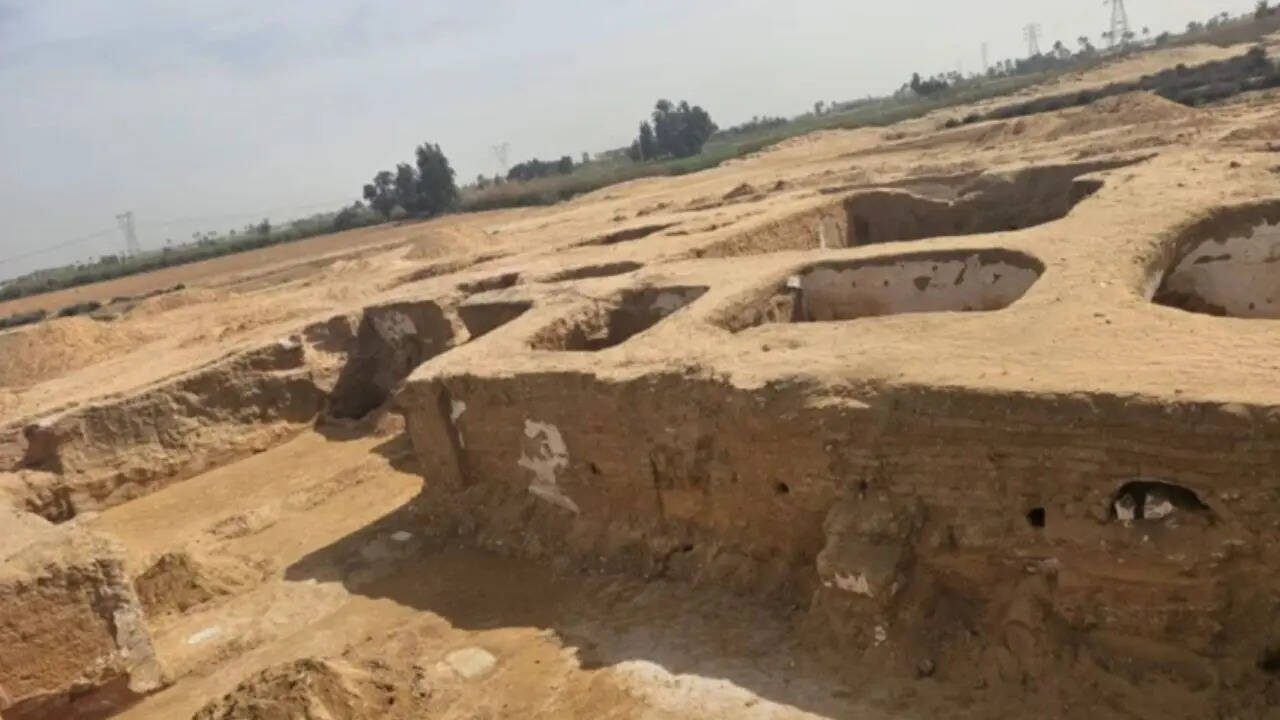
The wind across the Nile Delta doesn’t carry the scent of gold or the sterile air of a museum. It smells of damp earth, salt, and the persistent, heavy heat of the Egyptian sun. For decades, farmers in the Tal al-Deir region of Damietta moved across this land with a singular focus: the next harvest. They walked over ground that felt solid, predictable, and ordinary. They had no idea that mere feet beneath their sandals, a silent congregation was waiting to be heard.
Archaeology is often sold to us as a series of glittering prizes—Tutankhamun’s mask or the towering grandeur of the Giza plateau. But the real story of human history isn't found in the monuments of kings who demanded to be remembered. It is found in the limestone blocks of a 1,500-year-old monastery, recently pulled from the mud of the Delta. This isn't just a collection of ruins. It is a record of people who chose a life of radical simplicity in a world that was falling apart.
The Ghost in the Garden
Imagine a monk named Markos. He is a hypothetical man, but his reality is etched into the very floorboards of the structures uncovered at Tal al-Deir. In the late fifth century, Markos didn't see himself as a historical figure. He saw himself as a man trying to find God in a swamp.
While the Roman Empire was fracturing and the Mediterranean was a churn of political upheaval, Markos and his brothers were building. They used limestone, likely salvaged from older, "pagan" structures, to create a sanctuary. They weren't building for ego. They were building for survival—both spiritual and physical.
The discovery by the Egyptian archaeological mission reveals a complex that functioned like a clock. The team found more than just walls; they found the mechanics of daily life. There were residential cells where monks slept, communal areas where they broke bread, and, perhaps most importantly, the places where they worked. These men weren't just praying; they were part of a thriving, self-sustaining economy.
Bread and Bricks
The Delta is a temperamental host. It provides water, but it also provides rot. To build a monastery here required a sophisticated understanding of the environment. The ruins show us a layout designed for a specific kind of communal living called cenobitic monasticism. Unlike the hermits who wandered into the deep desert to be alone, these monks lived together.
They lived in the tension between the individual and the collective.
The excavations revealed something fascinating: the monastery was a hub of production. Archaeologists found evidence of kilns and pottery shards. Consider the sensory reality of that. The constant smoke from the kilns, the rhythmic slapping of wet clay, and the smell of baking bread mingling with the incense from the chapel. This wasn't a place of quiet, ethereal floating. It was a place of grit.
They made amphorae—those long, pointed clay jars used to transport wine and oil. The presence of these jars suggests that the monastery wasn't an isolated bubble. It was a node in a massive trade network. These monks were businessmen. They were exporters. They were anchors of the local economy in a region that was a vital breadbasket for the Byzantine Empire.
The Architecture of Faith
When you look at the limestone remains, you see the marks of the tools. You see where a mason’s hand slipped. You see the repairs. These physical "scars" on the building tell a story of persistence. The Delta is prone to flooding and shifting soil. Maintaining a stone structure in this environment is a constant war against gravity and moisture.
The discovery includes a main church area, characterized by its traditional basilican style. It featured a central nave and side aisles, a design intended to funnel the human spirit toward the altar. But outside the sacred space, the mundane was just as carefully organized. The excavations uncovered storage rooms and workshops, proving that the spiritual life was supported by a heavy backbone of manual labor.
Life here was dictated by the bell. It woke you before the sun touched the Nile. It called you to the fields. It called you to the clay pit. It called you to the psalms. There is a specific kind of peace that comes from having every hour of your day decided for you by a higher purpose. For the people of the fifth and sixth centuries, a world of plague and war, the monastery at Damietta wasn't a prison of rules—it was a fortress of order.
The Layers of the Delta
The Nile Delta is essentially a giant, wet history book where the pages have been glued together by centuries of silt. To find this monastery, the team had to peel back the layers of time with surgical precision. This isn't "Indiana Jones" swinging from a whip; it’s a group of people in the heat, moving dirt with brushes and small trowels, one centimeter at a time.
What they found beneath the surface was a transition. Egypt was shifting from the world of the Pharaohs and the Greeks into a deeply Christian society. The monastery at Tal al-Deir sits right in the middle of that transformation. It shows us how the new faith didn't just replace the old—it grew out of it, literally using the stones of the past to build the foundations of the future.
The monastery also serves as a reminder of the Delta’s lost geography. Today, we see a landscape of modern agriculture and bustling towns. But 1,500 years ago, this was a more amphibious world. The monks would have traveled by boat through a labyrinth of canals and river branches that no longer exist. Their world was defined by the rise and fall of the water.
Why the Mud Matters
It’s easy to look at a pile of rocks and see only a pile of rocks. But these ruins are a mirror. We live in an era of digital noise, where the "communal" experience is often a series of angry comments on a screen. We are isolated in our crowds.
The monks of Damietta were the opposite. They were crowded in their isolation.
They gave up the "world" to live in a small, damp corner of it with twenty other men they might not have even liked. They shared everything: their food, their work, their silence. The discovery of their home reminds us that the human need for belonging and purpose is more powerful than the need for comfort. They chose the mud of the Delta because it offered them a chance to be part of something that wouldn't wash away with the next flood.
The artifacts recovered—the coins, the pottery, the fragments of daily life—act as a bridge. A coin dropped in a hallway 1,500 years ago is a tiny tragedy of the mundane. A broken jar is a frustrated afternoon. When we see these items, the "Byzantine Era" stops being a chapter in a textbook and starts being a lived experience.
The excavation continues, and more secrets will undoubtedly emerge from the silt. Each new room uncovered is another sentence in the story of how we became who we are. We are the descendants of people who refused to let their light go out, even when the world around them was growing dark.
As the sun sets over the modern fields of Damietta, the shadows of the limestone walls stretch out across the ground. The farmers are still there. The Nile is still there. And for the first time in over a millennium, the voices of the monks are beginning to whisper through the stones again. They aren't asking to be worshipped. They are simply asking to be remembered as people who worked, prayed, and built a life out of the river's mud.
The earth eventually claims everything, but sometimes, if we are patient enough to dig, it gives a little bit of it back.