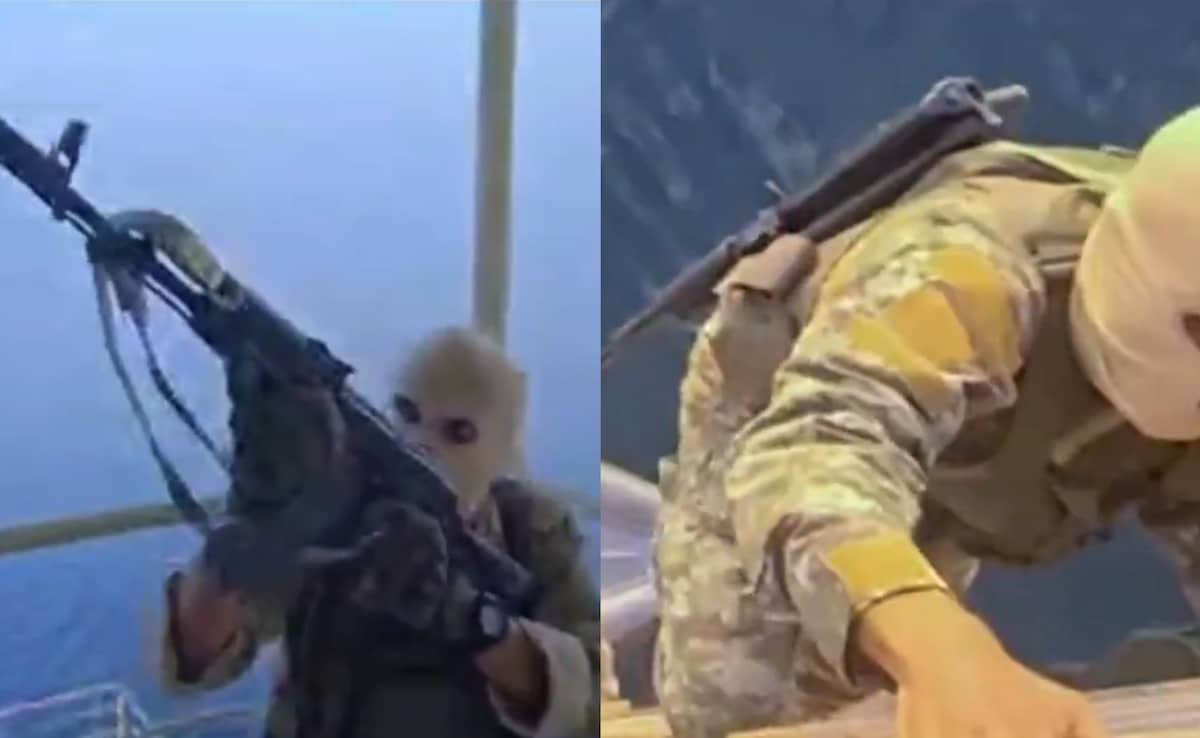
The Strait of Hormuz is essentially a narrow throat for the world's economy, and on April 13, 2024, the Islamic Revolutionary Guard Corps (IRGC) decided to squeeze it. Most people think of maritime seizures as pirate movies with wooden legs and parrots. The reality is much colder. It looks like a Soviet-era Mil Mi-17 helicopter hovering over a massive container ship while commandos slide down ropes with rifles at the ready.
When the IRGC seized the MSC Aries, they weren't just grabbing a ship; they were sending a message to Israel and the West. The vessel, bound for Nhava Sheva, India, was intercepted 50 nautical miles off the coast of Fujairah. If you’re wondering why this matters two years later in 2026, look at your shipping costs. The blueprint for modern maritime disruption was perfected that morning.
The Mechanics of a Modern Hijack
The IRGC didn't use a subtle approach. They used a combination of fast boats and aerial insertion to take the 15,000 TEU vessel. The crew of 25—mostly Indians—suddenly found themselves at the center of a geopolitical firestorm. This wasn't a random act. Iran claimed the ship violated "maritime laws," but everyone knew the real reason. The MSC Aries is leased by the Mediterranean Shipping Company (MSC) from Gortal Shipping, an affiliate of Zodiac Maritime. Zodiac is led by Israeli billionaire Eyal Ofer.
In the world of shipping, "links to Israel" is a death sentence for safe passage in the Persian Gulf.
The commandos wore masks. They carried rifles. They acted with the efficiency of a state military because they are one. By the time the world realized the ship had gone dark on tracking systems, it was already being steered into Iranian territorial waters near Bandar Abbas.
Why India Was the Biggest Collateral Victim
While the fight was between Tehran and Tel Aviv, the pain was felt in Mumbai. Out of the 25 crew members, 17 were Indian nationals. This put New Delhi in a brutal diplomatic spot. India has a "strategic partnership" with Iran—especially regarding the Chabahar port—but it also has deep security ties with Israel.
- Human Cost: Families in Kerala and Maharashtra spent weeks wondering if their sons would ever come home.
- Economic Blow: The ship was carrying roughly $10.6 million worth of goods specifically destined for India.
- Cargo Logistics: Thousands of containers filled with polymers, steel products, and chemicals were essentially kidnapped.
India's Ministry of External Affairs had to burn the midnight oil to get access to the crew. Eventually, the Indian deck cadet Ann Tessa Joseph was the first to be released, but the rest of the crew stayed in limbo for weeks. By May 2024, the crew was technically released, but the ship and its $93 million cargo remained stuck.
The Hidden Cargo Problem
If you think the seizure ended when the commandos stepped off the ship, you're wrong. The legal nightmare lasted much longer. Shipping associations like the International Chamber of Shipping (ICS) were furious. Why? Because the cargo didn't belong to Israel. It belonged to companies in Turkey, Belgium, Egypt, and Algeria.
The MSC Aries was a "common carrier." That means it's like a bus. Just because the bus company might have a link to a specific country doesn't mean the passengers (the cargo) do. Over 3,600 containers were caught in a legal "no-man's land." By early 2025, insurers were facing "Constructive Total Loss" claims. This is when the cost of recovering the goods is more than the goods are worth.
The 2026 Reality of Shipping Security
Looking back from 2026, the MSC Aries was the turning point where "dark shipping" became the norm. To avoid the fate of the Aries, ships started turning off their AIS (Automatic Identification System) transponders. They began using "shadow" identities.
The IRGC didn't stop there. Just last month, in March 2026, we saw more MSC vessels—the Francesca and the Epaminondas—getting targeted under similar "maritime violation" excuses. The playbook is always the same:
- Identify a ship with even a 1% link to a rival.
- Use the "maritime law" excuse (like turning off transponders).
- Seize the vessel to use as a bargaining chip in nuclear or sanctions talks.
Honestly, the shipping industry is tired. We’ve seen freight rates spike every time a mask-wearing commando drops onto a deck. The "war risk premium" you pay on every imported gadget? That’s the "Aries Tax."
What You Should Do Now
If you're involved in global trade or logistics, the era of "set it and forget it" shipping is over. You can't just assume a Portuguese-flagged ship is safe because it's not "Israeli."
- Audit Your Carriers: Don't just look at the flag; look at the ultimate beneficial owner (UBO) of the vessel. If there’s any link to controversial jurisdictions, your cargo is a target.
- Diversify Routes: Stop relying solely on the Strait of Hormuz. The Cape of Good Hope route is longer and more expensive, but your cargo actually arrives.
- Update Your Insurance: Ensure your policy specifically covers "political seizure" and "state-sponsored piracy." Standard marine insurance often has loopholes for these specific events.
The sea used to be a neutral zone. Now, it's a chessboard. Don't let your cargo be a pawn.