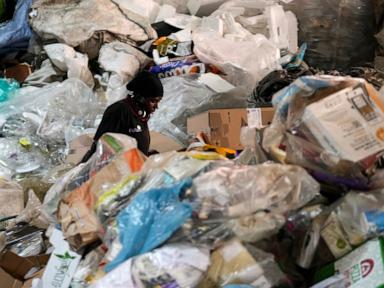
Dawn in Lagos does not arrive with the gentle painting of pastel colors across the sky. It arrives with a heavy, metallic thud.
For Amina, that sound is the rattle of a rusted zinc gate swinging open to reveal the visitor she never invited: a low, creeping ridge of dark plastic bags, discarded sandals, and decomposing cardboard that overnight has swallowed the narrow concrete drainage ditch outside her doorway.
She doesn’t curse. She doesn't call a municipal helpline. She knows by heart the quiet futility of both. Instead, she sighs, ties a frayed yellow wrapper tighter around her waist, and reaches for a long wooden broom.
Multiply Amina by twenty million. Multiply her single drainage ditch by the thousands of miles of choked arteries crisscrossing the explosive metropolitan centers of the African continent. What you get is not merely an inconvenience of municipal management. It is a slow-motion tectonic shift, a geological layer of our own making, accumulating faster than concrete can set or policy can be printed.
The Math of the Avalanche
To understand the crisis of urban waste in modern Africa, you have to abandon the neat, sterile spreadsheets of Western sanitation departments. You have to look at the raw geography of velocity.
Urbanization across the continent is happening at a pace that defies historical precedent. Cities like Dar es Salaam, Nairobi, Accra, and Lagos are expanding outward and upward, drawing hundreds of thousands of rural migrants every month in search of opportunity. They bring life, ambition, and labor. They also bring packaging.
Every single economic transaction—a sachet of drinking water bought in traffic, a meal of fried yam wrapped in old newspaper, a cheap smartphone shipped in molded styrofoam—leaves a physical receipt. Multiply those receipts by a billion.
Infrastructure investment has not merely lagged behind this growth; it has been left standing at the starting line while the runner is already halfway down the track. Municipal budgets, often strapped by debt servicing and constrained by bureaucratic inertia, are designed to service cities of the 1980s. They are attempting to digest the economic output and refuse of the 2020s with fleets of broken-down trucks that run on borrowed diesel and repaired tires.
Consider the sheer physical weight of the problem. In many sub-Saharan African cities, solid waste collection rates hover below fifty percent. The rest? It stays behind. It fills the spaces between houses. It lines the shoulders of major arterial highways. It drifts into coastal lagoons, turning turquoise waters into monochrome slurries of polyethylene.
The Invisible Toll
We talk about waste as an environmental problem. That is our first mistake. It sanitizes the reality, turning human tragedy into a conservation headline.
Waste is an epidemiological time bomb and an economic tax on the poorest.
When the rains come—and in West Africa, when they come, they arrive with the terrifying fury of a falling sky—the plastic mountains do not vanish. They migrate. They choke the concrete canals engineered decades ago to protect neighborhoods from seasonal flooding. Water, finding its path blocked by a dense mat of millions of discarded plastic water sachets, rises.
It enters living rooms. It submerges mattresses where children sleep. It mixes with the contents of overflowing septic tanks, creating a toxic, gray soup that laps against the walls of schools and corner shops.
Amina has seen what happens when the flood recedes. She has watched her youngest son spikes a fever of one hundred and four degrees within forty-eight hours of the water clearing—typhoid, malaria, and cholera riding in on the back of municipal neglect. The true cost of uncollected waste is not paid in landfill fees. It is paid in lost workdays, in hospital bills that devour family savings, in the stunted potential of children who spend half the rainy season recovering from waterborne infections.
Economists call this an externality. People like Amina call it life.
The Informal Army
Yet, to look at the streets of an African metropolis and see only victimhood is to miss the most vital, dynamic engine of survival on the ground.
While municipal governments stall, an informal army moves.
Walk through the sprawling markets of Kumasi or the bustling districts of Nairobi, and you will see them: the scavengers, the sorters, the pushcart operators, the recyclers who form the invisible circulatory system of the city. They do not wear high-visibility vests or operate million-dollar hydraulic compactors. They wear faded shirts and flip-flops, pushing hand-welded steel carts loaded high with crushed plastic bottles, discarded aluminum cans, and scrap copper wire.
These men and women are economic alchemists. They look at what the rest of society has designated as worthless and extract a living from its remnants. They supply the burgeoning local recycling plants that melt down polymers to manufacture cheap household goods, feeding a circular economy born out of absolute necessity.
And yet, they do so with their hands tied. They operate in the shadows, often harassed by local authorities who view them as a nuisance rather than an essential public health service. They work without protective gear, sorting through medical waste and shattered glass with bare hands, vulnerable to exploitation by middlemen who buy their recovered materials at pennies on the dollar.
To watch a young man sort through a smoking mound of municipal refuse in the midday heat is to witness a profound indictment of modern urban planning. He is doing the job of the state, fueled only by hunger and ingenuity.
Rethinking the Blueprint
If the crisis is outpacing infrastructure, then building more of the same broken infrastructure is a fool's errand. You cannot simply pave your way out of a mountain of trash with more dump trucks and traditional landfills. Landfills are expensive, they consume valuable peri-urban land, and in wet tropical climates, they become toxic sponges leaching heavy metals into the water table.
The transformation must begin upstream, at the point of entry.
Across the continent, visionary policymakers and grass-roots entrepreneurs are beginning to redraw the map. Rwanda banned single-use plastic bags years ago, transforming the streets of Kigali into some of the cleanest urban thoroughfares on the global map—proof that stringent regulation, when backed by political will and civic pride, can alter cultural habits almost overnight.
In Nigeria and Ghana, tech-enabled waste collection startups are using mobile applications to connect households directly with independent collectors, turning plastic bottles into a digital currency that can pay for utilities, school fees, or mobile data. Families are no longer dumping their waste; they are hoarding it, treating an empty bottle not as trash, but as small change.
These are bright spots, flickering against a vast expanse of gray. But they prove a fundamental truth: the solution to Africa's urban waste crisis will not be imported from Geneva or Washington. It will be forged locally, through a hybrid model that marries the resourcefulness of the informal sector with smart digital logistics and decentralized processing.
The Long Sweep of Tomorrow
Back in her courtyard, Amina finishes sweeping the dark silt and stray wrappers away from her doorway. The sun is now high, beating down with a fierce, blinding intensity that makes the distant metal roofs shimmer like water.
The pile she has gathered is small—just a tiny fraction of the neighborhood's daily output. By tomorrow morning, the wind and the runoff will have brought more. She knows this. She is under no illusions that her broom can defeat a systemic failure of governance and consumerism.
And yet, she sweeps. Because dignity in the face of chaos is an act of quiet rebellion.
The cities of Africa are writing the playbook for the urban future of the developing world. By 2050, a massive share of the planet’s human population will live in African cities. How those cities manage their waste—how they choose to treat the physical byproduct of their own ambition—will determine whether those urban centers become monuments to human ingenuity or monuments to our collective carelessness.
The mountain at our doorstep is formidable. But every revolution in human history has begun with someone picking up a tool, looking at the mess before them, and refusing to step around it.