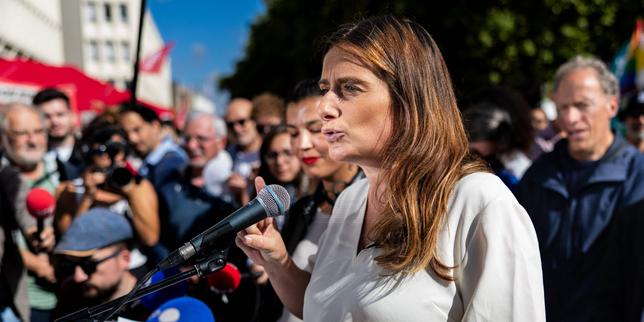
The debate over European sovereignty has long suffered from political rhetoric that substitutes volume for verification. When prominent political figures like Marine Tondelier and Raphaël Glucksmann label the Rassemblement National (RN) a "Trojan horse of imperialists" or the "party of the foreigner" regarding the war in Ukraine, they are tapping into a profound, justified anxiety across the continent. Yet, reducing complex diplomatic alignments and ideological sympathies to simple soundbites misses the structural mechanics of how political parties in Western democracies develop and maintain external dependencies. To understand why the French far right faces persistent accusations regarding its posture toward Moscow, one must examine financial trails, historical party ties, and the pragmatic evolution of nationalist rhetoric in an era of renewed continental conflict.
Accusations of external allegiance are not new in French political history. During the Cold War, the French Communist Party faced continuous scrutiny over its alignment with Moscow. Today, the vector has shifted from the extreme left to the extreme right, fueled by concrete historical episodes rather than abstract paranoia. The financial lifeline extended to Marine Le Pen’s party in 2014 via a Russian-Czech bank loan remains a foundational exhibit in every investigative file concerning foreign influence in French politics. While party leadership has repeatedly defended the transaction as a desperate commercial necessity born of French banking boycotts, the geopolitical optics created a permanent vulnerability. In statecraft, perception often dictates operational reality, and a political movement funded by institutions responsive to the Kremlin naturally draws intense counter-intelligence scrutiny.
Beyond balance sheets, ideological convergence plays a vital role. The modern European nationalist movement frequently portrays itself as the defender of traditional values against both Euro-federalist bureaucracy and progressive social shifts. Within this framework, Vladimir Putin’s Russia has historically positioned itself as a champion of conservative civilization, a pitch that found a surprisingly receptive audience among various European right-wing formations. Figures within the Rassemblement National have historically praised aspects of Russian leadership or advocated for the lifting of sanctions imposed after the illegal annexation of Crimea in 2014. Even as the full-scale invasion of Ukraine in 2022 forced a rhetorical recalibration—prompting party leaders to offer careful verbal support for Ukrainian territorial integrity while opposing heavy military aid and strategic escalation—the underlying ambivalence remains visible in parliamentary voting records and public statements.
The practical consequences of this ideological hedge manifest clearly in European policy debates. When the European Parliament votes on financial assistance packages for Kyiv, joint defense procurement, or sanctions enforcement, the positioning of far-right deputies frequently aligns with outcomes favored by Moscow. Party strategists argue that these votes stem from a consistent doctrine of national sovereignty and a desire to avoid dragging France into an unmanageable economic or military escalation. Critics, however, view these positions through a different lens, interpreting them as a systematic effort to weaken European solidarity from within. This tension turns every foreign policy debate into a domestic proxy war over national loyalty, leaving little room for nuanced discussions about military logistics or diplomatic exit strategies.
The rhetorical escalation from figures like Tondelier and Glucksmann reflects a broader electoral calculation. As European security architecture faces its most severe crisis since 1945, foreign policy has transformed from a secondary campaign topic into a primary litmus test for statecraft. For the pro-European center and the radical left alike, isolating the Rassemblement National on the Ukraine question serves a dual purpose. It satisfies genuine security concerns while attempting to disqualify a leading political rival from holding the keys to the Élysée Palace. By framing the debate around terms like foreign allegiance, opponents seek to shift the electoral terrain away from domestic economic grievances—where the far right historically performs strongest—and onto the treacherous ground of national defense and geopolitical reliability.
Navigating this landscape requires separating legitimate strategic disagreements from compromised loyalties. In a democracy, opposing foreign military intervention or questioning the architecture of the European Union is a protected political stance, regardless of how short-sighted or dangerous critics might judge it to be. Conflating a nationalist, isolationist ideology with active treason risks trivializing real foreign subversion while hardening the resolve of millions of voters who feel alienated by mainstream consensus. Yet, ignoring the historical proximity between European nationalist parties and the Russian state apparatus is equally dangerous. Transparency in party financing, rigorous counter-intelligence oversight, and unsparing public debate remain the only reliable defenses against external capture. Until the French political class develops a bipartisan consensus on national security that transcends domestic electoral maneuvering, the shadow of foreign influence will continue to hang over the republic.
Marine Tondelier's perspective on political dynamics and the French left
This video provides context on the ongoing tactical debates and political positioning among French leftist figures as they navigate the shifting electoral terrain.
http://googleusercontent.com/youtube_content/1