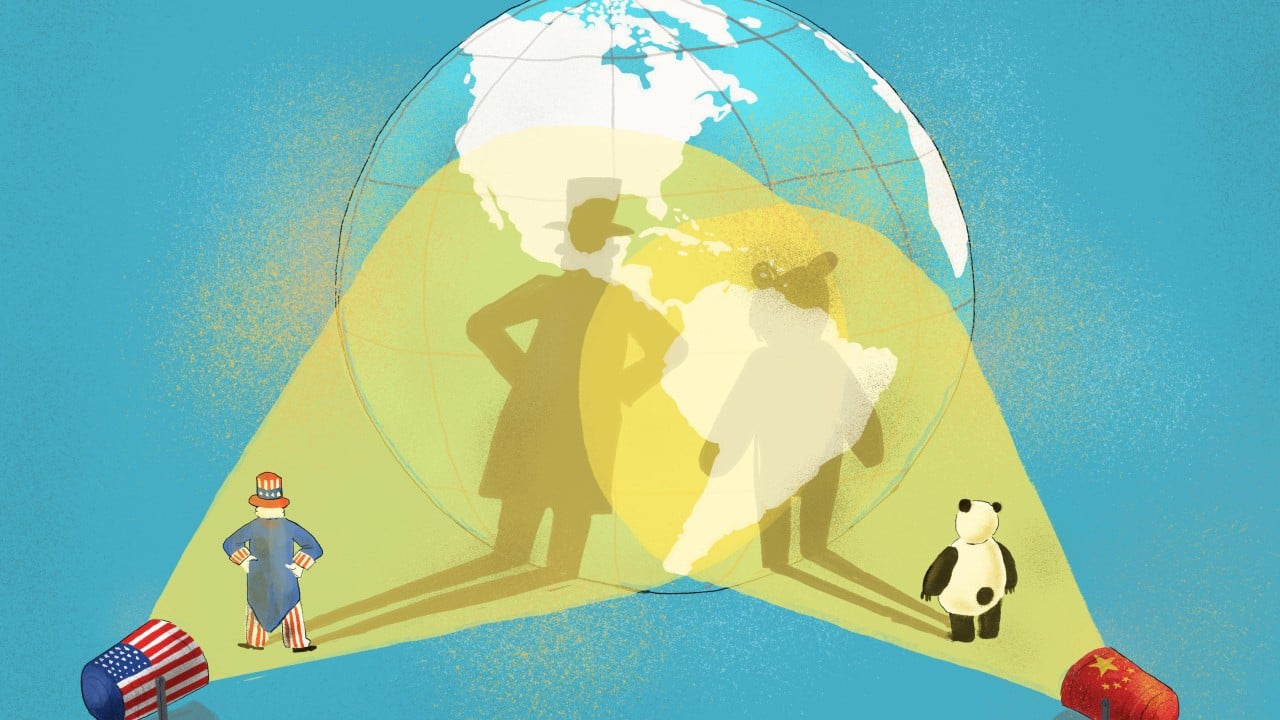
The United States reaches its 250th anniversary facing an uncomfortable reality on its own doorstep. For two centuries, Washington treated Latin America as an exclusive backyard, a strategic shield formalized by the Monroe Doctrine in 1823. Today, that shield is shattered. The Western Hemisphere has transformed into a primary arena of global competition where American influence is fading, not because of military invasion, but through decades of economic indifference and diplomatic arrogance. Washington expected automatic loyalty based on geography, but local capitals chose to look elsewhere for partners who actually show up with checkbooks.
This loss of authority is the defining test of American global power. While US foreign policy experts obsessed over eastern Europe and the Taiwan Strait, a profound transformation occurred closer to home. South American nations now routinely bypass Washington to secure deals with Beijing, Moscow, and Tehran. The historic zone of security that allowed the United States to project power across the Atlantic and Pacific is no longer secure or exclusive. This erosion is an active, ongoing systemic failure driven by a bipartisan refusal to treat southern neighbors as equal economic partners.
The Illusion of Permanent Ownership
Washington spent generations assuming Latin America had no other options. The region was expected to absorb American exports, provide cheap raw materials, and fall in line during United Nations votes. This entitlement blinded successive US administrations to the deep resentment brewing across the continent. Military interventions during the Cold War left deep scars, while the subsequent economic mandates of the Washington Consensus failed to deliver widespread prosperity.
When regional leaders looked for alternatives to Western financial institutions, they found them. The shifts were not subtle. Across Argentina, Brazil, and Peru, major state-backed enterprises from outside the hemisphere began buying up critical infrastructure. They did not arrive with lectures about governance or fiscal austerity. They arrived with state-backed financing, ready to build deep-water ports, ultra-high-voltage power grids, and lithium processing plants.
The American response was slow and remarkably tone-deaf. Instead of offering competitive economic packages, US diplomats chose to scold regional leaders for accepting foreign investment. This strategy achieved nothing. Telling a capital city to reject billions in infrastructure spending without offering an equivalent alternative is a recipe for diplomatic irrelevance. Regional leaders recognized that American attention only spiked when an adversary made a move, proving that Washington valued the region only as a chess piece, never for its own sake.
Beijing and the Silent Balance Sheet
The most significant shift in the hemisphere involves cold, hard cash. China is now the top trading partner for most of South America. This did not happen by accident. It is the result of a deliberate, multi-decade strategy focused on securing food, minerals, and diplomatic allies.
Consider the trade data. In 2000, Chinese total trade with Latin America sat at roughly 12 billion dollars. By the mid-2020s, that figure surged past 450 billion dollars. Beijing signed free trade agreements with Chile, Peru, Costa Rica, and Ecuador. More than twenty nations in the region joined the Belt and Road Initiative. These are not just symbolic signatures on pieces of paper. They represent concrete infrastructure projects that anchor these economies to Asian supply networks.
The nature of these investments exposes the strategic blind spot in American foreign policy. While US venture capital chased software and digital services, state-aligned entities from Asia bought the physical world. They acquired copper mines in Chile, soybean logistics networks in Brazil, and lithium concessions in the Andean ridge. They constructed the Chancay megaport in Peru, a three-billion-dollar deep-water facility designed to slash shipping times between South America and Asia. This single port fundamentally rewires maritime trade routes, allowing massive container ships to bypass North American ports entirely.
This economic integration creates immediate political leverage. Countries dependent on a single buyer for their primary exports rarely cross that buyer on the international stage. The diplomatic consequences are obvious. Several nations switched their official recognition from Taiwan to Beijing over the past decade, directly undermining a core goal of US foreign policy.
The Broken Mechanics of American Engagement
The failure of American policy in the hemisphere is a structural issue, not a temporary political phase. United States development tools are outdated, underfunded, and tangled in bureaucratic red tape. The primary vehicle for American overseas development financing operates under strict restrictions that prevent it from backing large-scale infrastructure projects that do not meet narrow, rigid criteria.
Meanwhile, commercial entities from rival nations operate with state backing, allowing them to absorb financial risks that private Western banks refuse to touch. When a Latin American government needs a new hydroelectric dam or a nationwide rail line, American companies are rarely in the room. They cannot compete with the subsidized financing or the speed of execution offered by state-backed competitors.
Furthermore, American diplomatic posts in the region frequently sit vacant for months or years. Diplomatic nominations routinely become political hostages in the United States Senate, leaving embassies managed by temporary charges d'affaires. This lack of senior representation sends a clear message to host nations that they are a low priority for Washington.
The policy focus remains narrow and reactive. For decades, the United States viewed its southern neighbors through just three lenses: undocumented migration, illicit narcotics, and communist containment. This reductionist approach alienates regional leaders who want to discuss technology transfer, industrial development, and access to capital markets. By treating the region purely as a source of problems to be managed rather than opportunities to be developed, Washington guaranteed its own marginalization.
The Supply Chain Mirage
In recent years, Washington policymakers began talking about nearshoring, the practice of moving supply chains out of Asia and bringing them closer to the United States. This trend was supposed to revitalize economic ties with Latin America, particularly with Mexico and Central America.
The reality fell far short of the rhetoric. Moving complex manufacturing ecosystems requires massive investments in roads, reliable electricity, clean water, and worker training. The United States government expected the private sector to shoulder the entire burden of this transition without providing the necessary sovereign guarantees or infrastructure funding to make it viable.
Mexico benefited from its proximity and existing trade agreements, but the rest of the region remains largely excluded from the nearshoring boom. Central American nations suffer from chronic electricity shortages and decaying transport networks. South American nations are too geographically distant to serve as efficient nearshoring nodes for the North American market without significant upgrades to their maritime infrastructure.
Worse, foreign companies quickly adapted to this trend. Enterprises from outside the hemisphere simply built factories inside Mexico and other regional trade partners. They utilized local assembly plants to bypass American tariffs, effectively using the region as a backdoor into the United States market. The profits and intellectual property still flow back to home capitals in Asia, leaving the United States just as exposed to supply chain vulnerabilities as before.
A Hard Realist Course Correction
Reversing this decline requires a complete abandonment of the patronizing attitudes that defined the last two centuries of American policy. The United States cannot bully or scold its way back to dominance in the Western Hemisphere. It must out-compete its rivals on a transactional, pragmatic level.
This shift means transforming American development institutions into aggressive, flexible tools capable of matching foreign state financing. The US must offer genuine alternatives for infrastructure funding, streamlined regulatory approvals, and direct access to North American consumer markets. If Washington wants regional capitals to reject foreign state-backed telecom networks or port developments, it must provide a superior, economically viable alternative.
Diplomacy must be decoupled from domestic political theater. Key ambassadorial posts must be filled by professionals who understand commercial diplomacy, not political donors. The agenda needs to expand beyond security cooperation and migration control to encompass joint ventures in critical minerals, renewable energy manufacturing, and advanced technology.
The United States no longer enjoys the luxury of a secure, uncontested hemisphere. The assumption that proximity equals loyalty is a dangerous myth that has been thoroughly debunked by current events. As the country marks its 250th year, the true measure of American power will not be found in its ability to project force across distant oceans, but in its capacity to rebuild frayed alliances and re-establish its credibility on its own continent. The clock is ticking, and the competition is already well ahead.