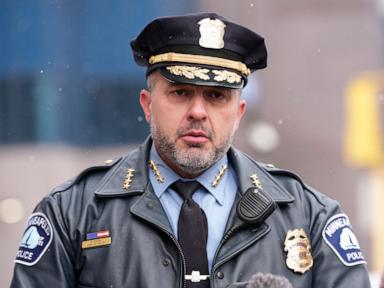
Trust is a fragile thing, but in police governance, it is the actual currency of survival. When Minneapolis Police Chief Brian O’Hara abruptly resigned on Tuesday evening, it felt like a recurring bad dream for a city that has spent the last six years under an intense national microscope. This is not just about a single police chief getting caught in an embarrassing internal investigation. It is a stark reminder that the deep, systemic rot in the city's accountability structures is nowhere near healed.
The technical reason for O’Hara's swift exit sounds almost pedestrian compared to the massive crises the city usually faces. An internal investigation probed allegations that he had improper, intimate relationships with city employees. Investigators actually found no evidence to substantiate those specific sexual misconduct claims. Also making waves in related news: The Soho Road Trap and the Fatal Vulnerability of the Streets.
But they found something else. O'Hara panicked.
He intentionally deleted a contact card from his city-issued cellphone during the investigation to hide his connection to an employee. Then, he ignored direct orders and blabbed about his phone being seized to another city staffer. Mayor Jacob Frey, who only weeks prior called O’Hara the "right leader for this moment," was forced to issue a scathing "serious misconduct" reprimand. Faced with a choice between getting fired or walking away, O'Hara chose to step down. Further insights on this are explored by NPR.
The Illusion of the Reformer Saviours
We have seen this movie before. When O’Hara was brought in from Newark, New Jersey, in November 2022, he was supposed to be the ultimate outside reformer. The department was hollowed out, reeling from the murder of George Floyd, and facing a blistering U.S. Department of Justice report that detailed a long history of excessive force and racial discrimination. O'Hara was supposed to fix the culture.
Honestly, he did make progress on some metrics. He bumped the cratering officer count from 550 up to more than 640. He managed to boost applications by 200% and presided over a genuine drop in city crime rates. But the obsession with putting a single charismatic outsider on a pedestal always ignores how deeply embedded internal police subcultures resist change.
The mistake Minneapolis keeps making is relying on individual leaders to project the appearance of reform while the underlying machinery remains broken. City Council President Elliott Payne didn't hold back after the announcement, calling the mayor's recent re-nomination of O’Hara a "massive error in judgment" given that these rumors had been swirling for months. Payne argued that leadership prioritized optics over actual governance. He is right.
Why the Investigation Itself Points to Deeper Failure
Look at what actually triggered the downfall. It wasn't a sudden, massive policy failure or a high-profile case of police brutality. It was a cover-up of something investigators ultimately couldn't even prove.
Think about the sheer hubris required for a police chief—a man whose entire job is built on uncovering truth and enforcing compliance—to delete evidence from a government-owned phone during an active internal probe. It shows a profound contempt for the very oversight mechanisms he was hired to champion.
“When you serve as chief of the Minneapolis Police Department, trust is not secondary to the job, it is the job,” Mayor Jacob Frey stated during his Tuesday evening press conference. “When trust is broken, it becomes extremely difficult to continue leading effectively.”
It is a great quote for a press conference, but it ignores the political shielding that happened before this week. The city still has 17 other open complaints against O’Hara sitting in limbo. During his tenure, a total of 30 complaints were lodged against him by various individuals, yet the specifics of these files remain closely guarded secrets.
A Department Pulled in Too Many Directions
You cannot understand this resignation without looking at the impossible political tightrope the Minneapolis Police Department tries to walk. Just last winter, the department faced intense national and local crossfire during a federal immigration crackdown.
O’Hara publicly criticized federal enforcement tactics after an agent kneeled on a woman's back in December, drawing praise from immigration advocates but furious blowback from conservative factions and police union loyalists. The department has been constantly stuck between a progressive city council demanding a complete reimagining of public safety and a political reality that requires standard, aggressive law enforcement to keep a lid on violent crime.
When you push a chief into a political meat grinder like that, the cracks show quickly. Combine that pressure with a complete lack of transparent internal oversight, and you get an executive who feels like they can play by their own rules behind closed doors.
Where Minneapolis Goes from Here
Assistant Police Chief Katie Blackwell has taken over as the acting chief. She is stepping into a minefield. The next steps for Minneapolis cannot just involve another expensive, nationwide search for a slick communicator who promises to mend community relationships.
If city leadership wants to actually break this loop, they need to execute three immediate structural changes:
- Enact Total Transparency in Leadership Complaints: The fact that dozens of internal complaints against a sitting police chief can remain hidden from both the public and the city council until a explosion occurs is absurd. Oversight data must be shared with the council immediately.
- Establish Hard Cellphone and Data Audits: If the city-issued technology of top officials can be altered without immediate, automated flags, then internal affairs is a toothless tiger. Digital forensics protocols for city executives must be handled by independent state investigators, not internal peers.
- Pivot from the 'Hero Chief' Model: Stop looking for a messiah. The next chief needs to be an administrator focused on systemic checklists, rigid compliance with the city's ongoing federal consent decree requirements, and strict internal discipline.
The city did not fall back into tumult because O’Hara resigned; it never actually left it. Until the underlying system treats a breach of internal trust as an automatic, unpreventable firing offense from day one—regardless of how good the crime stats look on a chart—Minneapolis will keep finding itself right back at the podium, explaining why another leader failed the test.