The coffee in Terminal One always tastes like burnt paper and desperation at three in the morning. It is a universal truth known to airport janitors, baggage handlers, and transit passengers stranded between continents. For the expatriate workers who keep the hubs of the Gulf running, that bitter brew is the only thing standing between exhaustion and the next twelve-hour shift.
They come from Kerala, from Punjab, from Manila and Dhaka, chasing the promise of a remittance check that can build a concrete house back home or pay for a niece’s wedding. They live in the margins of logistics. To the travelers rushing past them toward duty-free shops, they are invisible.
Until the sky tears open.
When a low-flying suicide drone strikes a civilian airport, it does not sound like the movies. There is no cinematic crescendo. There is only a sudden, violent tearing of aluminum, the shattering of reinforced glass, and a concussive wave that flattens lungs before the brain even registers the noise. In an instant, a mundane workspace becomes a geopolitical flashpoint. The ordinary lives inside it are transformed into collateral damage, statistics to be traded in diplomatic cables.
The Anatomy of a Frame
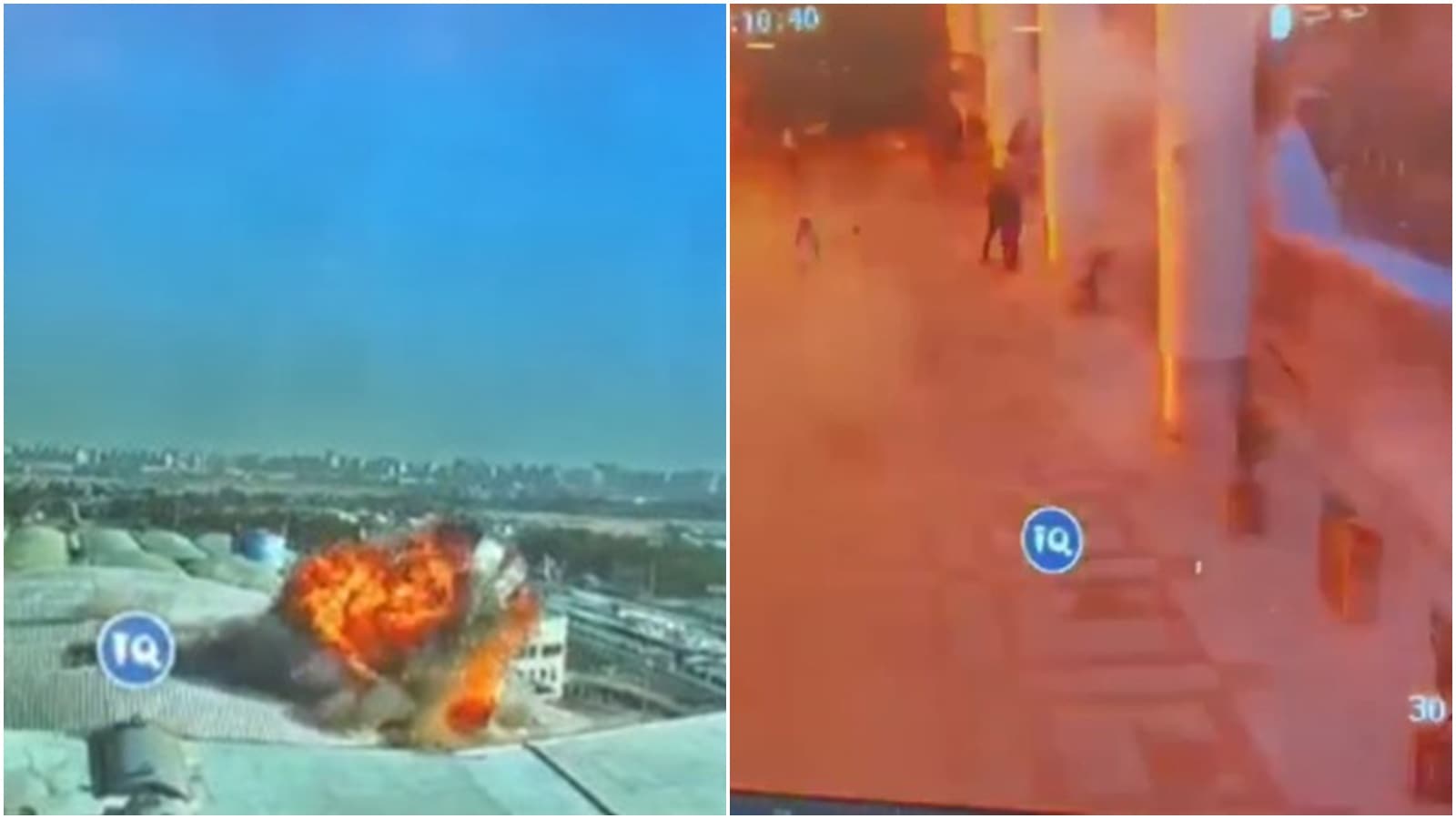
Security footage from Kuwait International Airport captured the moment with the clinical detachment inherent to surveillance. The timestamp flickered in monochrome. In one frame, the terminal exterior is quiet, bathed in the orange sodium glow of tarmac lights. In the next, a jagged silhouette streaks into the frame from the upper margin. It is small, shaped like a delta wing, moving with a buzzing whine that survivors later described as sounding like a lawnmower from hell.
Then, the whiteout.
The camera shakes, its digital sensor overwhelmed by the sudden bloom of thermal energy. Debris rains down in a slow-motion cascade of jagged shards and pulverized concrete. When the smoke clears from the lens, a section of the perimeter wall is gone.
Amid the wreckage lay the body of an Indian national. He was a worker whose name would initially be withheld, then broadcast across international newswires, and finally forgotten by everyone except a grieving family in a rural village thousands of miles away. He had survived the brutal heat of the Gulf summer, the isolation of labor camps, and the crushing weight of homesickness, only to be caught in the crosshairs of a shadow war he had no part in making.
The Denials of the Distance
Hours after the smoke cleared over Kuwait City, the machinery of international diplomacy began its predictable, synchronized dance.
From Tehran, the official statements arrived with practiced swiftness. The Ministry of Foreign Affairs issued a flat, categorical denial. They called the accusations baseless. They pointed fingers at regional adversaries, suggesting the attack was a false flag operation designed to derail fragile diplomatic thaws or provoke a Western response. The rhetoric was polished, designed to obscure the reality of the shrapnel littering the Kuwaiti tarmac.
But metallurgy tells a different story than diplomacy.
Modern forensic analysis of drone strikes relies on the unyielding physical evidence left behind in the debris. When a weapon system detonates, it scatters its lineage across the impact zone. Engineers can read the twisted carbon fiber and the charred remnants of circuit boards like a fingerprint. The specific layout of the guidance systems, the servo motors used to actuate the wing flaps, and the composition of the explosive payload all point back to specific factories, assembly lines, and design bureaus.
The drones used in these long-range strikes are often characterized by their low cost and high deniability. They are built from commercial-grade electronics, powered by small, two-stroke engines that can be purchased online, and guided by GPS coordinates that require no active satellite uplink during flight. This makes them incredibly difficult to track on traditional air defense radar, which is optimized to detect high-fast-moving fighter jets rather than low-slow-flying lawnmowers packed with military-grade explosives.
They are the perfect weapon for an era of asymmetric warfare. They allow states to project power across borders while maintaining just enough ambiguity to stall international consensus.
The Invisible Toll of the Remittance Pipeline
To understand why this matters, one must look away from the map of military alliances and toward the economic geography of the Indian subcontinent.
Every year, billions of dollars flow from the Gulf states back to India. This capital is the lifeblood of entire states like Kerala, where whole villages are funded by the labor of young men and women working in the sands of Kuwait, Saudi Arabia, and the United Arab Emirates. It is an unwritten contract: the workers provide the muscle and endurance to build the glittering mega-cities of the Middle East, and in return, they send home the means to lift their families into the middle class.
Consider what happens when that contract is pierced by a drone strike.
The immediate reaction is political panic. Embassies issue statements, security protocols are tightened, and airport defenses are scrambled. But the deeper, lasting tremor is felt in the labor camps and the villages. When a worker dies in a mortar attack or a drone strike, the shockwave travels backward along the remittance pipeline.
A father in Punjab realizes his son is no longer safe in the place he sent him to escape poverty. A mother in Cochin watches the news with a knot in her stomach, wondering if the next airport strike will hit the terminal where her daughter handles baggage. The illusion of safety—the idea that civilian infrastructure is immune to the burning conflicts of the region—is shattered.
The Geometry of Ambiguity
The challenge of modern statecraft is that accountability has become modular. When a missile is fired, a satellite can trace its trajectory back to a specific launch pad. A nation-state can be held directly responsible, balanced on the scales of international law and deterrence.
Drones have rewritten that geometry.
They can be launched from the back of a flatbed truck parked in an anonymous desert valley, hundreds of miles from any official military installation. They can skim the terrain, masking their radar cross-section against the clutter of hills and sand dunes, changing direction at pre-programmed waypoints to disguise their origin. By the time they reach their target, the trail is cold, buried beneath layers of proxy militias, black-market supply chains, and political deniability.
This ambiguity is not accidental; it is the primary feature of the technology. It creates a space where governments can strike their enemies without triggering a formal declaration of war. It allows for a state of perpetual friction, where the costs are borne not by the commanders who sign the orders, but by the bystanders who happen to be standing near the point of impact.
The international community watches these events unfold with a sense of weary familiarity. There will be meetings at the United Nations. There will be intelligence briefings behind closed doors, where satellite imagery and debris analyses are passed around conference tables. Accusations will be leveled, and counter-accusations will be hurled back with equal fervor.
Meanwhile, the concrete at Kuwait International Airport is scrubbed clean. The broken glass is replaced. The flight schedules resume their relentless rhythm, bringing in the next wave of passengers, the next shipment of cargo, and the next shift of migrant workers.
They will walk past the spot where the wall was repaired, perhaps noticing a slight mismatch in the color of the new cement, completely unaware of the ghost that lingers in the fabric of the terminal. The machinery of global commerce demands that the disruption be minimized, that the flow of capital and labor continue without interruption, regardless of the fire that occasionally falls from the sky.
The true tragedy of modern conflict is not that it is loud, but that it is so easily absorbed into the background noise of daily life. A life is extinguished in a flash of light on a security camera, a nation denies responsibility, and the world moves on to the next headline, leaving only a quiet vacancy in a home somewhere in India where a family waits for a phone call that will never come.