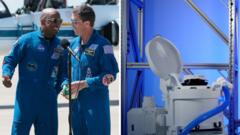
The success of the Artemis missions depends on the management of human biological output within a closed-loop system where mass, volume, and power are the primary constraints. Waste management is not a matter of hygiene but a critical engineering hurdle that dictates the life-support architecture of both the Orion spacecraft and the Human Landing System (HLS). To understand how astronauts will function on the lunar surface and during transit, one must analyze the physics of fluid dynamics in microgravity and the chemical conversion cycles required for long-duration habitation.
The Triad of Waste Management Constraints
Managing human waste in space is governed by three non-negotiable physical realities that do not exist on Earth. Any system designed for Artemis must solve for these variables simultaneously or risk mission failure due to mechanical blockage, biological contamination, or mass imbalance.
- Phase Separation in Microgravity: On Earth, gravity performs the "separation" of solids, liquids, and gases. In orbit, surface tension and airflow must replace gravity. Without a forced-air interface, fluids cling to surfaces and solids remain suspended, creating an immediate risk to both cabin air quality and internal electronics.
- Resource Recovery Ratios: Every kilogram of water launched from Earth costs thousands of dollars in propellant. The Artemis goal is to achieve a Water Recovery Management (WRM) rate exceeding 98%. This means urine is not waste; it is a primary feedstock for the potable water system.
- Biological Containment and Odor Control: In a pressurized volume the size of a small SUV (Orion) or a multi-level habitat (Starship HLS), the buildup of ammonia, methane, and bacteria is toxic. The system must maintain a negative pressure gradient relative to the cabin to ensure no particulates escape during use.
The Engineering of the Universal Waste Management System
The primary hardware for the Artemis missions is the Universal Waste Management System (UWMS). Unlike the legacy Waste and Hygiene Compartment (WHC) used on the International Space Station, the UWMS is 65% smaller and 40% lighter, specifically optimized for the tighter mass margins of the Orion capsule.
Liquid Waste: The Distillation Cycle
Urine collection utilizes a high-speed fan to create suction, drawing fluid into a funnel-and-hose assembly. The challenge is not the collection, but the chemistry. To prevent the precipitation of calcium and the growth of microbes, the urine is immediately treated with a "pretreat" solution—typically a combination of strong acids (like phosphoric or sulfuric acid) and a chromium-based oxidant.
This mixture is then fed into a Distillation Assembly. In the microgravity environment, this occurs in a rotating drum that creates an artificial gravity field. The centrifugal force separates the water vapor from the concentrated brine. This vapor is condensed and passed through multi-filtration beds and catalytic oxidizers until it meets the standard for "potable" water. The residual brine, which contains high concentrations of salts and urea, is currently stored and discarded, though future lunar surface operations aim to extract the remaining 10-15% of water trapped in this sludge.
Solid Waste: Compaction and Stabilization
Solid waste management follows a mechanical containment strategy. The UWMS uses a dual-fan system to pull waste into a removable canister. The critical design element here is the use of specialized liners that are permeable to gas but impermeable to liquids and solids.
- Fecal Collection: Once the waste is deposited into the canister, the air is pulled through the liner, trapping the solids while allowing the air to be filtered through an activated charcoal and HEPA system before returning to the cabin.
- Stabilization: To prevent the buildup of pressure from bacterial decomposition (off-gassing), the canisters are vacuum-exposed or chemically stabilized. On the Artemis HLS, where longer stays are expected, long-term storage involves compacting the canisters to minimize volume and then shielding them to prevent radiation interaction with the organic matter, which can produce secondary neutrons.
The Lunar Surface Paradox: 1/6th Gravity Dynamics
The transition from the microgravity of the Orion transit to the partial gravity (0.16g) of the lunar surface introduces a "Goldilocks" problem. The gravity is not strong enough to rely on terrestrial plumbing but significant enough to interfere with microgravity air-suction systems.
The Human Landing System must account for "settling" times. In 1/6th gravity, fluids do not fall; they drift. This necessitates a hybrid approach where the UWMS-style suction is maintained, but the hardware is oriented to take advantage of the slight downward pull. This prevents the "splash-back" phenomenon that occurs when high-velocity air encounters a surface in a low-gravity environment.
Logistics of the Extravehicular Activity (EVA)
When astronauts are on the lunar surface in their Exploration Extravehicular Mobility Units (xEMUs), they cannot access the UWMS. This creates a 6-to-8-hour window where waste must be managed within the suit.
The MAG System Evolution
The Maximum Absorbency Garment (MAG) is essentially a high-performance, multilayered polymer diaper. While it appears primitive compared to the UWMS, its chemical composition is highly engineered. It utilizes sodium polyacrylate, which can absorb up to 300 times its weight in water.
The limitation of the MAG is not capacity, but skin health. Prolonged exposure to moisture and waste leads to dermatitis and bacterial infections. For Artemis III and beyond, NASA is investigating internal "relief tubes" for male astronauts and redesigned external collection interfaces for female astronauts, though the MAG remains the baseline due to its 100% mechanical reliability—it cannot "break" in a way that compromises suit pressure.
Mass Balance and the Cost of Disposal
Every gram of waste retained on a spacecraft increases the propellant required for the Return to Earth Burn (TEI). Conversely, dumping waste on the lunar surface is a matter of planetary protection and logistical efficiency.
- Abitrary Disposal: During the Apollo era, waste bags were simply left on the surface. For Artemis, NASA’s "Planetary Protection" protocols are more stringent. The goal is to avoid contaminating the lunar poles, which contain water ice that scientists wish to study for its pristine chemical signature.
- Mass as Shielding: A strategic proposal for the Artemis Base Camp involves using stabilized waste canisters as radiation shielding. Human waste is rich in hydrogen. Hydrogen is one of the most effective materials for blocking Galactic Cosmic Rays (GCRs). By stacking dried, stabilized waste canisters in the walls of lunar habitats, the mission turns a logistics burden into a life-saving asset.
The Bottleneck: Nitrogen and Phosphorus Recovery
Current systems focus almost exclusively on water recovery. However, for a sustainable lunar presence, the loss of nitrogen and phosphorus (present in human waste) is a systemic failure.
In a closed-loop habitat, these elements are required for hydroponic or aeroponic food production. The "Cost Function of Nutrient Loss" dictates that as mission duration increases, the mass of fertilizer that must be launched from Earth eventually exceeds the mass of the waste management system itself. Therefore, the next iteration of Artemis hardware must move beyond simple "containment and disposal" and toward "biological processing." This involves using bioreactors—tanks filled with specific bacteria—that can break down solid waste into a nutrient-rich slurry for plant growth.
Strategic Operational Forecast
The immediate priority for Artemis II and III is the refinement of the UWMS's reliability. However, the long-term viability of the Lunar Gateway and the Artemis Base Camp hinges on shifting from a "disposal" mindset to a "refinery" mindset.
- Immediate Implementation: Maintain the UWMS as the baseline for Orion and HLS, utilizing vacuum-desiccation for solid waste to maximize water reclamation and minimize biological risk.
- Mid-Term Shift: Deploy centrifugal bioreactors on the Lunar Gateway to test the conversion of urea into nitrogen-based fertilizer in a stable orbit.
- Long-Term Objective: Integrate waste-processing streams into the habitat's shielding architecture. The conversion of fecal matter into high-density hydrogen-rich bricks provides a dual-purpose solution for waste disposal and solar particle event (SPE) protection.
The technical path forward requires abandoning the "toilet" analogy in favor of viewing the crew as a biological component of a larger chemical processing plant. Success is measured not by comfort, but by the percentage of atoms successfully cycled back into the mission's life-support consumables.