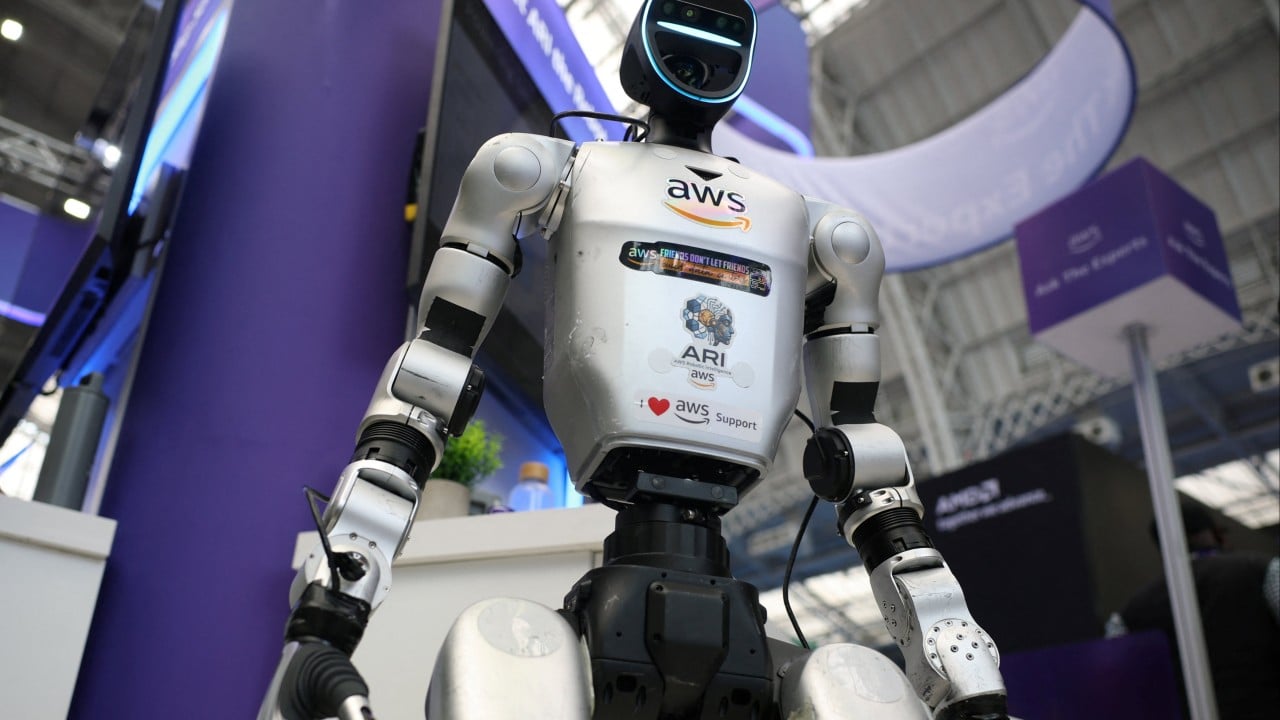
Wang Xingxing remembers when his mechanical creations could barely stand up without a safety harness tethered to the ceiling. Back then, in a cramped workshop filled with the sharp smell of burnt solder and cooling machine oil, building a quadruped robot felt like teaching a toddler to walk on a sheet of wet ice. That was a decade ago. Today, the machines built by his company, Unitree Robotics, do not just walk. They jog through factory floors, perform synchronized flips on prime-time television broadcasts, and anchor a multi-billion-dollar industrial shift that is quietly rewriting the rules of global power.
Next week, Unitree steps onto the Shanghai STAR Market to launch an initial public offering that aims to sell over forty million shares. On paper, it is a standard financial milestone for a high-growth tech firm. Look closer, however, and the offering resembles something entirely different. It functions as the opening salvo in a high-stakes economic tug-of-war, where the prize is nothing less than the physical automation of the planet.
To understand why this matters, step away from the Wall Street ticker symbols and imagine a quiet assembly floor in Zhejiang province. Rows of metallic frames hang from overhead tracks, their limbs twitching with initial diagnostic power-ups. Human technicians move among them with handheld terminals, checking torque limits and sensor calibrations. This is not the slow, bespoke craftsmanship of Silicon Valley garage startups that treat every humanoid chassis like a fragile work of art. This is volume. This is speed. This is a manufacturing cadence designed to pump out tens of thousands of units a year, driving down the cost of a mechanical worker until it rivals the price of a mid-range automobile.
While American robotics pioneers largely concentrate on software brilliance, trying to craft world-class artificial intelligence models capable of reasoning through abstract chaos, Chinese manufacturers chose a dirtier, more practical path. They built the body first. They mastered the supply chain, the actuators, and the sheer physical resilience of the hardware. Market analysts note that Chinese firms account for an overwhelming majority of global humanoid and quadruped deployments, producing affordable mechanical labor at a scale that western competitors struggle to match.
Yet, this rapid ascent unfolds under a darkening sky of geopolitical friction.
The United States has grown increasingly uneasy about the mechanical tide flowing from Asian factories. Just days before Unitree finalized its prospectus, the Federal Communications Commission added foreign-made advanced robots to its restricted equipment list, throwing up regulatory tollbooths designed to block future models from entering American markets. For years, the United States accounted for a meaningful slice of Unitree’s overseas revenue—hovering between thirteen and nearly twenty percent across recent reporting periods. Now, those bridges are burning. Washington regulators view these versatile machines not merely as commercial conveniences, but as potential vectors for surveillance, supply chain vulnerability, and strategic disadvantage.
Consider the paradox embedded in Unitree’s own supply chain. The prospectus boasts of domestic prowess, yet hidden within its electrical components are critical modules sourced from international brands, including high-performance processors and advanced vision boards engineered by American tech giants. Wang’s empire may assemble the physical shell in Hangzhou, but its nervous system relies on global components that politicians on both sides of the Pacific are eager to embargo. When a congressional hearing labels a rising tech star as a security risk, the distance between a corporate balance sheet and a geopolitical frontline vanishes entirely.
This is the invisible friction of our current technological era. We are watching the splitting of the industrial world into two distinct, incompatible ecosystems. On one side stands a philosophy of frontier autonomy backed by heavy trade barriers. On the other stands a philosophy of relentless manufacturing scale, state-supported momentum, and low-cost execution that refuses to slow down just because a foreign regulator drew a line in the sand.
When the trading bells ring in Shanghai next week, the capital raised will flow straight back into research facilities, feeding an insatiable hunger for smarter, cheaper, more autonomous machines. The restrictions imposed by overseas capitals may pinch export margins, but they will hardly halt a domestic market large enough to sustain its own momentum.
The future is being welded together piece by piece in brightly lit warehouses across eastern China. It does not wait for diplomatic clearance. It marches forward on four metal legs, indifferent to the borders we draw in the sand, ready to inherit a world that is only just beginning to realize what it has set into motion.