The salt air off the Mediterranean does not care about geopolitics. It corrodes steel just the same. It stings the eyes of a schoolteacher from Brisbane the exact same way it stings the eyes of a seasoned sailor from Istanbul. On the deck of a cargo ship, miles from the coast, the water looks impossibly blue, vast, and indifferent to the cargo it carries or the hands that hold the wheel.
Most people view international crises through the clean, detached lens of a television screen. We see maps with colored arrows. We hear anchors read statistics about tonnage, blockades, and diplomatic protests. But history is not made by arrows on a map. It is made by ordinary people who pack a single suitcase, leave behind the safety of a quiet suburban street, and step onto a rusted deck because they believe their presence might alter the trajectory of a disaster.
In May 2010, an Australian citizen decided to board the Freedom Flotilla bound for the Gaza Strip. This is not a story about the complex, jagged history of the Middle East, nor is it a defense of one political faction over another. It is an exploration of what happens when the abstract rhetoric of global activism collides with the cold, unyielding reality of military force on the high seas.
What drives someone to leave a comfortable life in the Southern Hemisphere to sail into a flashpoint?
To understand the mechanics of a blockade, you have to understand isolation. Imagine a community wrapped in concrete and monitored by drones. The inputs and outputs of daily life—the concrete to rebuild a school, the specific dosage of pediatric antibiotics, the simple luxury of fresh chocolate—are dictated by an external authority. For those inside, the world shrinks. For those outside who watch, a sense of powerlessness can become paralyzing.
But some people do not paralyze easily.
The Freedom Flotilla was a convoy of six vessels, spearheaded by organizations aiming to break the maritime blockade imposed on the Gaza Strip. The largest of these ships was the MV Mavi Marmara, a passenger vessel that became the symbolic and literal flagship of the enterprise. On board were hundreds of activists from dozens of nations. Among them were parliamentarians, journalists, humanitarian workers, and a few individuals from the opposite side of the earth, including Australian advocates who felt that distance was no excuse for apathy.
The atmosphere on a humanitarian ship before it reaches its destination is a strange mix of summer camp and high-stakes vigil. There are long hours of absolute boredom. Activists sit on plastic chairs, drinking bitter coffee, swapping stories about their home countries, and trying to find common linguistic ground. They practice non-violent resistance strategies. They discuss what to do if the ship is boarded. They map out scenarios.
Then, the sun goes down, the horizon disappears, and the dark water begins to feel heavy.
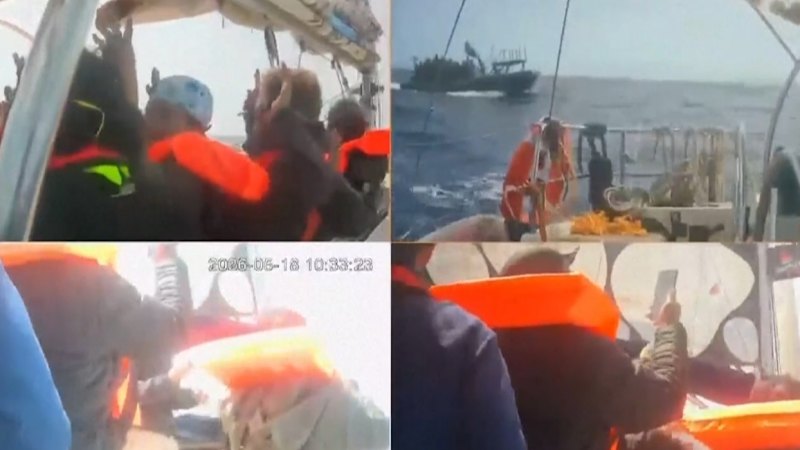
Consider the physics of an interception at sea. The ocean at night is a void. The only lights belong to the vessel itself and the stars above. When military zodiacs approach, they do not arrive with sirens. They appear as sudden, dark shapes cutting through the wake, moving with a speed and precision that makes the civilian cargo ship feel like a floating target.
On May 31, 2010, the theoretical scenarios became reality. Israeli naval commandos boarded the Mavi Marmara in international waters.
What followed was a chaotic explosion of violence that lasted only minutes but echoed across global capitals for years. The accounts of those moments diverge wildly depending on who is speaking. To the military, the boarding was a legal enforcement of a security blockade, met with unexpected and organized resistance from activists wielding iron bars, knives, and chains. To the passengers, it was an unlawful assault on a peaceful mission in international territory, met with desperate, improvised self-defense against soldiers firing live ammunition and stun grenades.
Nine activists died that night. Dozens more were wounded. The Australian aboard the flotilla found themselves thrust from the role of a witness into the center of a geopolitical firestorm.
The aftermath of such an event is a lesson in how quickly human tragedy is processed into political capital. Within hours of the raid, the news cycle swallowed the event whole. The identities of the people on board were obscured by labels. They were called terrorists. They were called martyrs. They were called provocateurs. They were called saints.
But when you are sitting in a detention center, stripped of your passport, waiting to see if your government will intervene to bring you home, those labels mean nothing. The reality is the taste of copper in your mouth, the sound of cell doors slamming, and the sudden, sharp realization that the safety net of your nationality is far thinner than you ever imagined.
The Australian government, like many Western administrations, faced a delicate balancing act. On one hand, there is the absolute obligation to protect citizens abroad, to demand their fair treatment, and to secure their release. On the other hand, there are the rigid gears of alliance, diplomacy, and strategic partnership with Israel. In those moments, the individual citizen becomes a complication—a legal anomaly that needs to be resolved as quietly as possible.
The ship is gone, the passengers are deported, and the news trucks move on to the next crisis. What remains?
The blockade of Gaza did not end because of the flotilla, though the international outrage did force a temporary easing of restrictions on certain civilian goods. The fundamental political deadlock remained as stubborn and bloody as ever. The rusted ships were impounded, turning into barnacle-encrusted monuments to a failed voyage.
Yet, the true legacy of the voyage is found in the shift that occurs within the people who survived it. To step onto a boat knowing it may be intercepted is an act of defiance against the comfort of looking away. It is an acknowledgment that sometimes, the only way to test the boundaries of human empathy is to put your own body in the space between two opposing forces.
Years later, the salt air still blows across the Mediterranean. The waves continue to hit the coast of Gaza, carrying the same indifference they always have. Back in Australia, life returns to the rhythm of traffic, morning commutes, and quiet evenings. But for those who walked the decks of the flotilla, the sound of the ocean will always carry a different frequency—a reminder of a night when the distance between a quiet life and a global conflict narrowed down to the width of a metal hull.