Steel is supposed to be absolute. We build our civilizations on the quiet confidence of straight lines and cold, unyielding bars. When you sit by a window on an eight-carriage service from London Victoria to Eastbourne, watching the Sussex countryside blur past at sixty-five miles per hour, you do not think about the molecular ambition of iron. You assume the ground beneath you is a solved problem.
Consider what happens next: a sudden, violent shudder. Not the ordinary rhythmic clack of a well-worn commute, but a sickening lateral heave that feels like an aircraft dropping into an empty pocket of sky.
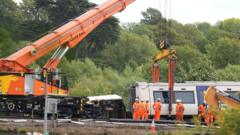
For the one hundred and fifty souls aboard that train on an oppressive August afternoon, the familiar world fractured in a fraction of a second. Outside, the thermometer had climbed past thirty-eight degrees Celsius in parts of the region, baking the earth into a brittle crust. Inside, luggage racks became missiles, seats shifted, and the final three carriages of the train lifted, tipped, and ground violently onto their sides. Twenty people required hospital treatment. Two suffered serious injuries that permanently altered the architecture of their lives.
The immediate aftermath was a blur of flashing amber lights, panicked breathing, and the frantic scramble of emergency services cutting through tangled metal. But while the sirens wailed and the walking wounded stumbled away from the wreckage near Lewes, a quieter, more technical hunt began.
Investigators from the Rail Accident Investigation Branch did not look for a villain with a switch or a catastrophic mechanical failure within the train itself. They looked down. They looked at a phenomenon known to civil engineers as a track geometry irregularity.
Metal expands when it suffers under heat. A steel rail exposed to direct summer sun can reach fifty degrees Celsius when the air itself is only thirty. With nowhere to go longitudinally as the immense forces push against each other, the track finds a weak point. It bows. It kinks. It breathes sideways.
Days before the crash, regular travelers had already noticed a strange, jarring bounce along that specific stretch. Local lawmakers had flagged the deteriorating, bumpier ride to operators. But a bumpy ride is easily dismissed as the ordinary friction of an aging transit network. We grow accustomed to the small indignities of public infrastructure. We assume minor jolts are just part of the price of getting from one place to another.
Then the track geometry shifts beyond the threshold of forgiveness.
The preliminary data recovered from the train's black box tells a stark story of a normal journey meeting an abnormal reality at sixty-five miles per hour. Cameras mounted on preceding services had already recorded the subtle warping of the steel, a microscopic warning written in the language of physics just hours before disaster struck. Yet the margin between a safe commute and a flipped carriage is terrifyingly thin.
This is the hidden tax of a warming world. We design our bridges, our tracks, and our power grids for a climate profile that belongs to the history books. Every degree the thermometer rises pushes our legacy materials past their intended tolerances. The steel is telling us a story about stress, and we are only listening when it breaks.
Recovery crews spent days clearing the wreckage, lifting heavy carriages back onto straightened foundations, repairing the scars left in the East Sussex earth. The line remained shut, cutting off communities and rewriting the daily routines of thousands.
Rail operators and transport authorities will issue reports, allocate funds for climate resilience, and adjust safety margins. Millions will be poured into modernizing the skeleton of the network. Yet the fundamental tension remains. We are hurtling forward across an aging landscape, trusting our weight to cold metal that is learning, violently, how to bend.
Watch footage of the emergency response and track investigation
This video captures the immediate aftermath and the complex recovery operations on the ground in East Sussex following the derailment.
http://googleusercontent.com/youtube_content/1