The linen towel was freezing when it touched my neck, but within sixty seconds, it was tepid. Within three minutes, it was hot.
We were standing in the courtyard of the Musée Nissim de Camondo, a magnificent 18th-century mansion in the heart of Paris, watching the high-gloss veneer of the luxury fashion industry melt. It was precisely 9:15 AM on a Wednesday. Ordinarily, the fashion elite do not do 9:00 AM. Runway shows are theatrical evening affairs or lazy mid-afternoon spectacles. But Western Europe was trapped in the suffocating throat of the "Omega" heatwave.
The mercury in the capital was already sprinting toward 40 degrees Celsius. Nearly half of France was under a government-mandated red alert. To survive, Christian Dior had done something unthinkable: they ripped up their scheduling playbook, moving their highly anticipated menswear spring/summer show from its comfortable 2:30 PM slot to the relative cool of early morning.
But relative cool is a myth when the stones of Paris begin to bake.
As we filed past security, staff handed out personalized fans, umbrellas, and small plates of strawberries. It felt less like an exclusive runway entrance and more like a triage station at an aristocratic garden party. Inside the mansion, where Northern Irish designer Jonathan Anderson was set to unveil his latest collection, the air was dense, heavy, and completely still. Air conditioning is a historical rarity in traditional Parisian architecture, and the old stone walls were acting as an oven.
Look closely at the front row and you could see the invisible stakes of an industry caught completely off guard. LaKeith Stanfield, Little Simz, and James Marsden sat shoulder-to-shoulder, trying desperately to maintain the effortless, cool composure required of global ambassadors. But nature is a brutal equalizer. Behind the oversized crystal sunglasses, people were visibly gasping for air. Makeup glistened with sweat. Heavy denim and thick jackets—the ironic hallmark of high-fashion summer dressing—suddenly felt like medieval torture devices. Water, normally an afterthought at these events, became the most valuable commodity in the room, and the supply was running terrifyingly low.
There is an inherent friction in showing luxury during a climate crisis. For decades, fashion has operated on an illusion of absolute control. Designers dictate the universe. They build massive, temporary worlds out of steel, glass, and mirrors to display garments that cost more than a year’s rent in most cities. But you cannot produce a billion-dollar spectacle if the human beings inside the clothes are on the verge of fainting.
Consider what happens next when the illusion breaks: the clothes themselves have to adapt.
Whether by brilliant foresight or cosmic irony, Anderson’s collection for Dior was themed around formality losing its grip. The house notes described it as "a soiree turning into a house party," or "something quite formal becoming undone." As the models began to walk, it felt less like a conceptual theme and more like a live report from the room itself.
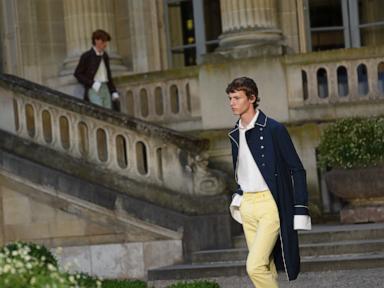
The traditional Dior codes were visibly loosening under the pressure of the heat. Anderson opened with tailoring, but it was stripped of its rigid structure. Pinstripes and houndstooth patterns weren't woven into heavy wools; instead, they were printed onto transparent silk chiffon. The clothes were literally shedding their weight, becoming semi-sheer veils against the climate.
Tuxedos arrived in slouchy, oversized silhouettes, as if the wearer had just escaped a suffocating ballroom. Pink denim shorts peeked out from underneath formal evening coats. Trousers covered in hologram sequins caught the harsh morning sun, flashing like disco balls, while disheveled boots adorned with tiny ladybirds stepped through the dust of the old-world mansion.
It was a beautiful, deeply unsettling paradox. The Musée Nissim de Camondo is a house built on preservation and old-world taste, currently closed to the public for extensive restoration. It is a monument to history, a space caught between repair and decay. And there we were, sweating through our clothes, watching models parade past in silver embroidery borrowed from an 18th-century gentleman’s coat, while the digital world outside went viral with videos of celebrities aggressively fanning themselves just to stay conscious.
The industry is fond of saying that the show must go on. Across the city, other luxury houses were scrambling to deploy their own survival tactics. Rick Owens pushed his midday slot to the morning. Over at Louis Vuitton, Pharrell Williams resorted to building a massive artificial waterfall as a backdrop, using the spray to drop the ambient temperature for an audience that was drowning in sweat even at 9:00 PM.
But these are temporary bandages on a severed artery.
For a long time, the conversation around sustainability in luxury has focused on supply chains, organic cotton, and carbon offsets. It felt distant. Academic. But standing in that sweltering courtyard, watching the elite of the culture gasp for oxygen in the middle of a red-alert heatwave, the reality became visceral. The climate isn't changing in a way that will affect fashion fifty years from now; it is rewriting the schedule today. It dictates when we can gather, what we can bear to wear on our skin, and whether a historic building is safe to inhabit for thirty minutes.
As the final loop of models exited the runway, the applause was polite but brief, driven by a collective, desperate urge to escape into the open air. There was no lingering to chat, no standard post-show mingling among the editors and influencers.
We spilled out onto the burning Parisian pavement, discarding our warmed linen towels, our eyes adjusting to a city squinting under a blinding, unforgiving sun. The Dior man hadn't just stayed at the party until morning. He had survived it.