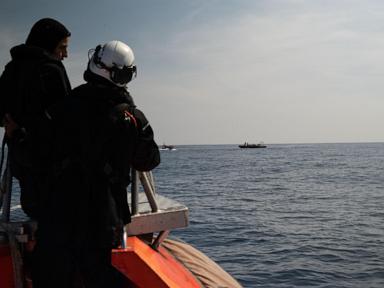
The standard narrative regarding Mediterranean migrant rescues is a script written in tears and moral absolutes. On one side, you have the "heroic" NGOs, operating white-hulled vessels equipped with high-tech sensors and media teams. On the other, the "villainous" Libyan Coast Guard, depicted as a pack of lawless sea-bandits firing on humanitarian missions.
This framing is more than just lazy journalism. It is a fundamental misunderstanding of the maritime economy.
When an NGO ship reports that "Libyan-linked vessels fired shots," the media reacts with a Pavlovian reflex of outrage. They treat the incident as a random act of aggression against a neutral party. It isn't. It is a turf war. By ignoring the incentive structures at play, the "humanitarian" sector has inadvertently become a predictable cog in a human trafficking machine that relies on their presence to lower the cost of doing business.
The Rescue As a Logistics Shortcut
Let’s look at the math of human smuggling. In a world without NGO rescue ships, a smuggler needs a seaworthy vessel, enough fuel to reach Lampedusa or Sicily, and a crew capable of navigating international waters. That is an expensive overhead.
However, when NGO ships patrol a few miles off the Libyan coast, the smuggler’s business model changes. They no longer need a boat that can survive a 200-mile crossing. They need a rubber raft that can survive for six miles. They don't need a professional navigator; they just need a compass and a cell phone to call the NGO’s hotline.
The NGOs provide the "last mile" delivery for the smuggling cartels. By shortening the required transit distance, these aid groups have effectively lowered the barrier to entry for the most predatory criminals in North Africa. Every time a rescue ship moves closer to the shoreline to "save lives," they are actually subsidizing the profit margins of the very militias they claim to despise.
The Sovereignty Myth
The outrage over Libyan vessels firing "near" or "at" rescue ships ignores the messy reality of the Search and Rescue (SAR) zones. The international community—specifically the EU—spent millions training and equipping the Libyan Coast Guard to manage their own waters.
Now, we see a clash of jurisdictions. You have private organizations, funded by European donors, acting as a de facto shadow navy within or adjacent to the territorial waters of a sovereign (albeit fractured) state. Imagine a private security firm from a foreign country patrolling ten miles off the coast of Florida, picking up people and refusing to coordinate with the U.S. Coast Guard. The reaction would not be "humanitarian appreciation." It would be a naval standoff.
When shots are fired, it isn't always about malice. It is about a state—or the militias pretending to be a state—asserting a monopoly on force. The NGOs aren't just rescuers; they are unauthorized actors interfering with a sovereign nation's maritime enforcement.
The Deadly Incentive Loop
If your goal is to stop people from drowning, the most logical step is to stop them from getting on unseaworthy boats in the first place. But the "rescue industry" creates a magnetic pull.
I have spent years analyzing the flow of irregular migration, and the data is brutal: when rescue capacity increases, the number of departures increases. The risk-reward calculation for a migrant changes when they believe a high-tech vessel is waiting just over the horizon.
This isn't a theory; it's a market reaction. When the Italian government scaled back Operation Mare Nostrum, critics predicted a vacuum. What actually happened was a shift in the smuggling routes. The smugglers are agile. They respond to the "rescue" landscape by using even flimsier boats, knowing that the "humanitarians" will fill the gap.
By being there, the NGOs are making the journey "safer" on paper, which encourages more people to risk the trip, which leads to more capsized boats, which requires more NGOs. It is a self-perpetuating loop of misery that keeps the donor money flowing into NGO bank accounts while the bodies continue to wash up on the sand.
The Complicity of the "Neutral" Observer
NGOs often claim they are just neutral observers fulfilling a duty under the Law of the Sea. This is a selective reading of maritime law. The 1974 SOLAS (Safety of Life at Sea) convention mandates that any ship must assist another in distress. It does not, however, authorize private entities to run a permanent ferry service that bypasses national borders and immigration protocols.
Furthermore, the "clashes" with the Libyan Coast Guard serve as a potent marketing tool. Nothing drives a fundraising campaign like grainy footage of a "rescue ship under fire." These organizations need the conflict. They need the villain. Without the friction with Libyan authorities, the NGOs are just an expensive, redundant navy. With the friction, they are martyrs.
Why the "Common Knowledge" Is Dangerous
The public is told that without these ships, the Mediterranean becomes a graveyard. The truth is more uncomfortable: the Mediterranean became a graveyard because we turned it into a regulated crossing point where the "regulators" are private charities and the "providers" are human traffickers.
We are told that the Libyans are the only ones at fault for the violence. In reality, the presence of NGO ships creates a high-stakes competition for the "cargo"—the people on the boats. For the Libyans, those people represent leverage with the EU and potential revenue. For the NGOs, they represent the mission. When two different entities are fighting over the same group of people in the middle of the night on high seas, violence is the inevitable outcome.
Stop Treating Symptoms
If you want to dismantle the smuggling networks, you have to make the "short-haul" trip impossible. That means moving the rescue focus away from the Libyan coast and back to a rigid enforcement of international borders. It means admitting that "rescue" has become "transportation."
The NGOs will tell you that every life saved is a victory. They won't tell you how many lives were put at risk because their presence made the journey seem viable to a family in sub-Saharan Africa. They won't admit that their "victory" is a smuggler's payday.
We have to stop rewarding the "rescue industry" for participating in a cycle that requires a constant supply of victims to justify its existence. The shots fired in the Mediterranean aren't just a sign of Libyan aggression; they are the sounds of a broken system finally tearing itself apart at the seams.
Stop donating to the ferry service. Start demanding a border policy that doesn't outsource its morality to a fleet of privateers.