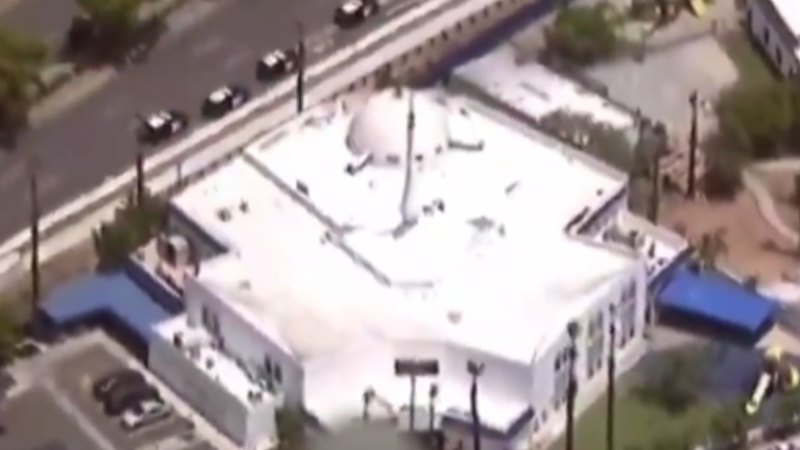
The notification flashes across your phone, triggering an immediate, visceral spike of adrenaline: "Active shooter declared." The algorithm does its job, the panic spreads, and the collective cultural script begins to run. We see the flashing lights, the breathless anchors, the immediate rush to political battle lines.
But when the dust settles on many of these high-profile alerts, we often find a completely different reality. No shooter. No mass casualties. Instead, a false alarm, a mental health crisis, a localized dispute, or a technical glitch amplified by a hyper-reactive security apparatus.
The lazy consensus in modern breaking news reporting is to slap the "active shooter" label on any ambiguous threat involving a weapon or a crowd. This isn't just bad journalism. It is a fundamental misunderstanding of threat mechanics that actually increases danger, drives systemic paranoia, and wastes critical emergency resources. We have built an ecosystem that monetizes panic, and it is time to dismantle the premise entirely.
The Anatomy of the Breaking News Illusion
When an incident occurs at a sensitive location—whether it is a house of worship, a school, or a corporate campus—the rush to be first overrides the necessity of being accurate. The competitor narrative follows a rigid, predictable playbook: declare the absolute worst-case scenario based on raw, unverified police scanner audio, ride the wave of social media hysteria, and figure out the facts later.
This approach fails because it treats the initial, chaotic fog of war as verified truth.
In threat assessment, we evaluate incidents based on a strict hierarchy of verification:
| Stage | Data Source | Reliability | Operational Utility |
|---|---|---|---|
| 1. The Flurry | Social media posts, initial 911 calls | Low | Extremely low (creates noise) |
| 2. The Dispatch | Preliminary police radio traffic | Medium-Low | Moderate (tactical staging only) |
| 3. The Containment | On-scene commander verification | Medium-High | High (resource allocation) |
| 4. The Clearance | Secondary sweep and forensic sweep | High | Absolute (investigative) |
The media consistently treats Stage 1 and Stage 2 data as if they are Stage 4 certainties. When an alarm goes off or a panicked crowd runs from a loud noise, the immediate assumption is a coordinated assault.
I have spent years analyzing security infrastructure and emergency responses. I have seen organizations spend hundreds of thousands of dollars on reactive security measures designed for movies, rather than the mundane, complex realities of actual physical security. The hard truth is that the "active shooter" designation is a highly specific tactical scenario requiring an active, ongoing, lethal threat to a mass group of people. Misusing the term dilutes its urgency. When everything is an active shooter, nothing is.
Why Our Current Threat Definitions Are Broken
Let’s dismantle the premise of the questions people usually ask during these events. The common queries clog up search engines the moment a siren wails: Is there an active shooter near me? How do I survive an active shooter? Why are these attacks increasing?
These questions are flawed because they assume the label matches the reality.
True active shooter incidents, while catastrophic and deserving of intense tactical focus, are statistically rare compared to other forms of violence. According to data maintained by the Advanced Law Enforcement Rapid Response Training (ALERRT) Center and the FBI, a vast number of daily gun-related incidents involve localized criminal activity, domestic disputes, or targeted targeted violence that does not fit the "active, random mass casualty" definition.
When a media outlet screams "Active Shooter Declared" based on a preliminary report that later turns out to be a single isolated shot fired into the air outside a building, or a swatting prank, they are participating in a feedback loop of terror.
The Cost of Hyper-Reactivity
What happens when we misclassify a threat?
- Resource Drain: Police departments dump every available unit, specialized SWAT team, and federal asset into a single radius. This leaves the rest of a municipality completely unprotected against actual, ongoing emergencies.
- The Stampede Effect: Mass panic kills. In multiple documented instances worldwide, false reports of gunfire or active attackers have caused crowd surges, trampling, and severe injuries that far outweighed the threat of the non-existent weapon.
- Tactical Confusion: First responders entering a scene under the impression they are hunting a mobile, heavily armed mass murderer behave differently than if they are responding to a localized containment issue. This heightened stress can lead to tragic friendly-fire incidents or the misuse of lethal force.
Imagine a scenario where a faulty fire alarm system trips a pre-recorded emergency message in a crowded facility. The crowd panics, someone shouts "He has a gun!" out of sheer confusion, and within three minutes, a national news network runs a banner headline. This isn't a hypothetical; it happens with disturbing regularity. The system is tuned for maximum sensitivity and zero nuance.
The Counter-Intuitive Reality of Modern Security
If you want to actually secure a facility—whether it is a mosque, a church, a synagogue, or an office building—you have to stop preparing for the Hollywood version of a tactical assault and start looking at the gaps in basic operational security.
The industry wants to sell you expensive, high-tech panaceas: AI-powered gun detection cameras, biometric access points, ballistic glass, and tactical training seminars led by guys in plate carriers. These look great on a budget proposal. They make board members feel secure.
They are almost entirely useless if your back door is propped open with a rock so the janitor can take a smoke break.
"True security is an unsexy, relentless commitment to the basics: access control, situational awareness, and communication protocols. Everything else is theater."
Consider the downsides to the contrarian approach I am advocating. If you refuse to validate the immediate panic, if you demand verification before locking down an entire city block, you risk a delay in response if the threat actually is the worst-case scenario. It is a brutal calculation. Acknowledge that a half-second delay for verification might save lives by preventing a stampede, but it could also give an actual adversary an advantage.
But the alternative—treating every shadow as a monster—has brought us to a point of collective exhaustion where the public no longer knows what a real threat looks like.
Stripping the Power from the Threat
We must redefine how we consume and react to breaking news of this nature. Stop looking at the initial headlines. Ignore the social media accounts that aggregate raw police scanner feeds for engagement metrics. They don't know anything; they are simply recycling chaos.
When an incident is reported, look for the missing variables:
- Has a suspect been visually confirmed by multiple, independent law enforcement assets on the ground?
- Is there an active engagement, or is the scene static and contained?
- Is the source of the report a verified public information officer, or an anonymous account looking for retweets?
If the answers are vague, ignore the noise.
The industry standard of reporting needs a violent disruption. We need to stop rewarding outlets that broadcast panic before the first police cruiser has even arrived on the scene. Turn off the broadcast. Demand verified data. Stop letting the narrative of fear dictate your understanding of public safety.