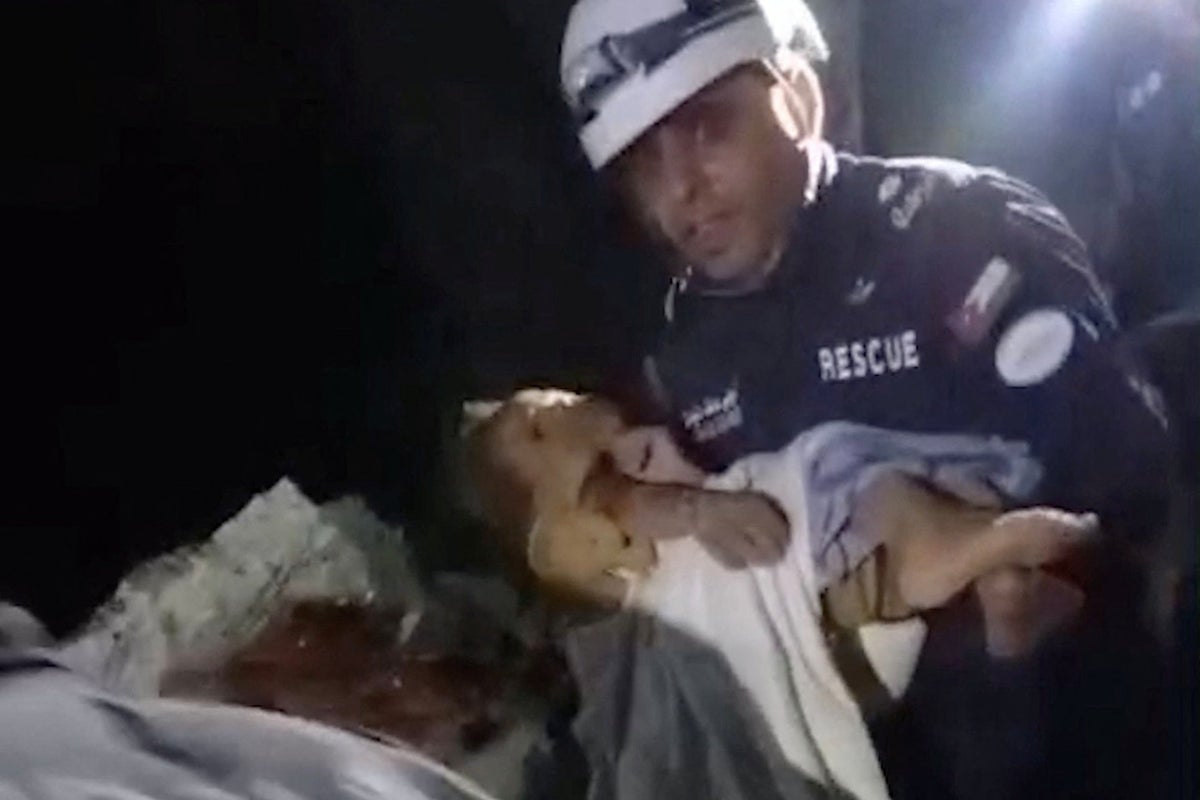
The survival timeline of an individual trapped beneath structural collapse dictates the deployment strategy, resource allocation, and risk calculus of urban search and rescue operations. While conventional emergency medicine establishes a 72-hour "Golden Window" for trauma and dehydration survival, anomalies involving extended entrapment—such as the six-day extraction of a toddler following seismic activity in Venezuela—defy standard statistical aggregates. Understanding these survival anomalies requires breaking down structural void physics, pediatric metabolic rates, and the mechanical limits of search and rescue protocols.
The Triad of Collapse Survivability
Survival inside a collapsed concrete structure depends on three interrelated physical variables: structural void geometry, environmental thermal regulation, and metabolic fluid preservation. The absence of any single component shifts the operational status from a rescue mission to a recovery action.
Structural Void Geometry and Mass Distribution
When reinforced concrete or masonry structures experience seismic failure, the resulting debris field is rarely homogenous. Structural collapse generally follows specific failure profiles: lean-to, V-shape, pancake, or cantilever.
- Pancake collapses offer the lowest probability of void formation due to the sequential stacking of structural slabs.
- Lean-to and V-shape collapses generate structural triangles where fallen beams or load-bearing walls bridge across internal furniture or secondary supports.
These triangular spaces create protective pockets. The volume and stability of the void determine the initial mechanical protection of the occupant. In pediatric cases, the required volume to avoid crush injuries is significantly lower than that of an adult. A micro-void measuring less than 0.5 cubic meters can fully accommodate a toddler while remaining structurally protected by surrounding debris that would compress or fail under the mass of an adult.
Environmental Thermal Regulation
The microclimate within a structural void acts as a critical modifier of human physiological endurance. Ambient temperature, relative humidity, and airflow velocity dictate the rate of heat exchange between the trapped individual and the environment.
Under extreme heat, hyperthermia accelerates dehydration through sweat-induced fluid loss. Conversely, concrete slabs in prolonged contact with the body induce conductive heat loss, triggering hypothermia even in moderate ambient temperatures. The optimal survival environment requires a sealed or semi-sealed void that stabilizes ambient temperature near the body's lower critical threshold, minimizing both evaporative water loss and metabolic caloric expenditure.
Metabolic Fluid Preservation Mechanisms
Dehydration represents the primary physiological bottleneck in prolonged entrapment. The human body requires a continuous fluid intake to maintain cellular homeostasis, blood volume, and renal function. The absolute limit of survival without water is typically indexed at three to five days for adults under standard metabolic stress.
Pediatric physiology presents a distinct contradiction in these scenarios. Children possess a higher body surface area-to-mass ratio and a higher baseline metabolic rate than adults, which theoretically accelerates dehydration and heat loss. However, specific behavioral and physiological counter-mechanisms can invert this vulnerability under precise conditions.
Pediatric Physiological Responses to Prolonged Entrapment
Analyzing how a toddler survives 144 hours without external hydration requires evaluating pediatric metabolic adaptability, fluid dynamics, and psychological responses to extreme stress.
The Cortisol and Metabolic Suppression Framework
Adults exposed to structural entrapment experience high levels of stress, triggering a sustained surge of catecholamines (epinephrine and norepinephrine) and cortisol. This sympathetic nervous system activation elevates heart rate, blood pressure, and metabolic rate, rapidly depleting glycogen stores and accelerating metabolic water consumption.
In contrast, young children subjected to prolonged isolation often transition from an acute panic phase to a state of profound psychological and physiological conservation, akin to behavioral torpor. This shift reduces the baseline metabolic rate.
$$M = 70 \cdot W^{0.75}$$
While Kleiber's Law establishes baseline metabolic scaling relative to weight ($W$), acute stress alters the actual energy expenditure coefficient. When a child enters a state of restricted movement and metabolic conservation, total energy expenditure drops toward the basal metabolic rate ($BMR$), minimizing the production of metabolic waste products and conserving internal fluid volume.
Fluid Total Body Water Calculations
The fluid dynamics of a toddler differ structurally from an adult. Total body water ($TBW$) constitutes approximately 70% to 75% of a child's body weight, compared to 55% to 60% in adults.
| Demographic | Total Body Water (% of Mass) | Extracellular Fluid (% of TBW) | Intracellular Fluid (% of TBW) |
|---|---|---|---|
| Toddler (1-3 years) | 70% - 75% | 40% | 60% |
| Adult Male | 60% | 33% | 67% |
| Adult Female | 50% | 33% | 67% |
A higher percentage of a child's fluid resides in the extracellular fluid ($ECF$) compartment. During acute dehydration, fluid shifts from the extracellular space into the vascular system to maintain blood pressure and perfusion to vital organs. This larger relative reservoir of extracellular fluid provides a longer buffer against hypovolemic shock, provided the child is protected from accelerated evaporative loss through sweating or rapid respiration.
Structural Engineering and Void Dynamics in Seismic Zones
The physical composition of the built environment in urban Venezuela directly influences the nature of structural failures and the subsequent formation of survival voids. Informal settlements and non-ductile concrete frame structures prevalent in Latin American urban centers present specific structural vulnerabilities.
Non-Ductile Concrete Failure Mechanics
Non-ductile reinforced concrete structures lack the structural detailing required to deform plastically during seismic displacement. Under lateral seismic forces, these buildings suffer brittle failure modes, primarily through shear failure in columns and the unzipping of beam-column joints.
This failure mode typically results in rapid, catastrophic structural collapse. However, the irregular nature of informal masonry infill walls, common in these regions, creates highly unpredictable debris patterns. When non-engineered brick or hollow concrete block infill fails, it often shatters into localized mounds rather than uniform sheets. These localized accumulations of masonry debris can jam together, creating arching actions that support overhead slabs and preserve survivable cavities beneath the primary failure plane.
The Mechanics of Arching Action
Arching action occurs when loose fragments of structural and non-structural material wedge against each other across an open space, transferring the vertical load of overhead debris laterally into stable structural elements.
      [Overhead Concrete Slab]
             |      |
             v      v
        .---.        .---.
       /     \      /     \  <- Arching Action of Debris
      /       \____/       \
     /                      \
    /     [Survival Void]    \
   /__________________________\
This mechanical phenomenon transforms a high-pressure downward force into a compressive lateral ring, stabilizing the micro-void directly beneath it. If a toddler is positioned within this zone during the initial seismic shock, the arching action prevents subsequent aftershocks from compressing the space further, isolating the occupant from the surrounding kinetic energy of the collapse.
Technical Constraints of Urban Search and Rescue Operational Lifecycles
The extraction of a live victim six days post-collapse highlights critical limitations and operational boundaries within standard urban search and rescue (USAR) protocols. International Search and Rescue Advisory Group (INSARAG) guidelines define the phases of structural collapse rescue, which must be adapted based on real-time field data.
Phase-Based Resource Allocation
USAR operations follow a strict five-phase progression to maximize life-saving efficiency while managing personnel risk:
- Reconnaissance and Surface Rescue: Assessment of the affected area and immediate extraction of visible casualties.
- Primary Search: Rapid, non-structural evaluation of accessible voids using acoustic and canine assets.
- Secondary Search: Systematic breach and exploration of deep structural voids based on intelligence or physical indications.
- Selected Debris Removal: Controlled lifting and cutting of heavy structural components to access confirmed live victims.
- General Debris Clearance: Heavy machinery utilization for total site clearing once the probability of life survival drops to zero.
The transition from Phase 3 to Phase 5 is typically executed between 72 and 96 hours post-event. Extending Phase 3 and Phase 4 operations into day six requires specific indicators, such as positive acoustic tracking, thermal imaging anomalies, or canine alerts, to justify the continued exposure of rescue personnel to unstable structural conditions.
Sensor Technology and Detection Limits
The detection of a trapped child introduces significant technical challenges for standard USAR sensor arrays. Acoustic detection systems rely on the victim's ability to respond to knocking signals or vocal calls. Pediatric victims, particularly those experiencing metabolic suppression or psychological shock, often remain silent or lack the physical strength to generate sufficient acoustic energy.
Search canines utilize olfactory tracking to detect live human scent filtering through structural cracks. This mechanism is subject to environmental variables:
- High wind velocities disperse scent plumes, leading to false negatives regarding void locations.
- Deep concrete cover combined with high relative humidity traps scent molecules within the structure, preventing them from reaching the surface.
- Decomposition odors from nearby fatalities mask the subtler scent markers of a live, metabolically suppressed survivor.
Thermal imaging cameras face similar limitations when scanning thick concrete debris. Concrete acts as an effective thermal insulator; a heat signature from a small body trapped under two meters of reinforced concrete will not register on standard infrared sensors at the surface. Rescue teams must rely on structural penetrations and optical search cameras (borescopes) inserted through drilled micro-holes to directly inspect suspected voids.
Strategic Recommendations for Seismic Resilience and Rescue Systems
The survival of a victim beyond standard physiological windows emphasizes the need to update regional emergency response models, structural assessment tools, and search methodologies.
Deployment of Micro-Borescope Arrays
Standard rescue protocols often rely heavily on heavy machinery and acoustic detection. Regional emergency management frameworks should integrate high-density deployments of flexible optical borescopes capable of navigating tortuous, narrow void networks. These tools should prioritize the inspection of micro-voids created by arching actions, which are routinely overlooked during rapid primary searches due to their small external entry points.
Upgrading Vulnerable Masonry via Structural Infill Mitigation
To reduce catastrophic pancake failures in developing urban environments, Municipal engineering departments must enforce retrofitting mandates focusing on masonry infill stability. Utilizing low-cost, high-tensile polymer netting on informal brick structures prevents brittle shattering during lateral seismic displacement. This modification ensures that if a collapse occurs, the masonry fails cohesively, increasing the probability of predictable, stable survival voids.
Refining Survival Probability Algorithms
Existing predictive software used by emergency dispatch centers to prioritize rescue locations often relies on generalized adult survival statistics. These algorithms must be recalibrated to include pediatric physiological scaling factors and structural void probability matrices based on specific local construction typologies. By adjusting survival probability curves for neighborhoods with high concentrations of non-ductile concrete and informal masonry, response teams can optimize search deployment schedules, extending the operational lifecycle of selected rescue sites well past the standard 72-hour threshold.