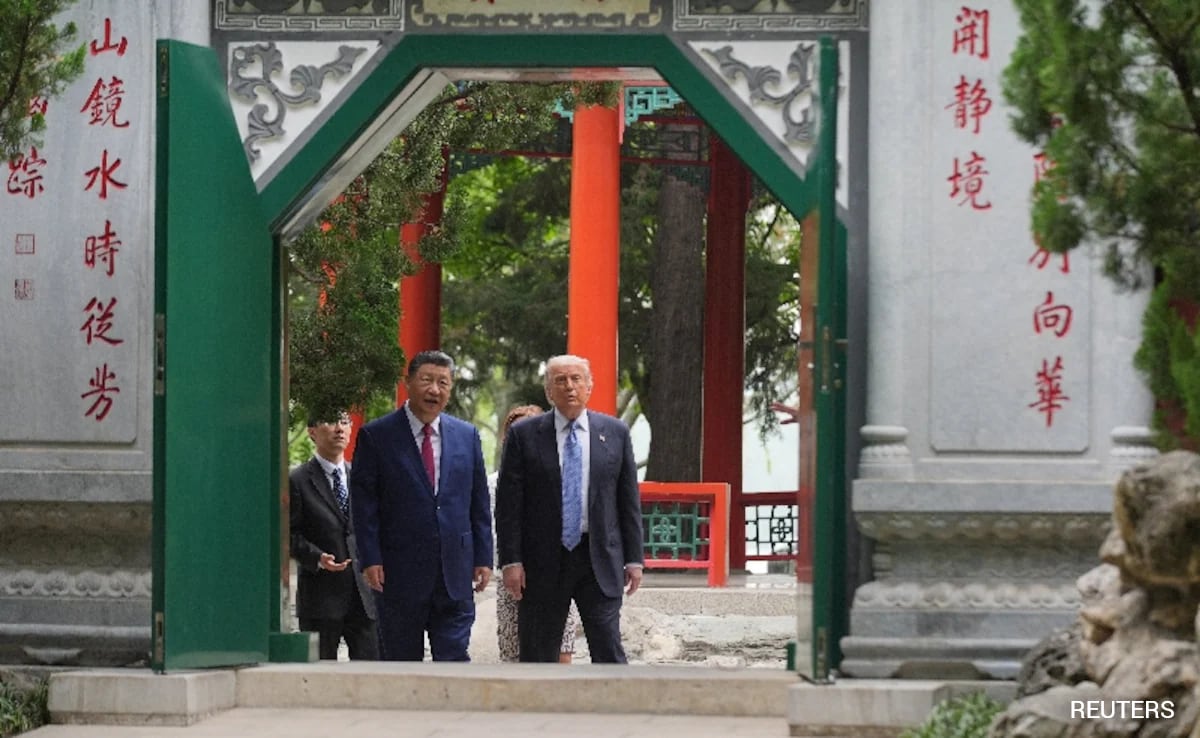
The physical orchestration of state visits serves as a non-verbal signaling mechanism that operates with higher fidelity than official joint statements. When Xi Jinping conducted a tour of the Yingtai Island gardens within Zhongnanhai for Donald Trump, the event functioned not as a social courtesy, but as a calibrated exercise in Relational Signaling Theory. By moving the dialogue from the Great Hall of the People—a venue designed for institutional bureaucracy—to the "secret" heart of the Chinese leadership compound, the Chinese state apparatus executed a transition from Formal Protocol to Privileged Access. This shift aims to reduce the "transactional friction" of international trade and security negotiations by establishing a psychological baseline of mutual exceptionalism.
The Spatial Hierarchy of Zhongnanhai
To understand the strategic value of this encounter, one must first quantify the geography of power within Beijing. Zhongnanhai is not a singular office; it is a nested hierarchy of exclusion.
- The Outer Ring (Institutional): Where ministries interface with the public and lower-tier diplomatic staff.
- The Inner Sanctum (Operational): The offices of the Politburo Standing Committee.
- The Residential/Historical Core (Symbolic): Locations like Yingtai Island, where the Qing Dynasty’s Emperor Guangxu was once imprisoned.
By selecting Yingtai, Xi Jinping utilized a historical anchor. The island symbolizes both the absolute authority of the state and the specific narrative of Chinese "rejuvenation." For a foreign leader, being granted entry here is an invitation to witness the continuity of the Chinese political project, effectively signaling that the current administration views itself as a permanent fixture rather than a temporary electoral cycle. This creates a psychological asymmetry: the visitor is a guest in a thousand-year narrative, whereas the host is the current custodian of that narrative.
The Cost Function of High-Stakes Hospitality
The "Secret Garden" tour represents a high-cost signal. In game theory, a signal is only credible if it is expensive to produce. The Chinese government incurs specific costs by hosting such an intimate event:
- Security Overhead: The logistical burden of securing the residential quarters of the CCP leadership against foreign intelligence capabilities.
- Political Capital: The risk that domestic hardliners might view "excessive" hospitality toward a Western leader as a sign of weakness.
- Protocol Precedent: Once a "special" tour is granted to one leader, it sets a benchmark that other G7 leaders will expect, potentially devaluing the currency of the gesture.
The objective of incurring these costs is to bypass the standard Diplomatic Bottleneck. In traditional summits, every word is filtered through several layers of translators, advisors, and stenographers. A "walk in the garden" reduces the density of observers, allowing for a higher "bandwidth" of personal rapport. This is an attempt to solve the Principal-Agent Problem, where the primary leaders (the Principals) try to establish a direct line of communication that their respective bureaucracies (the Agents) cannot easily interfere with or distort.
Three Pillars of Narrative Control
The tour utilized three specific environmental variables to manipulate the negotiation atmosphere:
I. Historical Parallelism
Xi frequently uses these tours to provide "history lessons." This is a tactical maneuver to frame current trade disputes within the context of the "Century of Humiliation." By explaining the origins of the gardens or the fate of previous emperors, the host establishes a framework where modern concessions by China are not just economic decisions, but potential threats to national sovereignty.
II. The "Sole Peer" Narrative
The exclusion of broader press pools and the presence of only high-level spouses and translators creates an atmosphere of "The Big Two." This reinforces the G2 concept—the idea that the world’s most critical issues are decided exclusively by the U.S. and China. For a leader like Trump, who prioritizes direct deal-making over multilateral institutions, this environment is a curated echo chamber of his own preferred operational style.
III. Aesthetic De-escalation
The "Secret Garden" serves as a visual counterpoint to the industrial and military might often showcased in parades. It projects an image of a "civilizational state" that is stable, contemplative, and unhurried. This is designed to lower the "threat perception" in the mind of the visitor, substituting the image of an aggressive rising power with that of a sophisticated, ancient culture.
Quantifying the Impact on Trade Volatility
Data suggests that personal diplomacy "peaks" like the Zhongnanhai tour correlate with temporary reductions in market volatility. When markets perceive a "special relationship" between heads of state, the Risk Premium associated with sudden policy shifts (like tariffs or sanctions) typically narrows. However, this is a transient effect.
The structural tension between a status-quo power and a rising power—often described as the Thucydides Trap—cannot be solved by garden tours. The mechanism at play here is "Time-Consistency Management." The host uses the tour to buy time, cooling the rhetoric of the visitor to prevent immediate escalation, even if the underlying structural competition remains unchanged.
Limitations of the "Personal Bond" Strategy
While the tour is an elite branding exercise, its efficacy is limited by several structural constraints:
- Institutional Inertia: While two leaders may find common ground in a garden, the legislative bodies and security apparatuses of their respective countries (e.g., the U.S. Congress or the PLA) operate on distinct, often conflicting, incentives.
- The Information Gap: The Chinese side often views these tours as a way to "educate" the American leader on China's "red lines." Conversely, the American side often views them as a sign that the Chinese leader is "ready to make a deal." This misalignment of intent leads to post-summit friction when the perceived promises of the garden fail to manifest in technical trade text.
- Duration Decay: The psychological "high" of a privileged tour has a short half-life. Once the leader returns to their domestic political environment, the pressure of polling, media cycles, and economic data quickly overrides the sentiment of the "Secret Garden."
The Strategic Optimization of Statecraft
For the analyst, the Zhongnanhai tour is a data point in a broader trend of Personalized Authoritarian Diplomacy. As power becomes more centralized in both the East and West, the "theatre" of the summit becomes more important than the "substance" of the communique.
The strategic play for any Western delegation is to accept the "Secret Garden" access as a signal of intent but to discount its value in actual policy modeling. One must distinguish between the Social Signal (we are peers) and the Policy Signal (we are changing our position). Xi’s tour offered the former while meticulously avoiding the latter.
Future engagements of this nature should be analyzed through the lens of Asymmetric Hospitality. The host provides an experience that is impossible to replicate in Washington, D.C. (which lacks a 1,000-year-old walled garden for its President), thereby ensuring they always hold the "home-field advantage" in cultural and historical framing. The intelligence value of these meetings lies not in what is said, but in the specific historical anecdotes the Chinese leader chooses to highlight, as these serve as a roadmap for the specific nationalistic triggers that will govern their future negotiating positions.