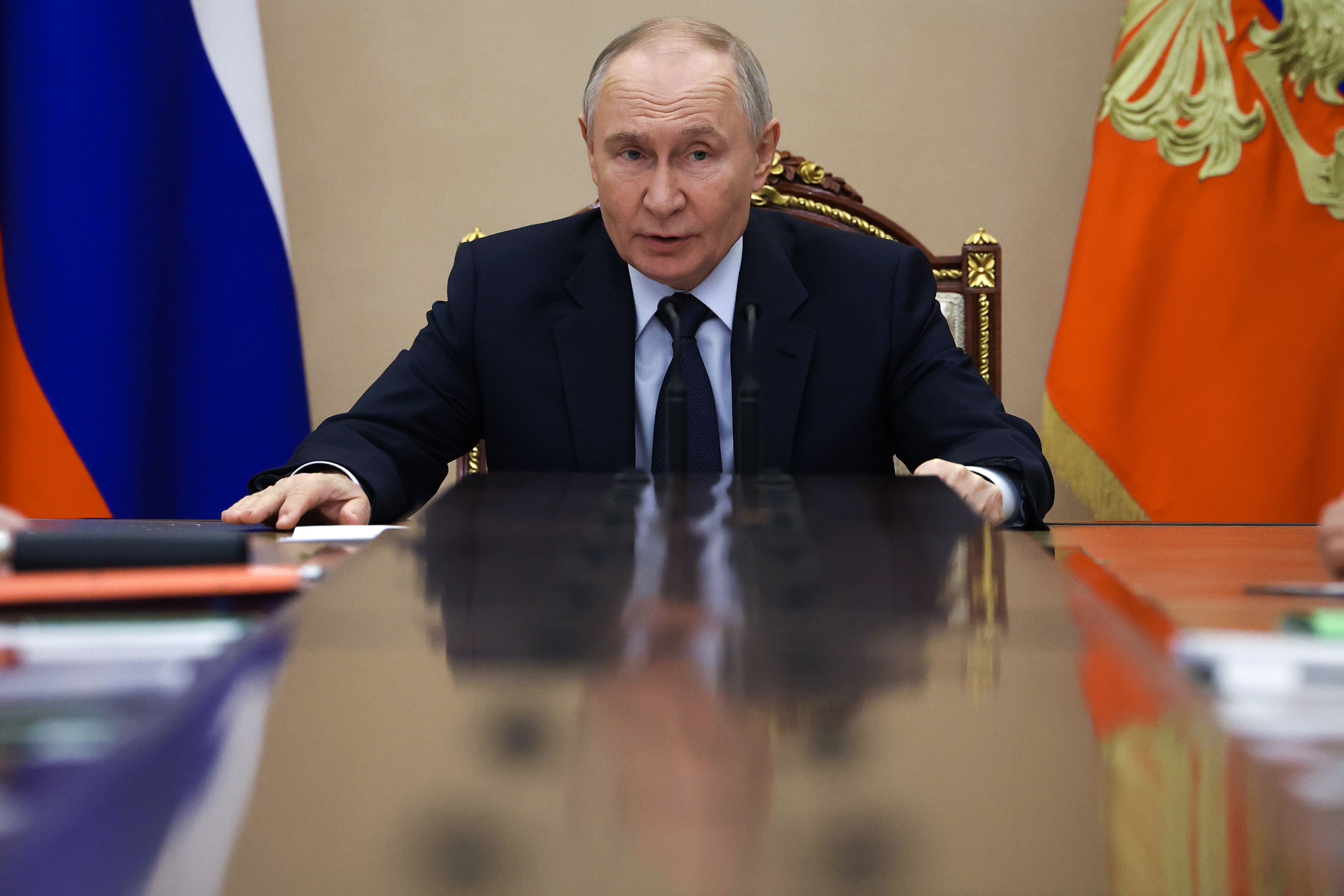
The stability of the Russian executive branch is currently governed by a negative feedback loop between front-line military degradation and the escalating cost of domestic suppression. While conventional media focuses on the optics of dissent, a structural analysis reveals that the primary threat to the incumbent administration is not a popular uprising, but a coordination failure among the "siloviki" (security elites). When military setbacks in Ukraine reduce the resources available for patronage, the probability of a "palace coup" increases as a rational response to diminishing returns on loyalty.
The Triad of Power Preservation
To understand the current tension in the Kremlin, one must first define the three pillars that sustain the existing power structure. These pillars are interdependent; a failure in one necessitates an over-compensation in the others, creating systemic instability.
- The Coercion Monopoly: The internal security apparatus, primarily the Rosgvardia and the FSB, serves as the kinetic barrier against both elite defection and mass mobilization.
- Resource Distribution Control: The ability to funnel rents from extractive industries to loyalists.
- The Myth of Inevitability: The psychological projection of total control that prevents potential challengers from coordinating.
The degradation of the Russian military position in Ukraine has systematically compromised the third pillar. When a regime’s perceived competence is shattered, the cost of maintaining the first two pillars rises exponentially. Security forces require higher "loyalty premiums" (pay raises and legal immunities) to remain committed during periods of uncertainty.
The Siloviki Incentive Structure and the Defection Threshold
A coup is rarely an emotional act; it is a calculated risk based on the Defection Threshold. For a high-ranking member of the security services or the military, the decision to remain loyal or to move against the center is a function of the following variables:
- L(t): The expected value of future rewards for continued loyalty.
- P(s): The perceived probability that a coup attempt will succeed.
- C(f): The cost of failure (usually execution or life imprisonment).
- B(n): The benefits of a new regime where the defector holds a higher or more secure position.
A defection occurs when $P(s) \times B(n) > L(t) + (1 - P(s)) \times C(f)$.
As the war in Ukraine drains the treasury, $L(t)$—the value of staying loyal—diminishes. Simultaneously, as military losses mount and the administration appears increasingly desperate, $P(s)$—the perceived chance of a successful power transition—increases. The administration’s recent "purges" of top-tier military brass under the guise of anti-corruption are not merely punitive; they are preemptive strikes designed to artificially increase $C(f)$ and signal that the cost of even thinking about defection is absolute.
The Tactical Shift to Internal Paranoia
The transition from a "Special Military Operation" to a "long war" footing has forced the Kremlin to reallocate its best-trained units from the front lines to internal security roles. This creates a strategic bottleneck. If the Russian National Guard (Rosgvardia) is equipped with heavy weaponry to prevent a repeat of the Wagner Group’s 2023 mutiny, those resources are unavailable for the Donbas front. Conversely, if the front line is prioritized, the capital remains vulnerable.
This creates the Autocrat's Dilemma: The more a leader fears their inner circle, the more they must decentralize power to prevent any single general from having enough force to stage a coup. However, decentralizing power makes the military less effective at winning the very war that is causing the instability in the first place.
The Role of Parallel Power Structures
The proliferation of Private Military Companies (PMCs) and regional militias (such as the Chechen "Kadyrovites") was originally a strategy to prevent any single military entity from gaining enough leverage to threaten the state. By creating competing centers of force, the regime ensured that the military and the FSB would balance each other out.
However, this "Coupproofing" strategy has a fatal flaw: it creates a high-friction environment where intelligence is hoarded, and operational coordination is impossible. The recent friction between the Ministry of Defense and various irregular units is not a bug in the system; it is a direct consequence of a design intended to prioritize regime survival over military efficiency. The unintended consequence is that these parallel structures now compete for the same shrinking pool of resources, increasing the likelihood of horizontal conflict—fighting between elites—rather than a vertical coup against the top.
Economic Contraction as a Catalyst for Instability
The Russian economy has pivoted to a "war Keynesianism" model. While GDP figures remain bolstered by massive state spending on defense manufacturing, this growth is cannibalistic. It draws labor and capital away from the civilian sectors that provide the rents used to buy elite loyalty.
- Labor Scarcity: The mobilization of 300,000+ men, combined with the flight of an estimated 500,000 to 1,000,000 high-skill workers, has created a structural labor deficit.
- Inflationary Pressure: The printing of rubles to fund military contracts is driving up the cost of living, which necessitates even higher spending on police to suppress potential labor strikes or public unrest.
- Technology Degradation: Without access to Western high-tech components, the "Cost of Maintenance" for Russia’s internal surveillance state is rising. Tracking dissidents and controlling the digital space becomes more difficult as hardware ages and software updates are blocked.
This economic reality creates a "Squeeze Ratio" where the regime must extract more from its remaining loyalists (the oligarchs) while providing them with less protection and lower profits. History suggests that an elite class that is being squeezed to fund a failing war eventually looks for an exit strategy.
The Information Vacuum and Decision-Making Decay
In highly centralized autocracies, the quality of information reaching the top declines as the stakes of delivering "bad news" increase. This is the Dictator’s Information Trap. Because Putin has narrowed his inner circle to a small group of "Yes-Men" (the obsluzhivanie), his perception of both the front-line reality and the level of domestic discontent is likely filtered through a lens of extreme optimism.
This information decay leads to three distinct types of strategic errors:
- Sunk Cost Fallacy: Continuing to pour resources into unattainable military objectives because admitting failure would be politically fatal.
- Over-Repression: Using excessive force against minor domestic threats, which inadvertently radicalizes the moderate population.
- Delayed Reaction to Mutiny: As seen during the Prigozhin march on Moscow, the central command may experience "paralysis of analysis," where the fear of making the wrong move leads to making no move at all until the threat is at the gates.
The Fragmentation of the Russian Core
The fear of a coup is not just about a single person replacing another; it is about the potential fragmentation of the Russian state itself. The Russian Federation is a collection of diverse ethnic and regional entities held together by the gravity of Moscow’s wealth and power.
When the center weakens, peripheral regions begin to calculate their "Independence ROI." If Moscow can no longer provide security or subsidies, the incentive for regional governors to follow federal orders diminishes. We are seeing the early stages of this in the "sovereignty of convenience," where regional leaders prioritize local stability over federal mobilization quotas to avoid local uprisings.
Strategic Forecast: The Siege Mentality and Purge Cycles
The Russian executive will likely enter a phase of "Permanent Purge." To maintain the Myth of Inevitability, the administration must constantly identify and neutralize "internal enemies." This creates a climate of universal suspicion that temporarily prevents coordination among plotters but permanently hollows out the state’s administrative capacity.
The strategic play for the West and its allies is not to actively sponsor a coup—which often leads to unpredictable and more radical successors—but to increase the Cost of Loyalty for the Russian elite. This is achieved by:
- Targeted Sanctions on the Mid-Level Technocracy: Targeting the people who actually run the systems, making their personal cost of supporting the regime higher than the cost of quiet sabotage.
- Information Operations targeting the Siloviki: Highlighting the disparity between the lifestyle of the top leadership and the attrition rates of the officer corps.
- Maintaining Military Pressure: Ensuring that the $P(s)$ (probability of success for a coup) remains high by demonstrating that the current path leads only to continued military degradation.
The stability of the Kremlin is no longer a matter of public opinion; it is a matter of elite accounting. When the cost of maintaining the status quo exceeds the projected cost of a messy transition, the internal security cascade will begin. The administration's current behavior—the arrests, the rhetoric, and the isolation—indicates they have already performed this math and realize they are in the red.