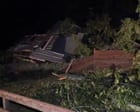
The destruction of hundreds of homes in Mississippi following recent tornadic activity is not a random distribution of misfortune but a predictable failure of the intersection between meteorological intensity and regional structural vulnerabilities. While standard reporting focuses on the visual aftermath, a rigorous analysis must deconstruct the event through three critical vectors: Kinetic Energy Loading, Structural Integrity Thresholds, and the Socio-Economic Recovery Lag.
The Kinetic Loading Function
Tornadoes operate as localized high-pressure gradients where the damage potential is a function of wind velocity squared. When an EF2 or EF3 tornado enters a residential area, the force exerted on a structure is not merely a horizontal push. It is a complex interaction of aerodynamic lift and internal pressurization.
- Velocity Pressure ($q$): This is calculated as $q = 0.00256 \cdot V^2$, where $V$ is wind speed. As wind speed doubles, the pressure on a home’s walls and roof increases fourfold.
- The Bernoulli Effect: Rapid airflow over a gabled roof creates a low-pressure zone above the shingles. If the building envelope is breached—usually via a failed garage door or shattered window—the internal pressure rises sharply.
- The Resultant Vector: The combination of external suction and internal pushing creates a net upward force that exceeds the dead weight of the roof and the capacity of its fasteners.
Mississippi's specific geographical profile facilitates these high-intensity events through the "Dixie Alley" corridor. Unlike the Great Plains, where visibility is high and storms are often discrete cells, Mississippi’s events frequently involve "High Shear, Low CAPE" (Convective Available Potential Energy) environments. This creates fast-moving, rain-wrapped vortices that reduce the Warning-to-Impact Lead Time, a critical metric in minimizing human casualty if not property damage.
Structural Failure Archetypes
The "hundreds of homes damaged" metric hides a significant variance in failure modes. Data suggests that residential destruction in Mississippi follows a hierarchy of structural weak points.
The Fenestration Breach
The most common point of failure is the garage door. Standard residential garage doors act as large sails. Once they buckle under wind pressure, the home's "sealed" status is lost. The sudden influx of air creates a "ballooning" effect, often blowing the roof off from the inside out. In these cases, the walls remain standing, but the lateral stability of the house is compromised beyond repair.
The Roof-to-Wall Connection Gap
A significant portion of the Mississippi housing stock consists of older builds or manufactured homes that lack hurricane clips or seismic ties. In these structures, the roof is held to the walls primarily by gravity and a few toe-nails. When the aerodynamic lift exceeds the weight of the roof (roughly 10-15 pounds per square foot), the roof departs, leaving the walls without lateral bracing. This leads to immediate "pancaking" or wall collapse.
Foundation Anchoring Deficiencies
In manufactured housing—which accounts for a disproportionately high percentage of the residential units in the affected Mississippi counties—the primary failure is often the anchoring system. If the ground is saturated from the heavy rainfall preceding the tornado, the "auger" style anchors lose their grip in the soil. The entire unit can then be displaced, leading to total structural disintegration upon secondary impact.
The Economic Friction of "Damaged" vs "Destroyed"
The headline figure of "hundreds of homes" fails to distinguish between structural total losses and functional impairment. From a strategy and recovery perspective, the distinction is vital for calculating the Insurance Displacement Duration.
- Category A: Total Loss. The foundation is shifted or the roof-to-wall connection is severed. Reconstruction requires a 100% capital outlay and 12-18 months of lead time.
- Category B: Functional Impairment. The structure is intact, but the envelope is breached (windows, shingles, siding). While "less" damaged, these homes face the Repair Bottleneck.
The bottleneck occurs because the localized surge in demand for roofing and contracting services exceeds the regional labor supply by a factor of 10 or more. This creates "Demand Surge" pricing, where the cost of materials and labor increases by 20% to 40% in the months following the event. For many Mississippi residents, particularly those in lower-income brackets or under-insured, this price hike effectively moves a Category B home into a permanent Category A loss because the cost of repair exceeds the depreciated value of the asset.
Infrastructure Interdependency and the Recovery Lag
A tornado does not just hit homes; it severs the "Utility Web" that makes homes habitable. The Mississippi reports indicate widespread power outages, which are the primary driver of the Recovery Lag Constant.
The failure of the electrical grid in rural Mississippi is a result of "Radial Distribution" vulnerability. Unlike urban "Mesh" grids where power can be rerouted, rural lines often have a single point of failure. If one mile of high-voltage transmission line is downed, thousands of downstream customers lose power.
This creates a secondary crisis: Water System Failure. Many rural homes depend on well pumps. No electricity means no water, which means even homes with zero structural damage become uninhabitable within 48 hours. This forces a mass migration to shelters, straining municipal resources and slowing the return of the workforce needed to begin the cleanup process.
Strategic Adaptation Requirements
To mitigate the impact of future events in the Dixie Alley corridor, the focus must shift from reactive "disaster relief" to proactive "Structural Hardening Policy."
Implementation of Mandatory High-Wind Building Codes
State-level mandates for hurricane clips (costing less than $500 for a new home) would reduce roof-loss incidents by an estimated 60% in EF2-strength winds. The resistance to this is primarily an upfront capital cost concern, but the ROI is found in the reduction of "Post-Event Displacement Costs."
Decentralized Power Grids
The integration of residential solar with battery backup (Microgrids) would break the dependency on the radial distribution system. If 20% of a neighborhood's homes were energy-independent, these structures could serve as "Stability Hubs" for neighbors during the weeks-long grid restoration process.
The Hardened Envelope Standard
The most effective tactical intervention for Mississippi homeowners is the installation of "Impact-Rated" garage doors. By maintaining the integrity of the building envelope, the probability of a total structural collapse is reduced significantly, shifting the damage profile from "Total Loss" to "Repairable Impairment."
The survival of Mississippi's residential infrastructure depends on acknowledging that "tornado-proof" is an impossible standard, but "envelope-intact" is an achievable engineering goal. The state must transition from a culture of rebuilding the same vulnerabilities to one of engineered resilience, prioritizing the mechanical connections that keep a roof attached to its walls.