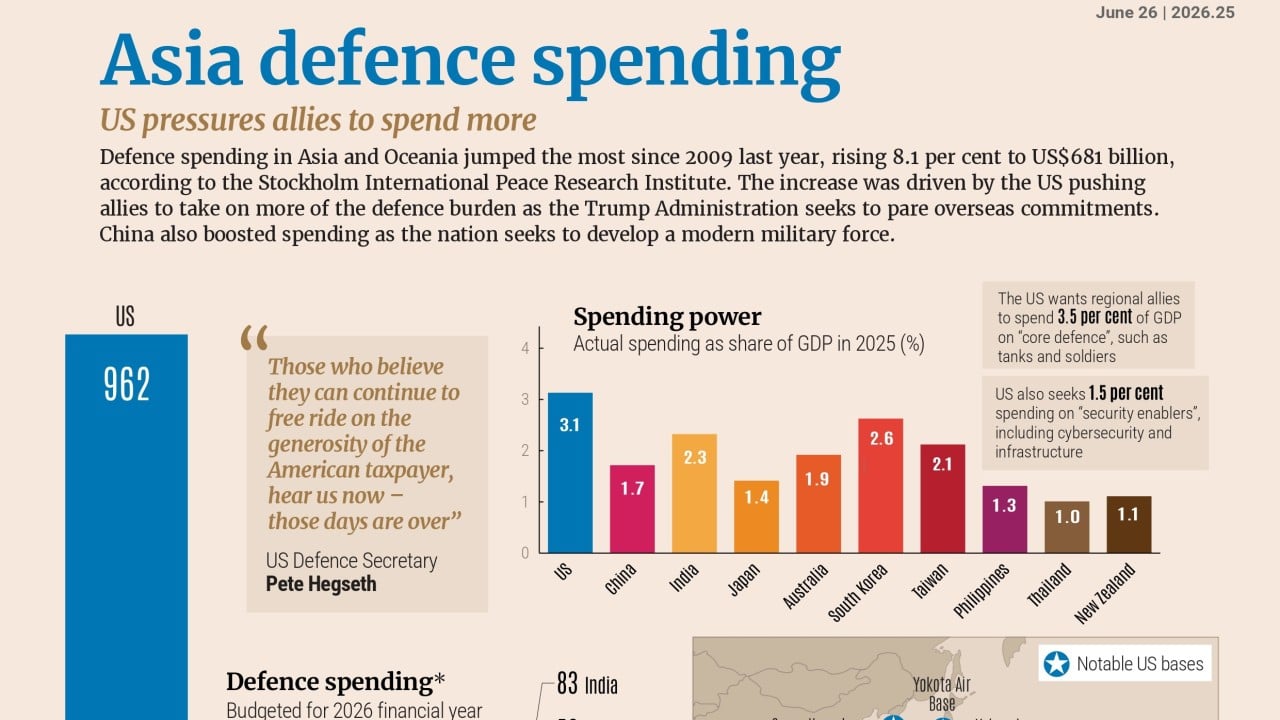
Evaluating military readiness through aggregate capital allocation creates a structural distortion in security analysis. Standard macroeconomic evaluations frequently rely on absolute USD-equivalent outlays or basic defence-to-GDP percentages. These metrics fail to capture true operational output, local purchasing power differences, or the technical division between personnel maintenance and asset modernization. In Asia, where aggregate military spending reached 681 billion USD in 2025, superficial budget tracking obscures the strategic realities of regional threat vectors and industrial capacity. Understanding the balance of power requires a transition from nominal spend tracking to structural input-output analysis.
The baseline metric of absolute spending understates the structural advantage of domestic procurement ecosystems. A clear example is the divergence between nominal exchange rate tracking and Defence Sector Purchasing Power Parity (PPP). When a state builds hulls, missiles, and radar networks using localized supply chains and domestic engineering labor, a dollar of defence budget yields significantly more capability than it would in a high-cost import economy.
The Structural Mechanics of Capital Allocation
Military budgets split into three primary competing operational demands:
- Personnel and Lifecycle Costs: Salaries, pensions, housing, and immediate healthcare costs for active and reserve forces.
- Operations and Sustainment (O&M): Fuel, maintenance cycles, ammunition stockpiles, and active deployment or training exercises.
- Procurement and Research & Development (R&D): The acquisition of new hardware platforms, systemic software integrations, and long-term scientific development.
High-income economies with volunteer forces often face structural budgetary locking, where personnel costs absorb over 40% of total outlays. This creates an allocation bottleneck. Conversely, structural models show that states maintaining low personnel costs can direct a higher proportion of capital toward procurement and R&D, accelerating modernization cycles even during periods of flat top-line growth.
The Regional Asymmetry Framework
The distribution of regional defense expenditure is highly concentrated, with China representing over 40% of Asia’s aggregate outlays, reaching an estimated 336 billion USD in 2025. This creates a regional security dilemma that forces distinct responses from adjacent actors. These responses follow two structural pathways:
[Threat Perception: Regional Hegemony]
         │
         ├───► External Balancing (Alliances + Interoperability)
         │     └─► Example: Japan (62.2bn USD), Australia (AUKUS Integration)
         │
         └───► Internal Balancing (Domestic Production + Niche Asymmetry)
               └─► Example: Taiwan (14% increase in 2025 to 18.2bn USD)
The first pathway relies on external balancing through alliance networks, focusing expenditures on interoperability and long-range counterstrike capabilities. Japan’s ongoing five-year defense buildup, which brought its 2025 expenditure to 62.2 billion USD (1.4% of GDP), focuses directly on acquiring long-range cruise missiles and hardening maritime defense networks to match allied operational frameworks.
The second pathway focuses on asymmetrical internal balancing. Taiwan's allocation strategy emphasizes localized anti-access/area-denial (A2/AD) capabilities rather than trying to match the adversary hull-for-hull. This strategy maximizes the cost-imposition ratio, ensuring that every dollar spent on defensive infrastructure requires an adversary to spend multiples of that amount to overcome it.
Supply Chain Constraints and the Procurement Bottleneck
Top-line budget increases do not translate immediately into expanded tactical options. The delay between capital authorization and industrial delivery introduces a significant lag phase. This bottleneck is governed by three primary variables:
- Rare Earth and Material Inputs: Advanced radar systems, missile guidance chips, and aerospace alloys depend on specialized supply chains often controlled by strategic competitors.
- Sovereign Shipyard and Aerospace Throughput: Capital availability cannot instantly build drydocks or train specialized welders and systems engineers.
- Fiscal Sustainability Under Inflation: Rising material and labor costs mean that a 5% nominal budget increase can result in a net contraction of actual platform procurement.
Southeast Asian procurement cycles illustrate these constraints clearly. Indonesia experienced a 27% real-terms spending spike in 2025 driven entirely by delayed procurement payment milestones, which compressed its 2026 fiscal flexibility and led to a projected 27% contraction to rebalance baseline operations. The Philippines face similar challenges, navigating its 'Re-Horizon 3' modernization plan by prioritizing maritime domain awareness over costly power-projection platforms.
The primary vulnerability for middle powers in this environment is the risk of project suspension. When economic headwinds slow regional growth, capital is consistently diverted back to personnel and immediate O&M, leaving long-term technological acquisitions unfinished.
The Technology Integration Multiplier
Evaluating modern defense spending requires accounting for the shift from physical platform scale to software-defined operational capabilities. Traditional metrics prioritize legacy counting indexes: hull numbers, fighter squadrons, and tank battalions. Modern capabilities depend heavily on systemic linkages:
- Sensor-to-Shooter Latency: The speed at which target data is passed from unmanned reconnaissance platforms to kinetic strike systems.
- Autonomous System Density: The integration of low-cost, uncrewed maritime and aerial vehicles to distribute sensor networks and reduce personnel risk.
- Electronic Warfare and Counter-C4ISR: Budgetary lines dedicated to degrading an adversary's communication, navigation, and space-based tracking infrastructure.
A state spending 20 billion USD with advanced command-and-control software integration can achieve greater regional denial capability than a state spending 40 billion USD on legacy platforms without secure digital networks. Singapore’s 2026 defense budget projection of 24.93 billion local dollars (approximately 19.5 billion USD) highlights this approach. By focusing its industrial strategy on high-technology defense ecosystems, automation, and advanced data processing, it maintains high operational deterrence despite severe geographic and demographic limitations.
Resource Allocation Strategy
To counter regional imbalances without triggering fiscal exhaustion, defense planners must shift away from tracking raw budget metrics and focus on optimizing the marginal yield of every unit of capital spent.
Prioritize modular, software-upgradable architectures over monolithic hardware platforms. Acquiring complex, proprietary platforms locks an organization into multi-decade maintenance contracts that drain operations and sustainment accounts. Instead, capital allocations should target open-architecture hulls and airframes that allow for rapid, localized integration of sensors, autonomous sub-systems, and electronic warfare suites. This approach creates a flexible cost structure, allowing forces to rapidly adapt to technological shifts without requiring wholesale platform replacement.
Invest heavily in domestic ammunition manufacturing and deep stockpiling rather than expanding frontline platform numbers. A high volume of modern aircraft or naval vessels is ineffective without a resilient supply of precision-guided munitions. Shifting the spending balance toward high-rate production of anti-ship missiles, air-defense interceptors, and loitering munitions offers a superior return on investment for deterrence compared to maintaining under-equipped legacy fleets.