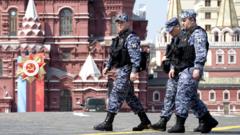
Russia just showed the world exactly how the war in Ukraine is going. It wasn't through a grand manifesto or a televised address from the Kremlin. It was through the conspicuous absence of heavy weaponry on Red Square. If you're looking for a barometer of military health, look at what wasn't there. For the second year running, the traditional display of armored might looked more like a vintage car rally than a superpower's flex.
Russia’s Victory Day used to be the moment the West held its breath. We’d see rows of T-14 Armata tanks and high-tech mobile artillery. Now? We get a lone, T-34 tank from World War II. It’s a museum piece. Seeing a single 80-year-old tank lead a procession in 2024 tells you everything about the current state of the Russian military machine. It’s not just about optics. It’s about a desperate shortage of hardware that's being chewed up on the front lines of the Donbas and Kharkiv.
Why the Missing Tanks Matter
Military parades are psychological operations. They're designed to project invincibility to a domestic audience and sow doubt in foreign capitals. When Vladimir Putin stands on that podium and the only tank he can spare is a relic, the mask slips. This isn't a choice made for humility. It’s a necessity born from staggering equipment losses.
Estimates from monitors like Oryx, which uses open-source intelligence to track visual confirmations of destroyed vehicles, suggest Russia has lost over 3,000 tanks since February 2022. That’s a catastrophic number. To put it in perspective, that’s more tanks than many NATO countries have in their entire active inventories. When your frontline units are screaming for reinforcements, you don't keep a battalion of modern T-90s in Moscow to drive over cobblestones for the cameras. You send them to the mud of Ukraine.
The absence of aviation is another glaring hole. Flypasts are usually the crescendo of these events. In recent years, they've been cancelled at the last minute, often blamed on "weather" even when the sky looks clear. The reality is likely more grim. Maintaining flight hours for a parade takes away from combat sorties. It also exposes high-value assets to potential drone strikes, which have become a terrifyingly common occurrence deep inside Russian territory.
Security Paranoia is the New Normal
It’s not just the missing gear. It’s the missing people and the cancelled events across the rest of the country. Victory Day was once a nationwide celebration. The "Immortal Regiment" marches, where citizens carry photos of ancestors who fought in the Great Patriotic War, were a staple of Russian civic life. Those are mostly gone now.
The Kremlin says it’s for security. They aren't lying, but the admission is a self-inflicted wound. By acknowledging that they can’t guarantee the safety of people in cities like Belgorod or even Moscow, they admit the war has come home. Ukraine’s long-range drone program has turned the interior of Russia into a front line. A massive gathering is just a target.
But there’s a darker reason for cancelling the marches. If thousands of people show up with photos of "ancestors," the government risks people slipping in photos of sons, husbands, and brothers killed in Ukraine. A sea of fresh faces among the black-and-white photos of 1945 would break the state narrative. It would turn a celebration of historic triumph into a protest against a modern tragedy.
The Narrative of Permanent War
Putin’s speech this year didn't focus on a quick end to the "Special Military Operation." Instead, he leaned into the idea of a long-term struggle against a "global West" that wants to destroy Russia. This is a classic pivot. When you can’t deliver a quick victory, you redefine the war as an existential fight for survival.
He’s trying to link the struggle against Nazi Germany directly to the current fight in Ukraine. It’s a powerful emotional hook for the Russian public, but it’s becoming harder to sell when the material reality doesn't match the rhetoric. The Soviet Union won because of its massive industrial output and the sheer scale of its Red Army. Today, Russia is relying on North Korean shells and Iranian drones. That’s a far cry from the self-sufficient superpower image the Kremlin tries to project.
The rhetoric is getting more aggressive as the parade gets smaller. We heard more mentions of nuclear readiness and "strategic forces." It’s the ultimate fallback. If you can’t impress them with your tanks, remind them you have the Button. It’s a sign of weakness, not strength. A confident military doesn't need to rattle the nuclear saber every time a parade looks a bit thin.
Economic Reality Bites Back
War is expensive. Beyond the loss of life, the financial drain is starting to warp the Russian economy. You can’t see inflation on Red Square, but you can feel it in the shops. Transitioning to a "war economy" means the government is pouring money into defense plants while the rest of the country’s infrastructure rots.
Russia is producing tanks, sure. But they’re mostly refurbished older models—T-62s and T-54s pulled from long-term storage. These are rolling coffins against modern anti-tank weapons like the Javelin or the NLAW. The fact that these aren't featured in the parade shows that even the Kremlin knows they aren't "victory" material. They’re desperation material.
The Strategy for the Coming Months
If you're watching these developments, don't mistake a thin parade for an imminent collapse. Russia is dug in. They’ve built massive defensive lines. They’ve shown a willingness to trade lives for tiny slivers of territory. The empty Red Square tells us they're hurting, but it also tells us they're prioritizing the fight over the show.
What should you watch for next? Keep an eye on the Caspian and Black Sea regions for more drone activity. Watch the Russian rail networks. As the military depletes its modern stocks, logistical bottlenecks become the biggest vulnerability. If they can’t move the old gear they have left, the frontline will crumble regardless of how many speeches Putin gives.
The world saw a diminished Russia on display. It was a silent admission that the plan failed. Now, we’re in a war of attrition where the side that can outproduce and outlast the other wins. Russia is betting that its tolerance for pain is higher than the West’s patience. The lone T-34 is a symbol of that bet: we will use every last scrap we have to stay in this fight.
Keep your eyes on open-source intelligence feeds like the UK Ministry of Defence daily updates and the Institute for the Study of War. They provide the context that the state-run media in Moscow tries to hide. The reality of the conflict isn't found in the polished boots of the soldiers on Red Square, but in the satellite imagery of the graveyards and the burnt-out hulls of vehicles in the Donbas. Pay attention to the supply chains. That’s where this war is actually being fought.


