Democrats enter the 2028 United States Senate cycle holding a 56-to-44 majority following a nine-seat net gain in the 2026 midterms, leaving Republicans with a six-to-seven-seat deficit across a 35-seat Class III map that represents the most structurally hostile terrain for the GOP since 1966. Standard political commentary treats this cycle as a conventional pendulum swing where national campaign committees simply allocate resources to battleground states. That framing misses the underlying structural mechanics. Because the 2028 electorate will vote concurrently with a presidential race—eliminating the low-turnout, high-propensity midterm anomalies that enabled split-ticket outcomes in 2026—the chamber's mathematical floor is governed by presidential partisanship, incumbency asymmetries, and primary-induced resource depletion.
The Baseline Arithmetic of Chamber Control
To understand the 2028 battlefield, analysts must separate the chamber's static baseline from the contested pool. Thirty-five of the 100 Senate seats are on the November 7, 2028 ballot: all 34 regular Class III seats plus a special election in Tennessee. Of the 65 seats not up for election, Democrats hold 40 (including two independents who caucus with them) and Republicans hold 25.
This creates an immediate asymmetric threshold for control:
- The Democratic Retention Threshold: Democrats need to win just 11 of the 35 contested seats to retain a 51-seat outright majority, or 10 seats if they win the 2028 presidential election and secure the vice president's tie-breaking vote.
- The Republican Reclamation Threshold: Republicans must hold every single one of their 19 contested seats—18 Class III seats plus the Tennessee special election—and flip at least six Democratic-held seats to reach 50, or seven to reach 51 without the White House.
The structural impossibility of the GOP's position becomes visible when mapping the 16 Democratic-held seats up in 2028 against baseline presidential partisanship. Eleven of those 16 seats reside in states won by Kamala Harris in 2024 or carrying double-digit Democratic Cook Partisan Voting Index (PVI) leans: California, Colorado, Connecticut, Hawaii, Illinois, Maryland, New Hampshire, New York, Oregon, Vermont, and Washington. Even if Republicans swept every contested seat in states Donald Trump won in 2024, they would still fall short of a majority unless they breached states that have not elected a Republican senator in over a decade.
The Three-Tier Vulnerability Matrix
Conventional horse-race journalism groups competitive races into an undifferentiated "battleground" bucket. A rigorous operational breakdown requires segmenting the 35 contested seats by their underlying causal drivers: partisan elasticity, presidential-year turnout reversion, and incumbent exposure.
Tier 1: Presidential Turnout Reversion (The Democratic Exposure Zone)
Five Democratic incumbents represent states that Donald Trump carried in 2024: Arizona (Mark Kelly), Georgia (Raphael Warnock), Nevada (Catherine Cortez Masto), Ohio (Sherrod Brown), and Pennsylvania (John Fetterman). In 2026, Democrats captured Ohio's special election and expanded downballot legislative control in Pennsylvania and Arizona largely because off-year electorates skewed older, higher-income, and more college-educated—demographics that now favor the Democratic coalition.
Presidential years invert that turnout model. High-turnout presidential electorates reintroduce millions of lower-propensity, non-college-educated voters into the electorate, tightening margins in the Rust Belt and Sun Belt.
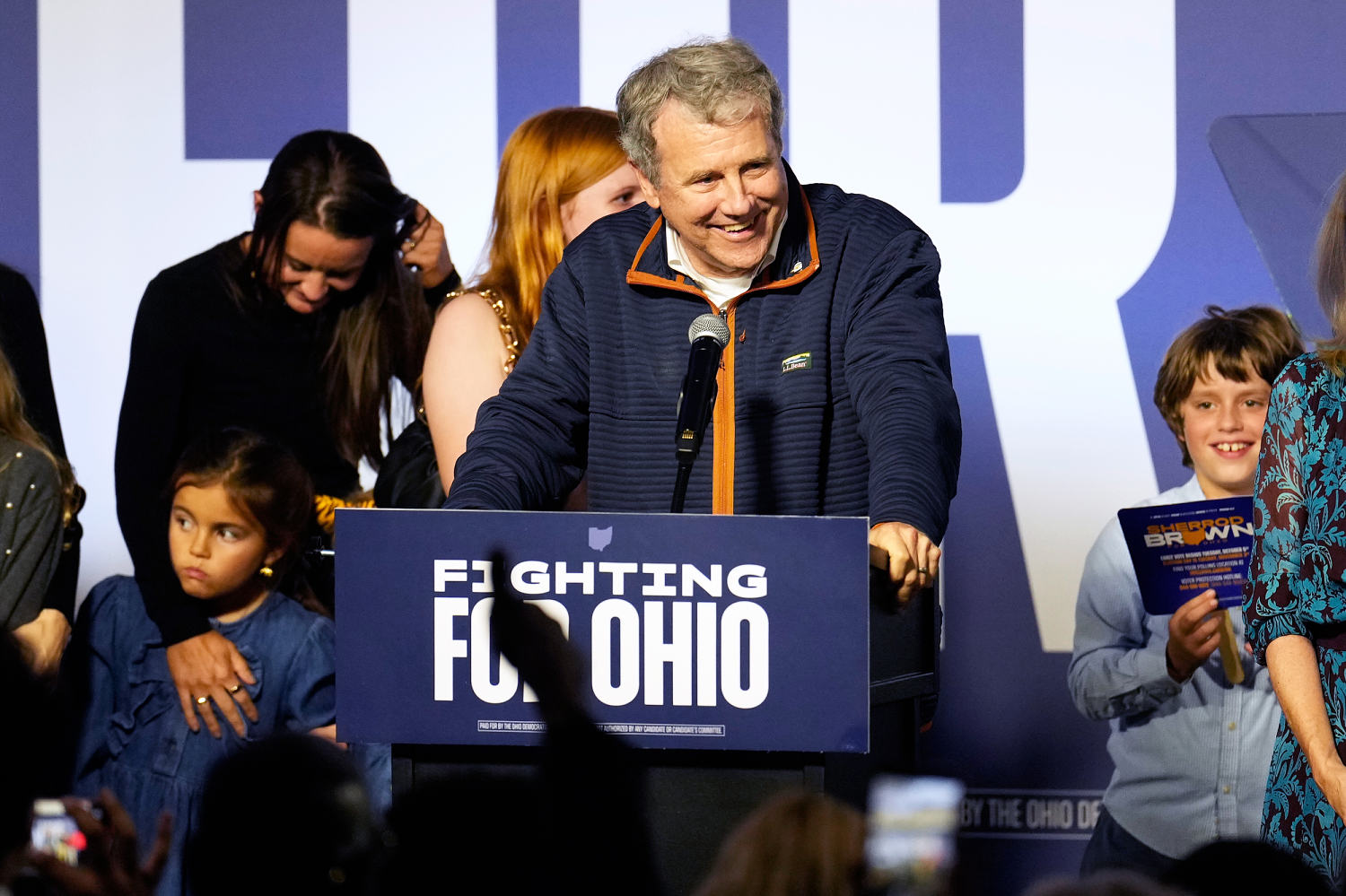
- Ohio (Sherrod Brown): Brown defeated appointed incumbent Jon Husted in the November 2026 special election to fill the remainder of Vice President JD Vance's term. Running again in 2028 for a full six-year term forces Brown to defend a state with a heavy structural Republican lean during a presidential cycle. While Vice President Vance and outgoing Governor Mike DeWine have declined to run, the GOP bench includes figures like Vivek Ramaswamy and Attorney General Andy Wilson. Brown's survival depends entirely on maintaining candidate-specific ticket-splitting in a hyper-polarized presidential environment.
- Georgia (Raphael Warnock) and Arizona (Mark Kelly): Both incumbents have won multiple statewide cycles in closely divided states, giving them entrenched fundraising networks and high name recognition. Their primary vulnerability is not candidate quality, but top-of-the-ticket drag if the Democratic presidential nominee underperforms among Sun Belt swing voters.
- Nevada (Catherine Cortez Masto): Cortez Masto survived 2022 by less than one percentage point (0.8%). Nevada's transient service-economy electorate makes it uniquely sensitive to macroeconomic conditions and presidential turnout surges.
- Pennsylvania (John Fetterman): Fetterman faces a dual-front vulnerability. His ideological break with progressive orthodoxy has boosted his approval among Pennsylvania Republicans while fracturing his Democratic base, inviting primary challenges from figures like Ahmed Moor and potential bids from U.S. Representatives Madeleine Dean and Chris Deluzio.
Tier 2: Defensive Attrition in Elastic States (The GOP Exposure Zone)
While media narratives focus on Democratic defense, Republicans must simultaneously protect three Class III seats in states with narrow partisan margins or volatile electoral histories: Wisconsin (Ron Johnson), North Carolina (Ted Budd), and Alaska (Lisa Murkowski).
- Wisconsin (Ron Johnson): Johnson won re-election in 2022 by exactly one percentage point. In 2026, Democrats flipped both chambers of the Wisconsin state legislature, demonstrating organizational strength across the state's suburban collar counties and rural driftless areas. If Johnson retires or runs for a fourth term at age 73, Wisconsin becomes an immediate toss-up.
- North Carolina (Ted Budd): Budd won his open-seat race in 2022 by 3.2 points, but the state's political environment shifted sharply in 2026 when Democrats flipped a U.S. Senate seat and broke the GOP's legislative supermajority. North Carolina's rapid suburban growth around Raleigh and Charlotte continues to erode the Republican rural firewall.
- Alaska (Lisa Murkowski): Alaska's ranked-choice voting system insulates Murkowski from traditional partisan primaries, yet the 2026 election proved that Democrats can win statewide when fielding top-tier candidates, as demonstrated by Mary Peltola's Senate victory over Dan Sullivan.
Tier 3: Asymmetrical Safe Floors and Open-Seat Risks
The remaining 27 seats sit in states where the partisan lean exceeds 10 points, creating a structural floor that insulates incumbents from national wave dynamics. However, two secondary risks persist within this tier:
- Florida's Special Election Follow-Up: Ashley Moody won the 2026 special election by a relatively narrow 2.9-point margin to finish Marco Rubio's term. While Florida's voter registration advantage favors Republicans, a sub-three-point margin in a wave year signals that Moody must run a full-scale campaign in 2028 rather than treating the seat as safe.
- Gerontocratic Retirement Waves: Several long-tenured incumbents—including Chuck Grassley in Iowa (first elected in 1980), Ron Wyden in Oregon (1996), Mike Crapo in Idaho (1999), and Chuck Schumer in New York (1999)—will face retirement decisions. While open seats in Oregon, Idaho, and New York will remain within their respective party columns, an open seat in Iowa—where Democrats flipped a Senate seat in 2026—would immediately expand the battleground map.
The Cause-and-Effect Mechanics Missed by Standard Coverage
Surface-level map analysis treats each state race as an independent event. In reality, national campaign committees operate under strict capital and bandwidth constraints, creating three interconnected feedback loops that dictate outcomes long before November 2028.
The Primary-to-General Resource Drain
When an incumbent faces a credible ideological primary challenge, campaign capital is diverted from general election voter persuasion to primary turnout defense. In Pennsylvania, an intraparty battle between John Fetterman and a progressive challenger forces both sides to spend millions of dollars attacking each other on ideological purity. Even if Fetterman survives the primary, he enters the general election with depleted cash reserves and alienated progressive volunteers—lowering Democratic turnout in Philadelphia and Allegheny County during a presidential year where every margin point determines both the Senate seat and Pennsylvania's electoral votes.
Conversely, Republicans face an identical structural trap in states like Ohio and North Carolina. Crowded GOP primaries incentivize candidates to adopt hardline positions tailored to primary voters, locking the eventual nominee into rhetoric that alienates moderate suburban voters in Cuyahoga, Franklin, Wake, and Mecklenburg counties.
The Downballot Bench Depletion Effect
A critical, underreported consequence of the 2026 midterms is the destruction of the Republican candidate pipeline. In 2026, Democrats captured 30 previously Republican-held statewide downballot offices—including attorneys general, treasurers, and secretaries of state—and flipped 12 state legislative chambers.
Statewide downballot offices and legislative leadership posts serve as the primary farm system for U.S. Senate recruits. When a party loses its statewide bench, national strategists are forced to rely on two suboptimal recruitment archetypes:
- Self-Funding Political Outsiders: Candidates who possess personal wealth but lack vetted campaign infrastructure, legislative records, or established voter coalitions.
- Recycled Losers: Candidates who previously lost statewide races and carry high negative name recognition.
Democrats enter 2028 with a newly expanded bench of sitting governors, attorneys general, and House members across swing states, whereas the National Republican Senatorial Committee (NRSC), led by Ohio Senator Bernie Moreno, must recruit challengers in states where the party's state-level apparatus was hollowed out in 2026.
The Ticket-Splitting Ceiling in Presidential Cycles
A common analytical error is extrapolating 2026 split-ticket results onto the 2028 map. In 2026, Democrats won Senate races in 10 states that Donald Trump carried in 2024, including deep-red states like Mississippi, Kansas, and South Carolina. Those victories occurred in a midterm environment without a presidential candidate at the top of the ballot, allowing local Democratic candidates to localize races around incumbent unpopularity and state-specific issues.
In 2028, the presidential race nationalizes every downballot contest. Straight-ticket voting increases sharply when voters cast ballots for president, compressing the margin by which a Senate candidate can outrun the top of their party's ticket. For Sherrod Brown in Ohio or a Democratic challenger in Iowa, winning in 2028 requires persuading hundreds of thousands of voters to split their tickets on the exact same ballot—a behavioral pattern that has declined steadily over the last four presidential cycles.
Operational Limitations of Early Map Forecasting
Treating a 24-month electoral projection as deterministic introduces severe analytical blind spots. Campaign strategists and political risk analysts must account for three structural limitations that can invalidate early baselines:
- Macroeconomic Shock Sensitivity: Senate maps reflect the political environment of the preceding cycle, not the economic reality of Election Day. A recession, inflation spike, or geopolitical crisis in 2027 or early 2028 will disproportionately punish the party holding the White House, regardless of map asymmetry.
- Candidate Recruitment Variance: Structural models assume generic candidate quality. A single recruiting failure—such as an incumbent retiring abruptly after the filing deadline or a scandal disqualifying a frontrunner—can flip a lean seat into a safe loss overnight.
- Presidential Coattail Nonlinearity: Because 2028 features an open presidential race with no incumbent president on the ballot, the ideological positioning and regional appeal of the two presidential nominees remain unknown variables. A Democratic nominee who underperforms in the Rust Belt could drag down incumbents in Pennsylvania, Wisconsin, and Ohio simultaneously, overriding their individual incumbency advantages.
Strategic Allocation Blueprint for 2027–2028
Because neither party can alter the geographic distribution of Class III seats, campaign leadership must execute a disciplined capital allocation strategy immediately:
- For the Democratic Senatorial Campaign Committee (DSCC): Enforce a strict defensive triage focused exclusively on the five Trump-state incumbents (Brown, Warnock, Kelly, Cortez Masto, and Fetterman). Do not divert early institutional capital toward long-shot offensive targets like Texas or South Carolina—which are not on the 2028 ballot—or low-probability Class III states like Indiana and Missouri. Intervene early in Pennsylvania to neutralize primary challenges against Fetterman so general election funds remain intact.
- For the National Republican Senatorial Committee (NRSC): Abandon broad-map expansion and concentrate 80% of early recruitment and independent expenditure commitments on a narrow, six-seat offensive corridor: Ohio, Pennsylvania, Nevada, Georgia, Arizona, and New Hampshire, while fortifying defensive walls in Wisconsin and North Carolina. Without sweeping at least four of those five Trump-won Democratic seats while holding every current GOP seat, Republican Senate control in 2029 remains mathematically unattainable.