Basketball games are fundamentally battles of possessions and structural efficiency. While standard post-game narratives rely on vague descriptors like "sloppy execution" or "mental fatigue" to explain the Atlanta Dream's 111-92 victory over the Toronto Tempo, an objective structural audit reveals a far more precise breakdown. This contest serves as a case study in how specific operational failure points—specifically, the compounding tax of live-ball turnovers and structural breakdown under defensive pressure—guarantee mathematical defeat against a high-efficiency transition offense.
The blueprint of Atlanta’s victory was not established by simple luck, but through the exploitation of Toronto's systematic inefficiency during secondary break states. By tracking the exact mechanisms through which Toronto’s offensive mistakes converted into Atlanta’s points, we can isolate the tactical friction points that transformed a tight 48-47 halftime margin into a second-half deficit from which the Tempo could not recover.
The Mathematics of the Live-Ball Tax
To understand why the game broke open so rapidly in the third quarter, one must look at the specific cost function of the Tempo's 20 turnovers. In professional basketball, all turnovers are not created equal. Dead-ball turnovers (such as offensive fouls or out-of-bounds violations) allow the defensive team to establish their half-court defensive shell, mitigating the immediate downside. Live-ball turnovers, conversely, completely bypass this defensive structure.
The Tempo surrendered 29 points directly off their 20 turnovers. This yields an efficiency of 1.45 points per possession (PPP) for Atlanta on those specific sequences—a figure that far outstrips the league-average half-court offensive efficiency, which typically hovers around 0.95 to 1.05 PPP.
The downstream effect of this turnover distribution manifests in two specific mechanical failures:
- Defensive Cross-Matching: When a live-ball turnover occurs, perimeter players are forced to sprint backward without clear communication. This frequently leaves smaller guards isolated against dynamic interior finishers or forces interior defenders to pick up elite perimeter operators high above the three-point arc.
- The Transition Funnel: By allowing Atlanta to operate in early transition on nearly a quarter of their total possessions, Toronto effectively conceded the highest-value shots in modern basketball: uncontested restricted-area layups and kick-out, catch-and-shoot three-pointers before the defense could adjust its perimeter rotations.
The Two Pillars of Atlanta's Interior Dominance
While Toronto's ball-security failures provided the raw possession volume, Atlanta’s frontcourt tandem of Naz Hillmon and Angel Reese executed a masterclass in high-percentage shot selection and spatial optimization. Their combined 47 points were generated through fundamentally distinct, yet complementary, tactical mechanisms.
Perfect Efficiency Through Spatial Awareness
Hillmon’s 24-point performance on a flawless 8-for-8 shooting night (including four 3-pointers) represents an extreme anomaly in offensive variance, but the underlying process was highly replicable. Hillmon consistently exploited the defensive gravity generated by Atlanta’s primary ball-handlers.
As Toronto's defense collapsed inward to counter middle pick-and-roll penetration, Hillmon executed precise "lift" and "drift" movements along the perimeter. By maintaining optimal spacing, she ensured that her catch-and-shoot opportunities were completely clean. Her flawless night was a direct outcome of capitalizing on a compromised, over-rotating defensive scheme.
The Offensive Rebounding Volume Engine
Conversely, Reese’s 23-point, 12-rebound double-double operated as a volume-heavy insurance policy. Reese's primary economic contribution to Atlanta's offensive ecosystem lies in her ability to manipulate structural box-outs.
When a shot is launched, defensive players are tasked with establishing legal, physical leverage against their assignment. Reese regularly bypasses standard face-up box-outs by leveraging horizontal swimming techniques and utilizing an elite second-jump velocity. This creates second-chance opportunities that completely reset the shot clock, wearing down opposing interior defenders physically while generating high-value put-back opportunities at the rim.
Structural Bottlenecks and Rotational Depth
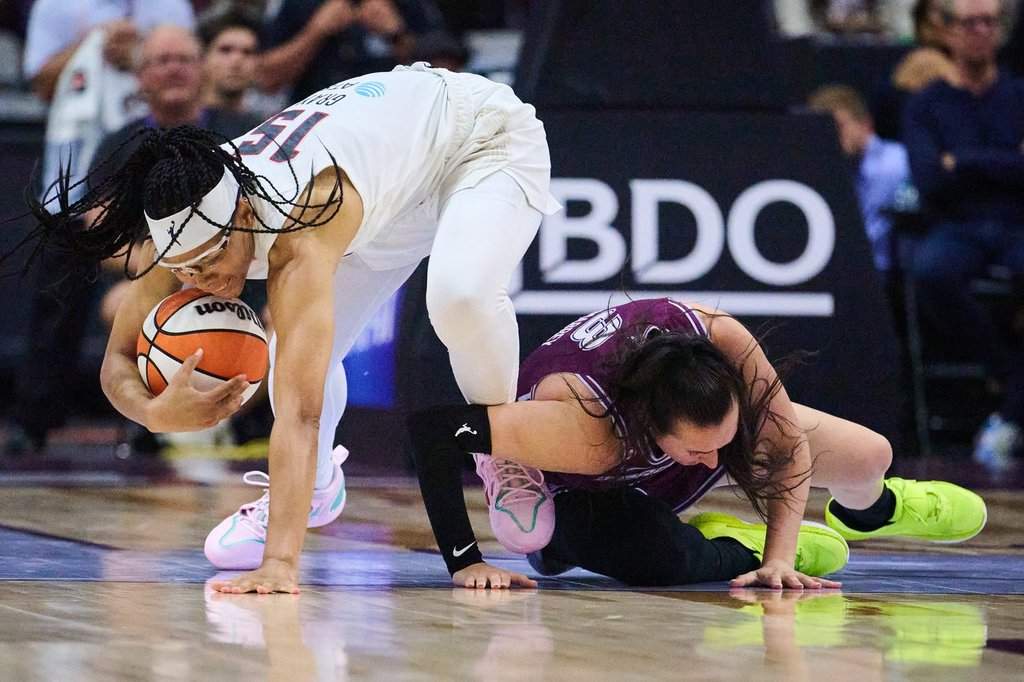
The tactical equation tilted decisively against Toronto due to an unexpected personnel constraint in the second half. Forward Nyara Sabally’s forced departure following a severe rib collision with Reese stripped the Tempo of their most effective interior substitute.
Prior to her exit, Sabally had contributed a highly efficient 16 points off the bench. Her removal created an immediate cascading failure across Toronto's frontline rotations:
[Sabally Injury Exit]
         │
         ▼
[Extended Minutes for Starters / Underconditioned Reserves]
         │
         ▼
[Increased Fatigue / Decreased Lateral Footwork Velocity]
         │
         ▼
[Compounded Rotational Lateness / Escalated Foul Rates]
This structural bottleneck forced head coach Sandy Brondello to rely heavily on Temi Fagbenle, who was visibly rusty in her return from a multi-game absence involving a shoulder injury and a concussion. The drop-off in lateral footwork velocity and screen-navigation efficiency between a fully healthy rotational piece and a returning player was ruthlessly targeted by Atlanta's Jordin Canada, who dismantled Toronto's drop-coverage scheme to the tune of 13 assists.
Emotional Contagion and the Cognitive Trap
A critical deficiency in Toronto's performance was their inability to isolate their tactical execution from psychological friction caused by questionable officiating. Brondello noted post-game that her squad allowed external factors to alter their internal focus. In elite sports analytics, this is recognized as emotional contagion leading to a cognitive processing bottleneck.
When a team becomes overly hyper-focused on perceived officiating inconsistencies, their cognitive load shifts away from real-time tactical adjustments. This manifests technically in several ways:
- Lateness in Secondary Rotations: A split-second delay spent gesturing to an official translates to two or three steps of lost ground on the perimeter, turning a contested jump shot into an open look.
- Frustration Fouling: Instead of playing disciplined, vertical defense inside the paint, frustrated defenders tend to reach across the ball-handler's body, yielding high-efficiency free-throw opportunities. Toronto did reach the free-throw line 25 times, but their defensive posture at the other end allowed Atlanta to consistently dictate physical terms.
- Hasty Offensive Possession Selection: In an attempt to instantly make up for perceived injustices, teams often break away from their designated half-court offensive protocols, opting for premature, highly contested individual isolation plays early in the shot clock. This lack of ball movement plays directly into the hands of a waiting transition defense.
Tactical Prescriptions
For the Toronto Tempo to stabilize their current stretch of dropped games, they must immediately pivot toward a possession-preservation strategy. Relying on isolated stellar individual offensive outputs, such as Marina Mabrey’s game-high 26 points, is an unsustainable formula when the team consistently surrenders nearly 30 points off self-inflicted mistakes.
The technical staff must enforce strict offensive spacing rules that reduce high-risk cross-court passes, which are easily picked off by athletic wing defenders like Allisha Gray. Furthermore, when operating with a depleted or recovering frontcourt, the team must implement a hard "safety valve" protocol—designating at least one perimeter player to completely abandon offensive rebounding positioning the moment a shot is released, thereby securing the primary retreat line against the opponent's fast break. Until these possession leakage points are plugged, structural schematic adjustments will remain entirely secondary to the raw mathematics of transition vulnerability.
Angel Reese and Naz Hillmon Highlights
This video provides a direct visual breakdown of the transition sequences and interior positioning dynamics that fueled Atlanta's high-efficiency offensive performance.
http://googleusercontent.com/youtube_content/1