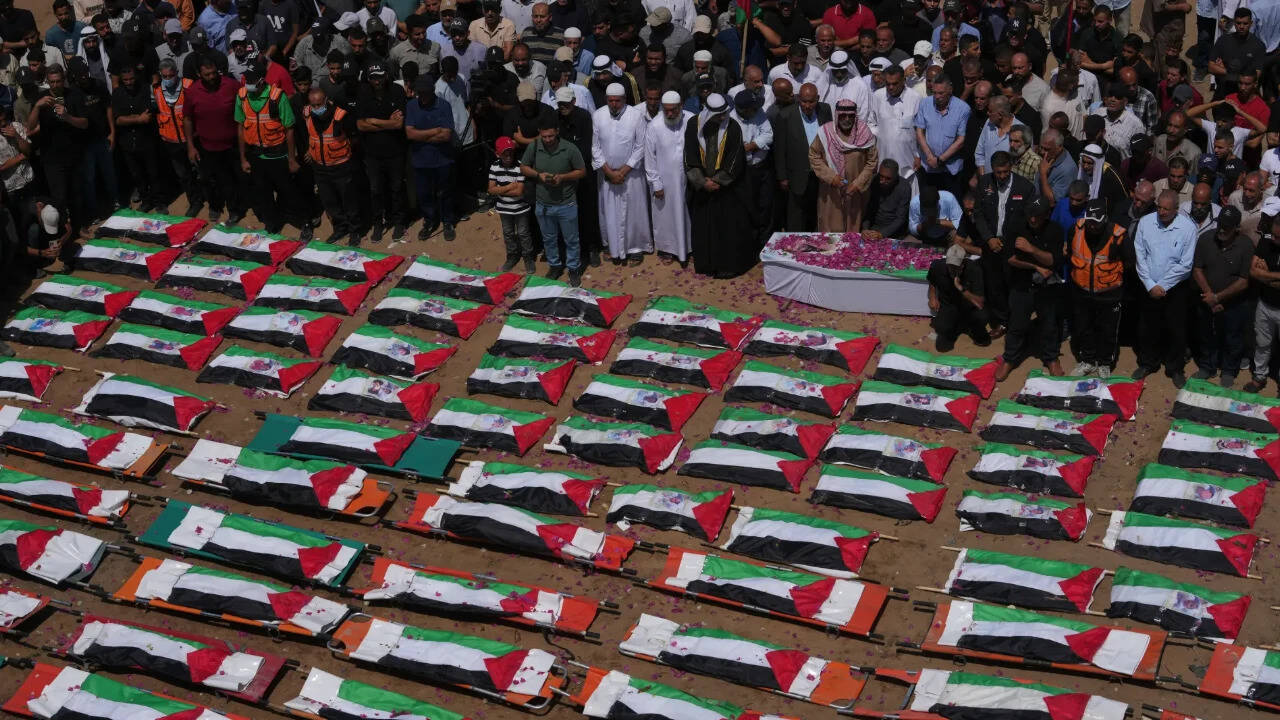
A mass funeral in Gaza for one hundred and twelve Palestinians recovered from a single 2023 strike lays bare the grinding mechanics of a conflict where documentation lags years behind devastation. Among the shrouded figures laid into the earth were dozens of children, their identities pieced together from fragments of clothing, rough municipal ledgers, and the fading memories of neighbors who survived the initial onslaught. This is not merely a delayed burial. It is an administrative artifact of a system under total collapse, where the sheer volume of human destruction overwhelms the basic capacity to record, identify, and mourn.
Years into the campaign, the process of recovering bodies from rubble and mass graves operates on makeshift infrastructure. Frontlines shift, municipal equipment rusts without spare parts, and fuel shortages turn every excavation into an agonizingly slow operation. When bodies are finally pulled from the ruins months after a bombardment, they arrive at makeshift morgues in advanced states of decomposition. Forensic pathology requires cold storage, DNA databases, and trained personnel. Gaza has none of these things in the quantities required. Instead, families identify their dead by a scrap of fabric, a wedding ring, or the placement of an old fracture.
The Mechanics of Delayed Recovery
The delay between a lethal strike and the final burial exposes a structural vulnerability in modern humanitarian monitoring. International bodies rely on verified casualty counts, yet verification demands access that has been systematically restricted or rendered impossible by ongoing military operations. When a building collapses entirely, crushing dozens of residents into a basement or a makeshift shelter, the site becomes a tomb that requires heavy machinery to open.
Heavy machinery is scarce. Bulldozers and backhoes have been targeted, run out of fuel, or denied entry at checkpoints. First responders often dig with their bare hands or small trowels. Days turn into weeks. Weeks turn into years.
By the time an excavator finally reaches the lower levels of a flattened apartment block, the context of the strike has vanished from the daily news cycle. The global media has moved on to the next escalation, the next diplomatic impasse, the next humanitarian crisis. Yet for the families remaining, the crisis is static, frozen in the concrete dust of 2023. The mass funeral for those 112 individuals is a statistical correction masquerading as a ritual. They were already dead, counted months ago in unverified tallies, but their physical absence from a grave kept their status in limbo.
Bureaucracy of the Unidentified
Civil defense departments function without electricity, communication lines, or a centralized database. Names are written in ink on ledger books that risk being destroyed by moisture, fire, or the next wave of displacement.
- Registry collapse: Municipal offices have been bombed out, forcing workers to rely on personal notebooks and decentralized memory.
- Forensic deficit: Traditional DNA matching is largely unavailable, leaving visual recognition as the primary method of identification.
- Mass burial necessity: When identification fails and bodies pose a public health hazard, authorities must inter the remains collectively, marking the trench with numbers rather than names.
This anonymity inflicts a specific psychological wound on the survivors. Grief requires closure, and closure requires a marker. A numbered mound in a municipal cemetery offers no finality. It tells the living that their relative existed, but it denies them the dignity of an individual resting place. Multiply this by thousands of missing persons still buried beneath the rubble across the strip, and the true scale of the administrative catastrophe comes into sharp focus.
The Logistics of Silence
Information is a casualty of infrastructure failure. When communication networks go down for days at a time, local civil defense units cannot coordinate with hospitals or relatives searching for missing loved ones. A body is recovered in the northern districts. Word travels by word of mouth because mobile data networks are throttled or destroyed. By the time a cousin from the southern displacement camps reaches the site, the burial has already taken place to prevent contagion in the summer heat.
This systemic friction alters how history will record these events. Future historians will not find neat spreadsheets detailing who died where and when. They will find contradictory estimates, municipal fragments, and oral testimonies gathered in haste. The 112 bodies recovered and buried together represent a rare exception—a moment where enough equipment and coordination aligned to clear a single site and offer a semblance of a ceremony.
Most victims do not receive this closure. Their remains stay where they fell, integrated into the foundations of destroyed architecture, waiting for a reconstruction effort that remains indefinitely postponed. The funeral is over, the shroud is covered by dry earth, and the machinery of survival grinds forward into another day without answers.


