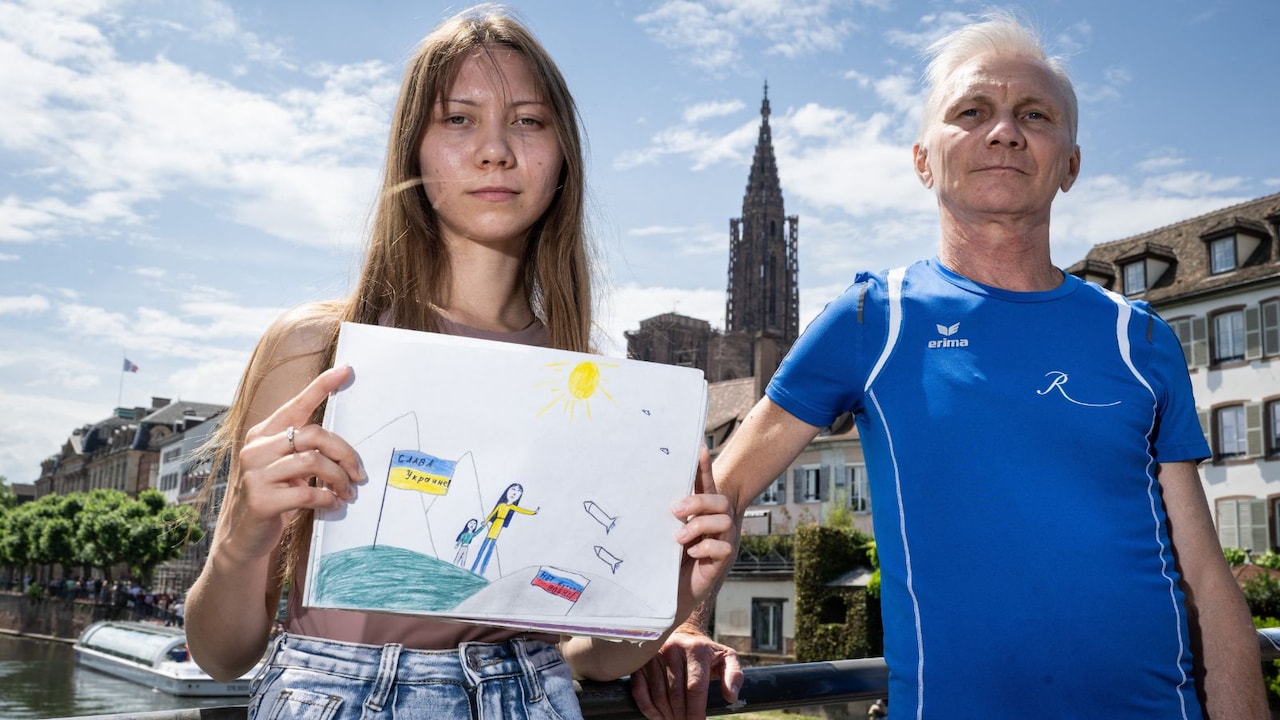
A school drawing shouldn't tear a family apart. In April 2022, a 12-year-old girl named Masha Moskaleva sat in an art class in Yefremov, a town south of Moscow. The teacher asked the class to draw pictures supporting Russian troops in Ukraine. Masha chose a different path. She drew a Ukrainian flag with a mother and child shielding themselves from missiles coming from the Russian side. She added the words "No to War" and "Glory to Ukraine."
The school principal called the police.
What followed wasn't a standard parent-teacher conference. It was the beginning of a state-sponsored nightmare that forced a father into a penal colony and his daughter into state custody before they eventually fled the country. The story of Alexei Moskalev and his daughter Masha reveals exactly how far Vladimir Putin's regime will go to crush domestic dissent. It shows that in modern Russia, even children aren't safe from the security apparatus.
The Cost of a Drawing in Putin's Russia
The Kremlin wants total conformity. When Masha drew that picture, she didn't just break a classroom rule. She violated the strict censorship laws introduced immediately after the February 2022 invasion of Ukraine. These laws make "discrediting the Russian armed forces" a serious criminal offense.
The day after the drawing appeared, the Federal Security Service (FSB) showed up at the school. They questioned Masha. They threatened her father, Alexei, who was raising her as a single parent. The authorities searched their apartment, seized their savings, and commented on the anti-war comments Alexei had posted on social media networks like Odnoklassniki.
The pressure built fast. Alexei faced fines, then criminal charges. By March 2023, officials placed Alexei under house arrest and separated him from Masha, sending the teenager to a local orphanage.
The Escape and the Sentence
Alexei knew what was coming. On the night before the court delivered its verdict, he cut off his electronic monitoring anklet and escaped through a window. The court sentenced him in absentia to two years in a penal colony for discrediting the military.
His freedom lasted only a few days. Authorities arrested him in Minsk, Belarus, after he turned on his mobile phone, allowing security forces to track his location. Belarus quickly extradited him back to Russia to face his sentence.
Meanwhile, Masha remained trapped in the social care system. The state tried to sever Alexei's parental rights completely. They used her drawing as evidence that he was failing to raise his daughter properly. Public outcry and international attention eventually forced the state to hand Masha over to her estranged mother, Olga Sitchikhina, who hadn't lived with the family for years.
Surviving the Penal Colony
Alexei served his time in a penal colony in the Tula region. Conditions in Russian penal colonies are notoriously harsh, designed to break a prisoner's spirit. Political prisoners face isolation, minimal medical care, and constant surveillance.
Supporters kept his story alive. Human rights organizations like Memorial, which Russia has banned, tracked his case closely. Activists wrote letters to Alexei, ensuring he knew the world hadn't forgotten the father who stood up for his daughter's right to draw the truth.
After serving his full sentence, Alexei was released. But life in Russia was no longer tenable. The state security services don't just forget about people who embarrass them on the global stage. The threat of new charges always loomed.
Life After the Escape From Russia
Alexei and Masha managed to leave Russia entirely. They joined a growing community of Russian exiles who chose flight over silence. Leaving everything behind is brutal, but staying meant risking permanent separation or further imprisonment.
Their journey highlights a massive shift in Russian society. The country is experiencing its largest emigration wave since the collapse of the Soviet Union. Hundreds of thousands of journalists, activists, IT specialists, and ordinary citizens have fled to places like Armenia, Georgia, Germany, and the Baltic states.
They left because the boundary of what the state considers criminal keeps expanding. It isn't just about high-profile politicians like the late Alexei Navalny anymore. The regime now targets ordinary parents, teachers, and school children.
Why the Regime Targets Children
Dictatorships rely on control over the future. The Kremlin has systematically overhauled the Russian education system since 2022. They introduced mandatory patriotic classes called "Conversations About Important Things." These lessons justify the war and teach children that dying for the motherland is the highest honor.
When a child rejects this narrative, it terrifies local officials. They worry about looking weak or disloyal to their superiors in Moscow. The school principal in Yefremov acted out of fear and ideological zeal. That combination makes the local bureaucracy incredibly dangerous.
The state uses cases like the Moskalevs to terrorize other parents. The message is loud and clear. If you don't control what your children say, think, or draw, the state will take them away from you.
How to Support Russian Political Prisoners
The Moskalevs made it out, but thousands of others are still trapped inside the system. If you want to help those who continue to defy the regime from within, you can take direct action.
- Support independent journalism: Outlets like Meduza and Mediazona operate from exile, providing accurate reporting on political trials inside Russia. Supporting them keeps the truth accessible.
- Write to prisoners: Organizations like RosUznik help people send letters to political prisoners in Russian jails. A simple letter shows guards and inmates that the world is watching.
- Donate to legal defense funds: Groups like OVD-Info provide legal aid to people detained at protests or charged under wartime censorship laws. They need financial support to keep lawyers in courtrooms.