Rain in Belfast does not merely fall; it lingers, hanging in the narrow alleys between red-brick terraces like a collective memory refusing to evaporate.
I remember standing on the Shankill Road years ago, watching the water pool in the deep gouges of a curbstone while a rusted lamppost cast a yellow glare over a mural of masked men. Back then, borders felt permanent. They were written in concrete, sealed with razor wire, and guarded by checkpoints that sliced neighborhoods into quiet, hostile camps. You knew precisely where you stood because the paint on the curbstones told you. Red, white, and blue on one side; green, white, and orange fifty yards down the block.
Lines drawn on paper, bled into reality.
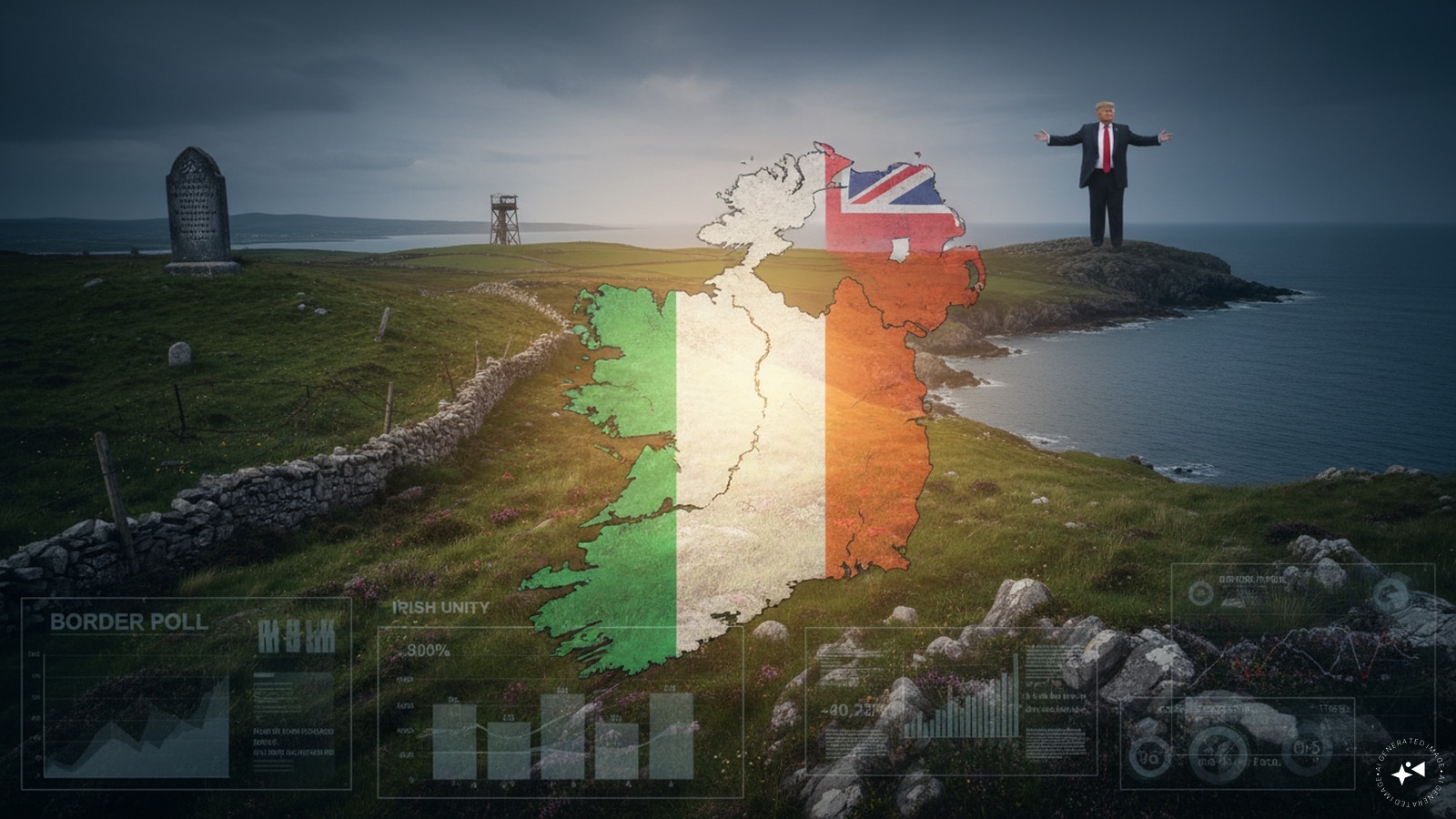
Today, those concrete barriers are crumbling under the quiet erosion of time, demographics, and political geometry. But as a new wave of political turbulence ripples across the Atlantic, the old map of the United Kingdom is trembling. The return of Donald Trump to the White House has once again thrust the question of Irish unity into the global spotlight. Washington has always possessed an outsized, sentimental fascination with the Emerald Isle—a fondness fueled by millions of diaspora voters whose ancestral heartstrings are tugged every time an American president claims a drop of County Mayo or County Cork in their bloodline. When Trump speaks of trade, tariffs, or global alliances, the echo in Belfast and Dublin carries a distinct frequency.
Yet, reducing the future of Northern Ireland to a diplomatic footnote in an American election cycle is an intellectual lazy luxury. The momentum toward a united Ireland is not born in the Oval Office. It is being forged in kitchens, classrooms, and maternity wards across the island.
Consider a hypothetical afternoon in a cafe on the Ormeau Road.
Two young professionals sit across from each other over lukewarm flat whites. Liam is Catholic by background, though he hasn't been to Mass since his grandmother's funeral. Chloe is Protestant, raised attending church fetes and marching bands, but her cultural identity feels increasingly disconnected from the flag-waving jingoism of her grandparents' generation. They are both economists in their late twenties. They talk about housing prices, mortgage rates, and the cost of living. They talk about the National Health Service buckling under chronic delays.
When the conversation drifts toward constitutional futures—toward a border poll and a thirty-two-county republic—neither of them speaks of armed struggle or historical grievance. They talk about spreadsheets.
"If we unify," Liam asks, stirring his cup, "how do we pay for our pensions? How does the Northern subvention work?"
Chloe doesn't answer with slogans. She points to a report on her tablet. "That's the rub. London currently subsidizes Northern Ireland to the tune of ten to fifteen billion pounds a year. Dublin's economy is booming, sure, but absorbing that deficit overnight? It would mean tax hikes down south or severe austerity. Nobody wants to vote for a pay cut, no matter how much they love the flag."
That is the hidden friction of modern politics. We crave romantic narratives of liberation and reunification, but history is ultimately settled by ledger books.
To understand why this conversation is suddenly inescapable, we have to look at how the demographic tectonic plates have shifted. For nearly a century, Northern Ireland was designed as a unionist-majority state—a political entity explicitly engineered to keep one community permanently on top and the other on the outside looking in. That architecture has officially cracked.
The 2021 census figures delivered a quiet earthquake. For the first time since the partition of Ireland in 1921, those identifying as Catholic or from a Catholic background outnumbered those identifying as Protestant or from a Protestant background.
Numbers matter. But identity is messier than a census box.
Millions of people in Northern Ireland occupy a political gray zone. They are neither die-hard unionists willing to die for the British crown nor passionate republicans singing rebel songs in crowded pubs. They are pragmatists. They want the bin collections to run on time, the hospitals to function, and their children to find jobs that don't require emigrating to London or Toronto.
When Brexit dragged Northern Ireland out of the European Union against the democratic will of its majority, it cracked the pragmatic consensus wide open. Unionism had promised stability and economic security within the UK. Instead, Brexit delivered the Northern Ireland Protocol—a bureaucratic trade border stitched down the middle of the Irish Sea, effectively cutting the region off from the British mainland's regulatory embrace while keeping it tethered to the EU single market.
For the first time, economic gravity began to pull south. Supermarket shelves in Belfast started stocking goods routed directly from Dublin and continental Europe rather than Liverpool or Cairnryan. Business leaders, historically cautious and deeply protective of the status quo, began quietly running calculations. If your supply chains point south, your economic future inevitably follows.
Enter the unpredictable variable of American politics.
When a U.S. administration leans heavily into protectionist trade policies, global trade corridors shudder. If Washington adopts an isolationist stance or imposes blunt tariffs, international investors look for stable harbors. A divided island with a complicated trade protocol becomes an administrative headache. Conversely, an American president eager to broker a historic diplomatic win can apply immense pressure behind closed doors, nudging London and Dublin toward long-term planning for a border poll.
Yet, American politicians often misunderstand the granular terror of the situation. They view Irish unity through the soft-focus lens of a St. Patrick's Day bowl of shamrocks. They do not hear the quiet anxiety of a Protestant tradesman in East Belfast who fears his culture will be erased in a unified state, nor do they feel the lingering resentment of a nationalist worker in Derry who was treated as a second-class citizen for decades.
Change here cannot be rushed. It must be negotiated with surgical, agonizing precision.
If a border poll were called tomorrow, what happens the day after the votes are counted?
Imagine the reality of a 50-plus-one victory for unity. It sounds romantic on a campaign poster. On the ground, it is a logistical nightmare. You have a million unionists—British citizens by birth, culture, and conviction—who suddenly find themselves incorporated into a state they never consented to join. If Dublin simply absorbs the North without restructuring healthcare, policing, and governance, you risk creating a mirror image of the old injustice: a disgruntled minority nursing grievances in the shadows, waiting for the wheel to turn again.
This is why thoughtful voices on both sides of the border are calling for a citizens' assembly—a prolonged, radical national conversation before any referendum is even scheduled. They argue that you cannot vote on an abstract concept. You must vote on a fully drafted constitution, detailing what happens to the police service, how the flag might change, whether health care remains free at the point of delivery, and how British identity will be legally and culturally protected in a new Ireland.
We are standing in the foothills of history.
The old certainties are dead. The British government is increasingly distracted by its own domestic turbulence, viewing Northern Ireland less as an integral part of the family and more as an expensive, complicated legacy issue. The Republic of Ireland is wealthier and more confident than at any point in its modern history, yet it looks north with a mixture of eager anticipation and profound nervousness, terrified of biting off more economic and social friction than it can chew.
And beneath it all, the ordinary people go about their lives.
They walk their dogs along the peace lines—those towering walls of steel and brick that still separate neighborhoods in Belfast. They buy groceries, complain about the weather, and watch their kids play football on damp pitches. They know that politicians in Washington, London, and Dublin can draft the speeches and draw the maps, but it will be the people living here—side by side, street by street—who will have to live with the consequences when the ink dries.
The rain continues to fall over the Lagan. The brickwork glistens. The border is still there, for now, traced in invisible ink across hills that have seen too much blood and heard too many speeches. But the ink is fading. And as the wind shifts, the map begins to move.