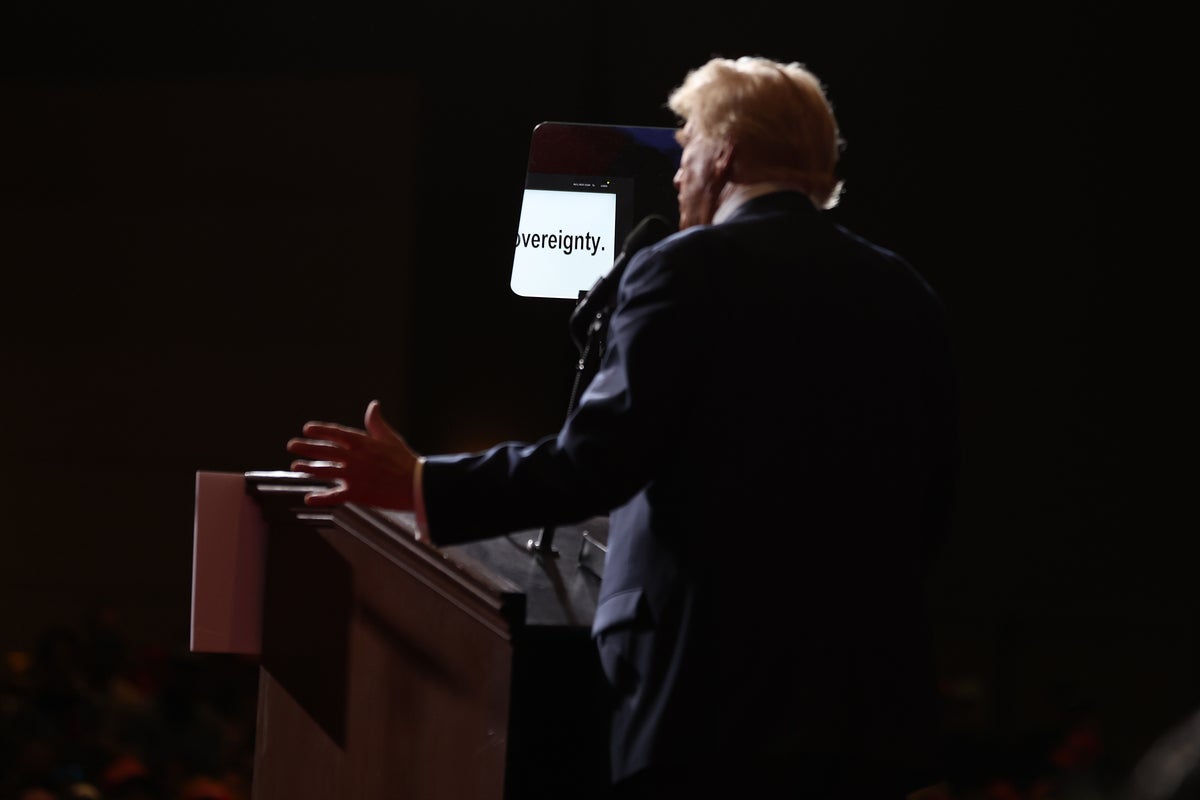
The air inside a presidential briefing room has a specific, heavy silence. It is the quiet of holding your breath, of waiting for a spark. Behind the bright glare of the television lights, just beyond the edge of the frame, sits a man whose entire career is defined by keeping pace.
For a decade, Gabriel Perez was that man. Since 2016, he sat in the shadows of the world’s most powerful stages, his fingers resting on a physical hand-dial that controlled the scrolling speed of two pieces of reflective glass. He was the keeper of the scroll. When the President spoke, Perez’s job was to match the rhythm of the voice, anticipating the pauses, slowing down for the dramatic emphasis, and speeding up when the delivery became a torrent. For a different perspective, see: this related article.
But as the words rolled across the green screen in front of him, Perez was not just reading. He was calculating.
Every syllable had a price. Every adjective was a wager. While the rest of the world watched the television screen to see where American policy was heading, Perez was staring at his smartphone, playing a high-stakes, invisible game where a single spoken word could net him thousands of dollars. Similar analysis on this matter has been shared by The Guardian.
The Market of the Spoken Word
To understand how a technical assistant pulling a federal salary could turn a routine address into a financial windfall, you have to understand the strange, rapidly expanding universe of prediction markets.
We live in an era where you can bet on almost anything. You can bet on the weather in Tokyo next Tuesday, the next CEO of a major tech conglomerate, or the exact date of a rocket launch. But the most volatile, addictive corner of this new financial frontier is the "mention market."
These are binary contracts hosted on platforms like Kalshi. They work with a simple, brutal logic: Will a specific person say a specific word during a specific public event? Yes or no. If the President says "rigged" during his address, the contract pays out. If he does not, the contract goes to zero.
For the average trader on the internet, betting on these markets is an exercise in extreme pattern recognition and guesswork. They analyze past transcripts. They track the speechwriters. They install specialized television antennas to gain a microsecond advantage over the standard cable feed, hoping to buy or sell contracts before the rest of the world hears the audio.
But Perez did not need a specialized antenna. He did not need to guess.
He was the person who loaded the text into the machine. He had final eyes on the prepared remarks before the teleprompter was even turned on. In the hierarchy of political information, he possessed a brand of absolute, pure foresight that Wall Street executives would kill for. He knew the script.
The Panic of the Off-Script Pivot
Imagine the scene at the World Economic Forum in Davos. The room is packed with global leaders, billionaires, and journalists. The lights are low. The President walks to the podium.
In the dark, Perez’s thumb hovers over his phone screen. On Kalshi, the odds of the President mentioning a specific European ally or a particular trade statistic are fluctuating wildly. Public traders are buying "Yes" contracts at forty cents, hoping for a modest return. Perez, knowing the exact phrasing of the text sitting on his screen, has already loaded up on the sure thing.
The scrolling begins.
“Our nation has achieved unprecedented heights...”
The words match. The trade is secure.
But there is a fatal flaw in this system, one that eventually became Perez's undoing. The President is not a robot. He is famously, habitually prone to abandoning his prepared remarks. He riffs. He gets distracted by a face in the crowd. He decides, mid-sentence, that the speechwriter’s prose is too dry, and he begins to speak from the hip.
Consider what happens to an insider trader when the subject of the trade decides to rewrite the reality in real-time.
Suddenly, a paragraph containing the critical target word—the word Perez has bet thousands of dollars on—is skipped entirely. The President’s eyes drift away from the glass. He starts talking about an old grievance or a crowd size.
At that moment, the teleprompter operator's job turns into a nightmare of conflicting interests. He must scroll the text forward to match where the President might land next, ensuring the public address does not turn into a disaster on national television. Simultaneously, his financial life is flashing red.
Investigators looking into Perez's account found a pattern that was almost comical in its desperation. During live speeches, as the President began to veer off-script and skip over sections of text, Perez would frantically log into his betting account to cancel his wagers or sell off his positions before the market realized the words were never going to be said.
You can picture the physical division of labor: one hand controlling the speed of the democracy's script, the other furiously tapping a glass screen to save ninety thousand dollars from vanishing into thin air.
The System Behind the Screen
It was this very desperation that blew the cover on the entire operation.
Prediction markets are built on data. When an anonymous account consistently places perfect bets on highly specific word choices, it catches the attention of market makers. But when that same account shows a supernatural ability to pull its money out of the market the exact second a speaker begins to ad-lib, it triggers alarms.
Kalshi’s internal surveillance team noticed the anomaly. The patterns did not look like the behavior of an analyst or a lucky gambler. They looked like someone who could see the future—until the future changed its mind.
They froze the account. They locked up ninety thousand dollars in unrealized profits. Then, they sent the data directly to the Commodity Futures Trading Commission.
The defense of prediction markets has always been that they harness the collective intelligence of the crowd to provide accurate forecasting. But the Perez scandal exposes a darker truth. When you turn public policy and political speech into a casino, the people closest to the house will always find a way to manipulate the wheel.
It is easy to look at Perez as a lone actor, a rogue staffer who let greed override his duty. But he is a symptom of a larger, more unsettling trend. We have spent the last few years financializing every single aspect of our shared reality. We have turned the serious business of governance into a series of tradeable assets. Why should we be surprised when the people who run the machinery want a cut of the action?
The Silent Room
On a recent Thursday, the White House Press Secretary stood at the podium to address the scandal. Her voice was cool, her phrasing deliberate. She called the actions a disgrace. She confirmed that the operator, a man who had stood feet away from the presidency for nearly a decade, was on unpaid administrative leave.
That evening, the President was scheduled to give another address to the nation.
The teleprompter screens were polished. The lights were calibrated. The digital text was loaded, ready to scroll.
But when the President walked out to speak, a different operator sat in the dark, his hands on the dial, his eyes fixed purely on the glass. There was no phone in his palm. There were no bets on the table.
Yet, for everyone watching, the illusion had been chipped. Every time the President paused, every time he searched for a word or veered into an unexpected anecdote, the audience was left to wonder: Who else is listening, and what is the exact price of the next word?