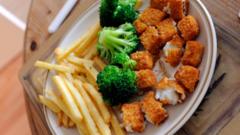
The political playbook for winning over parents is painfully predictable. Whenever inflation pinches households, a chorus of politicians and consumer advocates demands a Value Added Tax (VAT) cut on children's meals. The narrative sounds flawless: slash the tax, restaurants drop their prices, and hard-working families instantly save money while feeding their kids better food.
It is a beautiful fantasy. It is also basic economic illiteracy.
Tax cuts on restaurant meals do not trickle down to the consumer. They get swallowed by corporate margins. Even in the rare instances where a fraction of the savings is passed along, lowering the cost of restaurant dining does not improve childhood nutrition—it actively subsidizes the ultra-processed food pipeline.
We are asking the wrong questions about food policy because we are blinded by surface-level idealism. The real mechanics of fiscal policy and supply-side economics reveal a uncomfortable reality: cutting VAT on children's menus is a corporate handout disguised as family advocacy.
The Incidence Illusion: Who Actually Pockets the Tax Cut?
The fundamental flaw in the "cheaper meals" argument rests on a concept economists call tax incidence. Lawmakers can dictate who hands the money to the government, but the market decides who actually bears the financial burden.
When a government cuts VAT from 20% to 5% on restaurant food, there is absolutely no legal mechanism forcing a restaurant to alter its menu prices. A menu is a contract between the business and the customer, entirely independent of the tax authority.
Imagine a scenario where a casual dining chain sells a kids' chicken nugget meal for $10. Under a high VAT regime, $1.67 of that goes to the state, and the restaurant keeps $8.33. When the government slashes the VAT, the restaurant does not automatically rewrite its menus to charge $8.75. Instead, it keeps the price at $10. The consumer notices zero difference at the register, while the restaurant’s take-home revenue jumps to $9.52 per meal.
Historical Precedent: The French Cafe Experiment
We do not have to theorize about this. We have concrete data from one of the largest fiscal experiments in European hospitality history.
In 2009, France lowered its VAT on restaurant meals from 19.6% to 5.5%. The explicit goal, heavily promoted by the restaurant lobby, was to lower prices for consumers and boost employment.
The result? A comprehensive study by the French National Institute for Statistics and Economic Studies (INSEE) found that restaurants pocketed roughly 75% of the tax cut immediately to increase their profit margins and raise wages for staff. Only a measly one-quarter of the reduction was passed on to consumers. Within less than thirty months, prices crept right back up to where they started. The consumer lost. The treasury lost. The hospitality executives won.
I have spent years analyzing corporate restructuring and retail pricing strategies. When a business experiences a sudden drop in variable costs via a tax break, its first priority is padding its balance sheet against supply chain volatility, not passing charity down to the consumer. Believing corporations will collectively lower prices out of the goodness of their hearts is not policy; it is wishful thinking.
Subsidizing the Obesity Epidemic
Let’s entertain the best-case scenario. Assume an ultra-competitive market forces restaurants to pass 100% of the VAT savings directly to the consumer. Surely, this is a win for children's health?
Absolutely not.
Look closely at what actually populates a standard children’s menu. It is not grilled wild salmon and organic broccoli. It is deep-fried chicken tenders, mass-manufactured french fries, processed cheese quesadillas, and sugary sodas. These items are profit engines because their ingredients are dirt cheap, shelf-stable, and engineered for high hyper-palatability.
Standard Kids' Menu Composition:
[ High-Sodium Processed Meats ] + [ Refined Carbohydrates ] + [ High-Fructose Corn Syrup ]
When you cut VAT across the board on children's meals, you are lowering the relative price of ultra-processed foods compared to fresh, whole ingredients bought at a grocery store. You are incentivizing parents to take their children out to eat fast food more frequently.
The Price Elasticity Trap
Public health data proves that the price elasticity of demand for fast food is highly sensitive among lower-income demographics. A small drop in price yields a disproportionately large surge in consumption.
According to research published in The American Journal of Public Health, pricing interventions directly dictate dietary choices. By making restaurant-prepared children's meals cheaper, you artificially stimulate demand for food that drives childhood obesity, Type 2 diabetes, and long-term metabolic dysfunction.
If the state wants to improve youth health, it should not make processed restaurant food cheaper. It should make it prohibitively expensive while subsidizing agricultural supply chains for fresh produce. A flat VAT cut is a blunt instrument that rewards bad nutritional behavior.
Dismantling the "People Also Ask" Consensus
Public discourse around food taxation is riddled with emotional appeals. Let's dissect the standard justifications with cold logic.
"Doesn't a VAT cut help low-income families who rely on cheap meals?"
This argument is structurally backwards. High-income families spend significantly more total dollars dining out than low-income families. Because VAT is a consumption tax, a flat cut rewards the wealthy far more than the poor in absolute terms. A wealthy family buying a premium $15 organic kids' meal saves three times as much tax as a struggling parent buying a $5 fast-food box. If your goal is targeted welfare, dropping a consumption tax across the board is the most inefficient, regressive way to achieve it.
"Won't restaurants lose business if they don't lower prices?"
No. Restaurants operate on reputation, convenience, and location, not just micro-penny price competition. If every restaurant in a city retains its current pricing structure after a tax cut, no individual establishment faces a competitive disadvantage. The status quo remains intact, margins expand industry-wide, and consumers continue paying the exact same baseline prices because their dining habits are already locked in.
"Can't governments mandate that the savings are passed on?"
Price controls do not work. If a government mandates that a kids' meal must drop by the exact percentage of the VAT cut, restaurants adapt instantly through shrinkflation. They will cut the portion size of the fries, substitute high-quality ingredients for cheaper fillers, or artificially inflate the price of adult entrees and drinks to recoup the difference. The house always wins.
The Counter-Intuitive Alternative: Upstream Subsidies
If the goal is genuinely to make feeding children more affordable and healthier, the solution requires bypassing the restaurant industry entirely. We must stop trying to fix the problem at the point of sale.
Instead of starving the treasury of billions in VAT revenue to line the pockets of hospitality conglomerates, governments should reallocate those funds directly into the agricultural supply chain.
- Direct Subsidies for Cold-Chain Logistics: The primary reason fresh fruits and vegetables are expensive in urban food deserts is the cost of refrigerated transport and storage. Subsidizing this infrastructure directly lowers the wholesale cost of real food.
- Targeted Nutritional Vouchers: Expand targeted benefit programs that can only be redeemed for raw, unprocessed ingredients at regional markets and grocery stores.
- The Sledgehammer Approach: Increase taxes on high-sugar, ultra-processed items and use 100% of that specific revenue to completely eliminate VAT on fresh produce.
The Uncomfortable Trade-Off
Every policy decision involves a trade-off. If you support a VAT cut on children’s meals, you are supporting a policy that drains public funds, increases corporate profit margins, fails to guarantee consumer savings, and lowers the financial barrier to childhood obesity.
It feels good to yell about cheaper food for kids. It makes for an excellent political slogan. But it is an economic failure that leaves families poorer and children unhealthier.
Stop asking for cheaper restaurant bills. Start demanding better food systems.
Stop falling for corporate welfare disguised as family compassion.