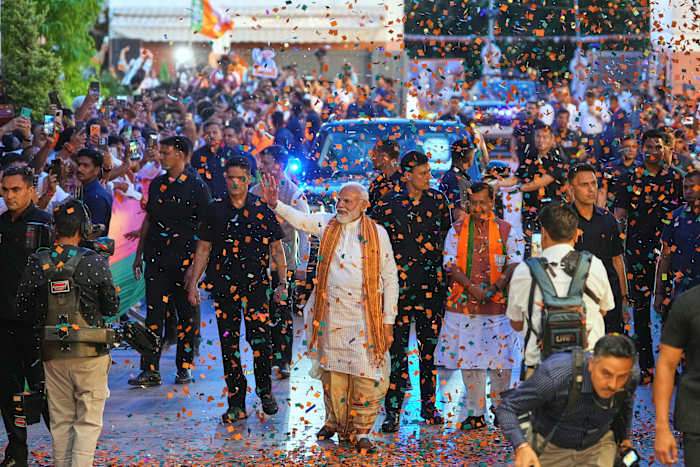
The air in Kolkata during election season does not just carry the scent of fried luchis and diesel; it carries the weight of a thousand shouting arguments. You can hear it in the tea stalls, where the clink of glass against wood keeps time with debates about identity, history, and the future of the Indian soul. To understand what happened when Narendra Modi’s Bharatiya Janata Party (BJP) finally breached the gates of West Bengal, you have to stop looking at the spreadsheets and start looking at the dirt.
For decades, Bengal was a fortress of the left. It was a place where the red flag flew so high it blocked out the sun. Then came the change, a shift toward the grassroots power of the Trinamool Congress. But the BJP, led by the formidable engine of Modi and Amit Shah, saw something else. They saw a state ripe for a different kind of revolution. They saw a chance to plant the saffron lotus in soil that many said would never accept it.
The Sound of the Conchs
Walking through the narrow lanes of Midnapore or the bustling markets of North 24 Parganas, the shift wasn't a sudden explosion. It was a slow, rhythmic vibration. Imagine a family sitting down for dinner in a small concrete home. The father, a laborer who grew up under Communist rule, remembers the promises of land reform that eventually stagnated into a stifling bureaucracy. His daughter, a college student with a smartphone and a hunger for the kind of infrastructure she sees in Bangalore or Delhi, wants something else. She wants the "New India" promised by the center.
This is where the BJP found its opening. They didn't just talk about policy. They talked about pride. They talked about the "Sonar Bangla"—the Golden Bengal—and promised to restore a glory that many felt had been eroded by years of industrial flight and political stagnation. When the conch shells sounded at the rallies, they weren't just calling for votes. They were calling for a cultural reclamation.
The numbers tell a story of a relentless march. In previous cycles, the BJP was a peripheral player, a shadow in the corner of the room. In this election, they became the room. By securing a commanding presence and seizing control of key administrative levers, they didn't just win seats; they shifted the gravity of Indian politics. The map of the east, once a stubborn holdout against the saffron wave that had swept the cow belt and the west, was suddenly transformed.
The Invisible Stakes of the Border
The victory wasn't won in a vacuum. Bengal shares a porous, winding border with Bangladesh, a line on a map that cuts through villages, rivers, and lives. In the border districts, the election wasn't about macroeconomics. It was about the existential fear of the "other."
The BJP leaned heavily into the narrative of the Citizenship Amendment Act (CAA) and the National Register of Citizens (NRC). To a farmer in Matua, these weren't legal acronyms. They were life-altering questions of belonging. The party promised a sense of security to those who felt their culture was being diluted, while their opponents decried it as a tactic of division.
Political analysts often get lost in the "incumbency" or "anti-incumbency" jargon. They forget that for the person standing in a three-hour queue under a 40°C sun, the vote is an act of hope or an act of revenge. In many parts of rural Bengal, it was both. The BJP tapped into a deep-seated resentment against local "syndicates"—the informal power structures that controlled everything from construction materials to government benefits. They positioned themselves as the outsiders coming to clean house.
The Architecture of a Win
Modi’s party operates with the precision of a clockmaker. While the opposition relied on the charisma of local leaders and the nostalgia of the past, the BJP deployed a digital and physical infrastructure that was unprecedented in the state’s history.
- Panna Pramukhs: These are the "page in-charges," individuals responsible for a single page of the voter list. They know who is sick, who is angry, and who needs a ride to the polls.
- Digital Saturation: Every WhatsApp group in the state became a battlefield. Memes, videos of the Prime Minister's speeches, and testimonials of central government schemes flooded screens from the Himalayas to the Bay of Bengal.
- The Narrative of Development: They pointed to the highways and the toilets built under central schemes, asking a simple question: "Why hasn't this happened here?"
It was a campaign of stamina. The Prime Minister himself made dozens of trips, his voice booming over loudspeakers, echoing through the palms. He spoke of the "Double Engine" government—the idea that having the same party in power in the state and the center would unlock a flood of progress. For a state that has often felt at odds with Delhi, this was a seductive promise.
The Human Cost of the Clash
Victory in Bengal is rarely quiet. It is often written in blood. As the results solidified and the BJP’s control over key regions was confirmed, the reality of political violence loomed large. This is the dark underside of Bengal's passionate politics. When the colors of the flags change, the loyalties of the streets are tested.
Think of a small-town shopkeeper who hung a saffron flag over his door for the first time. For him, the party’s win is a shield. For his neighbor, who campaigned for the incumbent, it is a threat. This tension is the invisible tax paid by the citizens of Bengal for their political engagement. The stakes aren't just about who sits in the legislative assembly; they are about who controls the neighborhood square.
The BJP's rise here signifies more than just a change in administration. It is a fundamental rewiring of the Bengali psyche. For decades, the "Bhadralok"—the educated, urban elite—dictated the terms of the state's identity. They prioritized secularism and intellectualism. The BJP’s victory represents the voice of the "other" Bengal—the subaltern, the religious, and the aspirational classes who felt ignored by the old guard.
A New Horizon
The lotus has finally bloomed in the marshlands. It wasn't a fluke, and it wasn't just a reaction to a single leader. It was the result of a decade of groundwork, a deep understanding of local grievances, and a narrative that offered a sense of destiny.
The "Red Fort" of the east has not just been breached; its walls are being repainted. As the dust settles on the polling stations and the ink dries on the fingers of millions, the reality of a BJP-influenced Bengal begins to take shape. It is a state that will now be at the heart of the national conversation, no longer a regional outlier but a central pillar of the new political order.
The arguments in the tea stalls haven't stopped. They've just changed their tune. The questions now aren't about if the change will come, but how far it will go. Bengal has always been a land of poets and revolutionaries, of people who would rather break than bend. In this election, they chose a new path, one that leads directly to the heart of the capital.
As the sun sets over the Hooghly River, casting long shadows across the Victorian monuments and the crowded ghats, there is a sense that an era has ended. A different wind is blowing through the palms. It is a wind that carries the scent of saffron and the heavy, undeniable weight of a kingdom finally won.