The desk is too large. That is the first thing you notice when the world shrinks to the size of a single room under bombardment. It is a heavy, dark wood desk, scarred by the frantic shifting of maps and the careless scrape of body armor. On it sits a single sheet of paper.
In the calculus of modern warfare, we measure conflict in terrifying, cold metrics. We talk about the caliber of artillery shells. We analyze the payload capacity of suicide drones. We track the shifting lines of a map on a glowing screen, watching hectares of earth turn from blue to red and back again. But wars do not start on maps, and they do not end there either. They end when one human being looks another in the eye and decides the killing must stop.
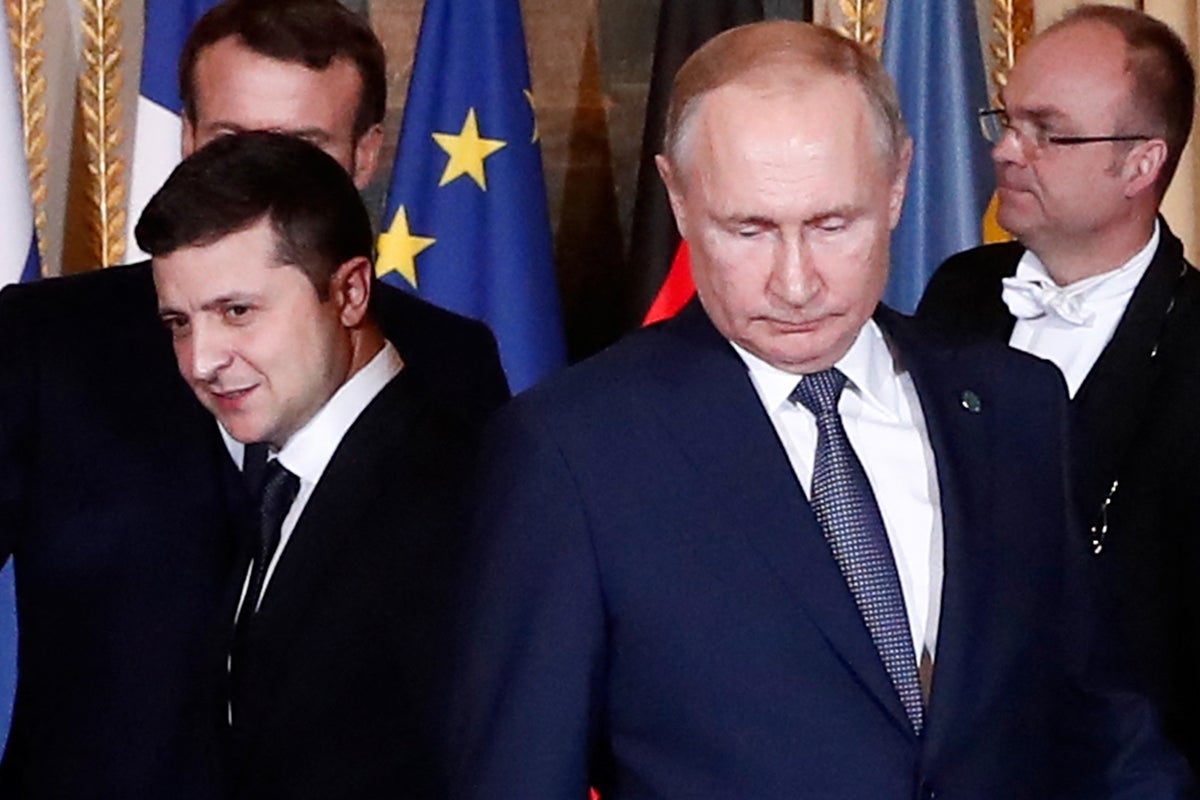
Volodymyr Zelensky sat at that desk, picked up a pen, and tried to force that confrontation.
It was a letter addressed to Vladimir Putin. Not a diplomatic cable routed through backchannels. Not a press release scrubbed clean by committees of nervous bureaucrats. A direct, urgent demand for a face-to-face meeting.
To understand the sheer weight of this document, you have to strip away the grand geopolitical theater. Imagine the silence of that room. Outside, the low, rhythmic thud of air defense systems echoes through Kiev, a heartbeat for a city holding its breath. Inside, a man who used to make people laugh for a living is trying to find the exact sequence of words that might stop a dictator from flattening his country.
It is an impossible task. It is trying to negotiate with a avalanche.
The Illusion of Distance
We have grown accustomed to seeing these two leaders on screens, separated by thousands of miles and completely incompatible realities. One speaks from deep within the gilded, sterile halls of the Kremlin, sitting at tables so absurdly long they feel like physical manifestations of paranoia. The other speaks from sandbagged corridors, clad in faded olive drab, his voice raspy from exhaustion.
The standard news reports treated the letter like a tactical chess move. They dissected the political timing. They debated whether it showed weakness or strategic positioning.
They missed the point entirely.
The letter was an act of desperate transparency. In a conflict defined by smoke and mirrors, by cyber warfare and state-sponsored disinformation, the document was an attempt to pull the conflict back down to earth. It was a recognition that beneath the grand theories of imperial destiny and NATO expansion, real people were bleeding into the mud.
Consider a hypothetical soldier. Let us call him Dmytro. He is twenty-four. Before the invasion, he repaired diesel engines in Kharkiv and spent his weekends arguing about football. Now, he is crouched in a frozen trench near Bakhmut, his boots soaked through, listening to the whistle of incoming fire. He does not care about geopolitical spheres of influence. He cares about the next ten seconds. He cares about keeping his fingers warm enough to pull a trigger.
Zelensky’s letter was written for Dmytro. It was an acknowledgment that every day the leaders refused to sit in the same room, another hundred young men like him would vanish into the earth.
The Chemistry of a Conflict
When you look at the raw mechanics of this request, the hurdles seem insurmountable. How do you invite your executioner to a negotiation?
The letter bypassed the traditional armor of diplomacy. Usually, when nations speak, they use a complex system of nods, winks, and coded language. Ambassador A speaks to Minister B, who passes a sanitized memo to Secretary C. It is a system designed to prevent friction, but it also prevents honesty. It insulates the decision-makers from the immediate agony of their choices.
Zelensky tore that system up. By demanding a face-to-face meeting, he threw the responsibility squarely onto one man’s shoulders. He stripped away the excuse of bad staff work or misunderstood intentions.
The text of the communication was stark. It did not beg. It did not offer grand concessions before the doors were even closed. It simply stated a truth that the Kremlin had spent months trying to ignore: this cannot be solved by proxies.
Think of the psychological tension inherent in that request. Putin has spent decades cultivating an image of detached, historical inevitability. He views himself as a force of nature, correcting what he sees as the grand errors of the twentieth century. To him, Ukraine is not a sovereign nation with its own culture and desires; it is a rebellious province, a historical footnote that needs to be corrected.
To accept a face-to-face meeting with Zelensky would be to acknowledge him as an equal. It would mean admitting that the comedian in the green t-shirt is the legitimate voice of millions of defiant people.
That is why the tables in Moscow are so long. Distance is a shield against empathy.
The Empty Chair at the Center of the World
The tragedy of the letter is not what it said, but where it landed. It landed in a vacuum.
Imagine the document arriving in Moscow. It passes through layers of security, scanned for radiation and chemical agents, before being placed on a silver tray. It is carried through corridors of marble and gold, past guards standing at rigid attention, into the quiet inner sanctum.
And then? Nothing.
Silence can be a weapon just as devastating as artillery. By refusing to answer, by dismissing the call for a direct meeting as a mere public relations stunt, the Kremlin attempted to dehumanize the offer. They wanted to turn a genuine cry for a cessation of violence into a piece of irrelevant paper.
But you cannot unwrite the words. The letter remains a historical marker, a permanent record of an open door that one side chose to slam shut.
Every war ends with a signature. The only question is how many graves must be dug before the ink is allowed to dry. The letter was an attempt to skip the graves and go straight to the ink. It failed, not because the logic was flawed, but because the man on the other side of the equation was operating on a currency of power that does not recognize human life as a variable.
The Echo in the Dark
We often look at these moments in history and feel a sense of profound helplessness. The decisions feel too big, the actors too distant, the machinery of statecraft too massive for any single person to influence.
But the letter reminds us that everything, eventually, comes down to the human scale. The grand structures of global politics are entirely fabricated. They are ideas we have agreed to believe in. What is real is the cold desk in Kiev. What is real is the silence in Moscow. What is real is the mud in the Donbas.
The document sits in the archives now, a testament to a moment when the trajectory of the century could have shifted by a few degrees. It stands as a reminder that leadership is not found in the safety of a bunker or the choreography of a military parade. It is found in the willingness to look your enemy in the eye, despite the terror, and demand a path toward the light.
The pen was put down. The paper was folded. The sirens outside began to wail again, their high, piercing scream cutting through the winter air, signaling that the machinery of destruction had resumed its work, indifferent to the words of men who still believed that peace could be written into existence.

:max_bytes(150000):strip_icc()/how-many-types-of-dwarfism-are-there-2860725-v1-8dae2c531b4b47d9ae36ae404d3308a0.png)