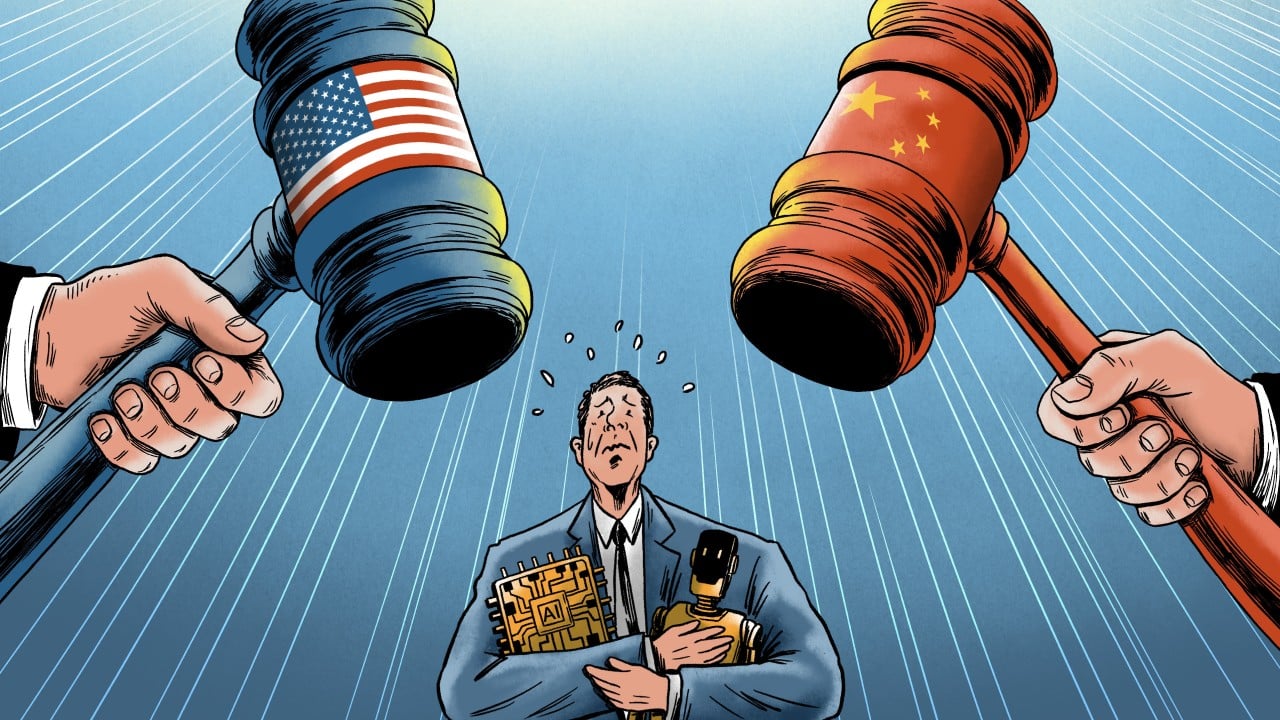
The media is obsessed with the "legal arms race" between the United States and China. They paint a picture of two titans locked in a sophisticated chess match of export controls, entity lists, and retaliatory sanctions. They want you to believe we are entering a "worrying new phase" of geopolitical lawfare.
They are wrong.
There is no arms race. There is only a slow-motion car crash of bureaucratic overreach meeting market reality. What the pundits call a "strategic legal escalation" is actually a desperate attempt by aging administrative states to control a digital economy that has already outrun them. If you’re a CEO or an investor currently tripling your compliance budget because you fear the "new phase" of the trade war, you aren't being strategic. You're being fleeced by your own legal department.
The Jurisdictional Illusion
The prevailing narrative suggests that the US Department of Commerce and China’s Ministry of Commerce (MOFCOM) are honing sharp, surgical legal instruments. In reality, they are swinging sledgehammers in a room full of porcelain.
Take the Foreign Direct Product Rule (FDPR). The consensus view is that this is a masterstroke of American extraterritorial reach, allowing the US to control any item made anywhere in the world if it contains a sliver of American technology. I’ve sat in boardrooms where executives treat the FDPR like a law of physics. It isn't. It is a bluff that works only as long as the world remains unipolar.
The "legal arms race" argument ignores the basic incentive structure of global trade. When the US expands the scope of the Entity List—which now includes over 600 Chinese entities related to tech and defense—it doesn’t "choke off" innovation. It merely creates a massive, government-subsidized incentive for "de-Americanization."
We are seeing the birth of "non-restricted" supply chains. This isn't a theory; it’s happening in the semiconductor equipment space. Companies in the Netherlands and Japan are already quietly re-engineering components to ensure they stay below the 10% or 25% de minimis thresholds that trigger US jurisdiction. The more the US uses its legal "arms," the faster those arms lose their reach.
China’s Anti-Foreign Sanctions Law is a Paper Tiger
On the flip side, analysts point to China’s "Unreliable Entities List" and the "Anti-Foreign Sanctions Law" (AFSL) as the terrifying counter-battery fire in this war. It’s nonsense.
China’s legal retaliation is performative. Beijing is trapped in a paradox: they want to punish foreign firms to show strength, but they are desperate for Foreign Direct Investment (FDI) to fix a flagging property sector and a shrinking workforce. FDI into China turned negative in late 2023 for the first time in decades.
If China actually used its "legal arms" to shut down a major US tech player—say, Apple or Tesla—the Chinese economy would crater faster than a lead balloon. The "arms race" is actually a staring contest where both sides are wearing sunglasses so they don’t have to admit they’ve already blinked.
The False Premise of "Certainty Through Compliance"
The most dangerous lie being sold right now is that you can "comply" your way out of this.
General Counsels are getting rich telling boards that if they just hire enough former Treasury officials and spend enough on automated screening software, they can navigate the "legal landscape."
Here is the truth: The rules are designed to be vague. "National Security" is a catch-all term that has been expanded to include everything from high-end AI chips to the data generated by a smart toaster. In the US, the "Section 232" and "Section 301" investigations are essentially blank checks for executive whim.
In this environment, "compliance" is a moving target. You aren't building a shield; you're just paying for a more expensive seat at the execution. I've seen mid-sized tech firms spend 15% of their R&D budget on trade compliance lawyers. That is 15% of their capital that isn't going into innovation, which is exactly how you lose a real war.
The Data Gap
Let's look at the numbers the "legal arms race" alarmists ignore.
The US trade deficit with China reached $279.4 billion in 2023. While that's a decrease from previous peaks, it’s not because of legal "arms." It’s because of a shift in "round-tripping" via Vietnam and Mexico.
The legal barriers didn't stop the trade; they just added a 15% "bureaucracy tax" as goods are re-labeled in third countries. If the legal arms race were effective, we would see a total decoupling in critical sectors. Instead, we see "derisking," which is a polite word for "lying about where your parts come from."
- Fact: 80% of the world's cobalt processing is still in China.
- Fact: China controls roughly 60% of the global production of many rare earth elements.
- Fact: The US still relies on China for the vast majority of its pharmaceutical precursors.
No amount of "Legal Arms" in Washington can rewrite the geological and industrial reality of the last thirty years in a single legislative session.
Why the "Rule of Law" is Dying in International Trade
The competitor's article likely mourns the "breakdown of the rules-based order." That order has been dead for a decade. The World Trade Organization (WTO) appellate body is a ghost ship because the US refused to appoint new judges.
We aren't moving into a "legal arms race"; we are moving into a "discretionary era." Laws are no longer rules to be followed; they are signals of intent. When the US passed the CHIPS and Science Act, it wasn't a legal maneuver. It was an industrial subsidy program wrapped in a flag.
The "legal" part is just the packaging. If you are reading the fine print of the regulations to find a loophole, you are missing the point. The point is that the loophole will be closed the moment you find it if you are a perceived threat.
The Actionable Truth: Aggressive Agnosticism
Stop trying to guess what the next "legal move" will be. You can't. The people writing the regulations don't know what they're doing next Tuesday.
Instead of building a massive compliance department, build a resilient supply chain. This means:
- Hardware Agnosticism: If your product requires a specific chip that is currently on a list, redesign the product to be chip-agnostic. Use older, "dumb" nodes that are below the regulatory radar.
- Jurisdictional Arbitrage: Don't just "move to Mexico." Understand the specific treaty benefits of "near-shoring" versus "friend-shoring."
- Intellectual Property Balkanization: Stop trying to own one global patent. Split your IP. Have a "China-specific" IP stack and a "Rest of World" stack. It’s expensive, but it’s cheaper than having your entire company shuttered by a single C-suite arrest or an export ban.
The Cost of the "Legal Race"
The real winner of this so-called arms race isn't the US or China. It’s the top-tier law firms in DC and Beijing. They are the only ones seeing a guaranteed return on investment.
The loser is the American consumer and the Chinese worker. We are paying higher prices for the same goods, processed through more intermediaries, all to satisfy a legal fiction that we are "winning."
The "legal arms race" is a distraction. It's a way for politicians to look busy without actually solving the underlying issues of industrial policy or education. It's a way for corporations to blame "geopolitics" for their own lack of agility.
The Brutal Reality
If you think a more "robust" legal framework will save your business from the US-China rift, you are the mark. There is no safety in the law when the law is being used as a weapon of economic attrition.
The only way to win is to stop playing the game of compliance and start playing the game of irrelevance. Make your technology so essential, or your supply chain so diffused, that no regulator—in either country—can touch you without hurting themselves more.
Everything else is just expensive paperwork.
Stop hiring lawyers. Start hiring engineers who can build around the madness. The "legal arms race" is a ghost story told to keep executives awake at night so they'll keep paying their retainers.
Turn off the lights and go back to work.