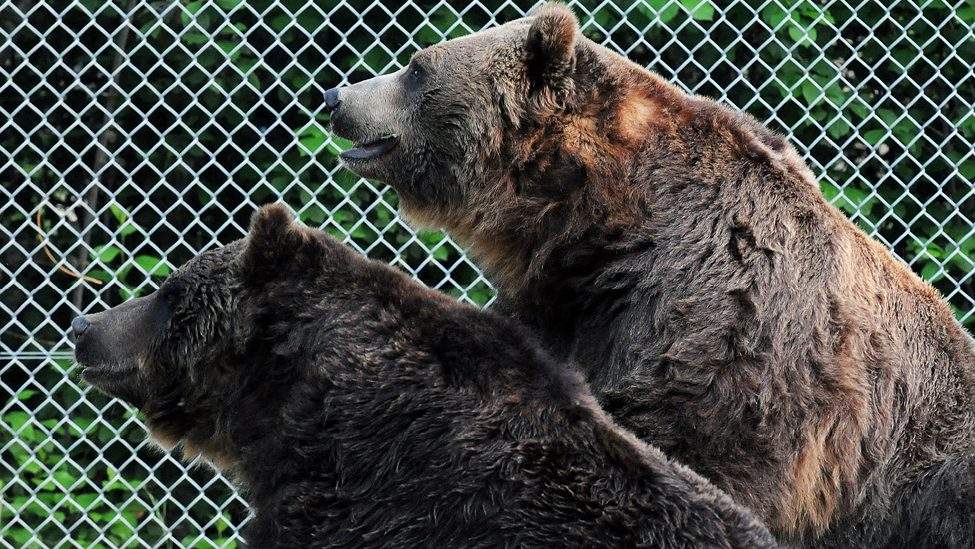
The frost on the iron latch of the enclosure gate does not melt easily in October. It clings, white and stubborn, until the mid-morning sun finally crests the pine canopy of the northern forest.
For nearly a quarter of a century, that latch meant something specific. It meant fresh fish, hauled in by the crate. It meant buckets of crushed berries, sweet and dark. It meant the heavy, rhythmic thud of massive paws hitting packed earth, a sound the zookeepers at the Saskatoon Forestry Farm Park and Zoo learned to feel in the soles of their boots long before they heard it echo across the clearing.
His name was Koda. Or perhaps, to the thousands of children who pressed sticky fingers against the glass over the decades, he was simply the bear. The great, amber-coated giant who proved that mythic creatures were not confined to storybooks.
Old age comes for wild things differently when they live in the margins of human care. In the wild, a grizzly bear rarely grows old. Tooth wear, starvation, or the brutal arithmetic of territorial combat usually intervene long before the muzzle turns frosted grey and the joints stiffen with the deep ache of arthritis. But Koda lived long. Too long, perhaps, for a body built to roam thousands of acres of subalpine tundra.
By his final autumn, the math had shifted.
Veterinary medicine is an exercise in heartbreaking negotiations. You weigh every heartbeat against the shadow of chronic pain. You measure quality of life not in years accumulated, but in moments of grace remaining. For months, the veterinary team at the zoo watched the invisible decline. The slow steps. The hesitation before climbing onto the elevated wooden platform where he used to survey his domain like a sovereign. The sudden, worrying lack of interest in the rich diet that had sustained him for a generation.
We often forget that captivity, even at its most compassionate, is a perpetual compromise. You trade the horizon for safety. You trade the bitter struggle of survival for regular meals and veterinary oversight. But you cannot negotiate with time.
Consider what happens when a apex predator's body simply starts to betray it. A human can understand why a hip aches or why a kidney falters; we have words for the decay, poetry for the twilight. An animal only experiences the sensation. Heavy. Dull. Wrong.
The decision to euthanize Koda was not made in a sterile boardroom. It was forged in the quiet hours of observation, in the reading of blood panels, in the heavy silence between keepers who knew every nuance of his posture. They knew the exact tilt of his head that meant he was annoyed, and the lazy roll onto his back that meant the afternoon sun was hitting his coat just right. When that latter posture stopped happening entirely, the truth became inescapable.
To end a life out of mercy is a profound burden. It requires a specific kind of courage—the willingness to absorb the grief so that the patient doesn't have to absorb the suffering any longer.
On the final morning, the air was sharp with the scent of decaying leaves and frost. The keepers brought his favorite treats, a final indulgence of rich foods he no longer had the appetite to properly enjoy. There was no panic. Just the quiet professionalism of people who had dedicated their lives to his well-being, whispering words of gratitude into the cold air.
When the procedure was complete, the enclosure felt instantly vast. Empty space has a strange weight to it. The wooden platform sat vacant under the pale Saskatchewan sky. The hollow in the grass where he curled up for summer naps remained, flattened and bare.
We build zoos as bridges between two worlds that were never meant to touch: the untamed wilderness and the concrete city. We put these magnificent, terrifying animals behind double-fenced perimeters so we can look into their eyes and remember that we are not the only masters of this planet. We look for a reflection of our own wildness, safely contained.
Koda gave that gift to Saskatoon for twenty-four years. He bore the weight of human curiosity, children's laughter, and the curious loneliness of living out of place and out of time.
The gate remains latched now. The frost comes and goes. But out where the northern trees meet the prairie wind, the absence of a heavy tread leaves a silence that takes a very long time to fill.


