The forest doesn't scream when it loses a soul. It sighs. It’s a wet, heavy sound—the rustle of leaves under a boot, the snap of a branch, and then a silence so thick you can taste the humidity. In the heart of the Democratic Republic of Congo, that silence is the most dangerous thing you can hear.
When a mother bonobo dies, she leaves behind more than a genetic vacancy. She leaves a child who understands grief with a depth that would terrify most humans. These are our closest living relatives, sharing nearly 99% of our DNA, yet we have treated them as a commodity, a delicacy, or an inconvenience.
To understand the stakes, you have to look past the "bushmeat" labels and the statistics. You have to look at the eyes of a three-year-old orphan named Beni.
The Market of Ghosts
Beni didn’t arrive at the sanctuary in a crate. He arrived as a ghost. He was found in a roadside market, tied by a nylon cord that had sliced through the skin of his ankle. To the man selling him, Beni was a byproduct. The mother had already been sold as meat; the infant was a novelty, a pet for someone with more money than conscience.
This is the reality of the illegal trade in the Congo Basin. It isn't just about hunger. It’s about a fractured economy where a single bonobo can represent a year’s wages. But the cost is calculated in more than francs.
Every time a poacher pulls a trigger, a social structure collapses. Bonobos are matriarchal. They solve conflict with affection rather than aggression. They are the peaceful mirror to our chimpanzee cousins. When we lose them, we lose a version of ourselves that figured out how to live without war.
The Architecture of a Sanctuary
Lola ya Bonobo is not a zoo. It is a desperate, beautiful attempt at restitution. Located just outside Kinshasa, it serves as the only place on Earth where these displaced spirits can find a semblance of the life that was stolen from them.
The process of healing is grueling. It starts with the "mamas."
These are local Congolese women, many of whom have survived their own horrors in a country plagued by conflict. They become the surrogate mothers for the orphans. They sleep with them. They carry them on their backs. They breathe with them. A bonobo infant that isn't touched will simply stop living. They succumb to a failure to thrive that no medicine can cure.
The mamas provide the "tactile bridge." It’s a slow, painstaking reconstruction of trust. Think of it as reweaving a tapestry that has been shredded by a serrated blade. One thread at a time, the mamas teach the orphans that a human hand can provide warmth instead of pain.
The Invisible Economy of Survival
We often sit in air-conditioned rooms and judge the poacher. It’s easy to do when your stomach is full. But the "bushmeat trade" is a symptom of a systemic fever.
In the villages surrounding the bonobo habitats, there are no supermarkets. There are few jobs. The forest is the bank, the pharmacy, and the larder. If your child is sick and the only way to pay for medicine is to track a troop of apes, you take the rifle.
The sanctuary realized early on that saving bonobos meant saving people. They began investing in the communities. They hired locals. They started education programs that didn't just lecture about conservation but provided alternatives.
If you give a man a way to feed his family without killing his heritage, he usually takes it. The shift is subtle but profound. The forest starts to be seen as a garden to be tended rather than a mine to be stripped.
The Long Walk Back
The ultimate goal is the "Re-wilding." It sounds cinematic, but the reality is terrifyingly fragile. You can’t just drop a group of rehabilitated apes into the jungle and hope for the best.
They have to be taught how to be bonobos again.
They have to learn which fruits are sweet and which are toxic. They have to learn the hierarchy of the troop. Most importantly, they have to learn to fear the right things. The sanctuary staff spends years preparing a group for release into the Ekolo ya Bonobo reserve, a massive protected forest.
The day of release is a quiet affair. There are no cheering crowds. Just the opening of a gate and the hesitant steps of creatures who have spent their lives caught between two worlds.
When Beni eventually joins a release group, he won't know he’s a success story. He won't know about the international treaties or the donor funding. He will only know the feeling of the earth under his feet and the canopy blocking out the sun.
The Mirror in the Trees
Why does this matter to someone thousands of miles away?
Because the bonobo represents a biological "what if." What if we had taken the other path? What if we leaned into our capacity for empathy and social cohesion instead of our drive for dominance?
The sanctuary is a laboratory of second chances. It’s a place where the worst of humanity—greed, violence, apathy—meets the best of it—patience, sacrifice, and love.
Every time a baby bonobo is saved, we are effectively saving a piece of our own history. We are proving that we aren't just the apex predator. We are also the protectors.
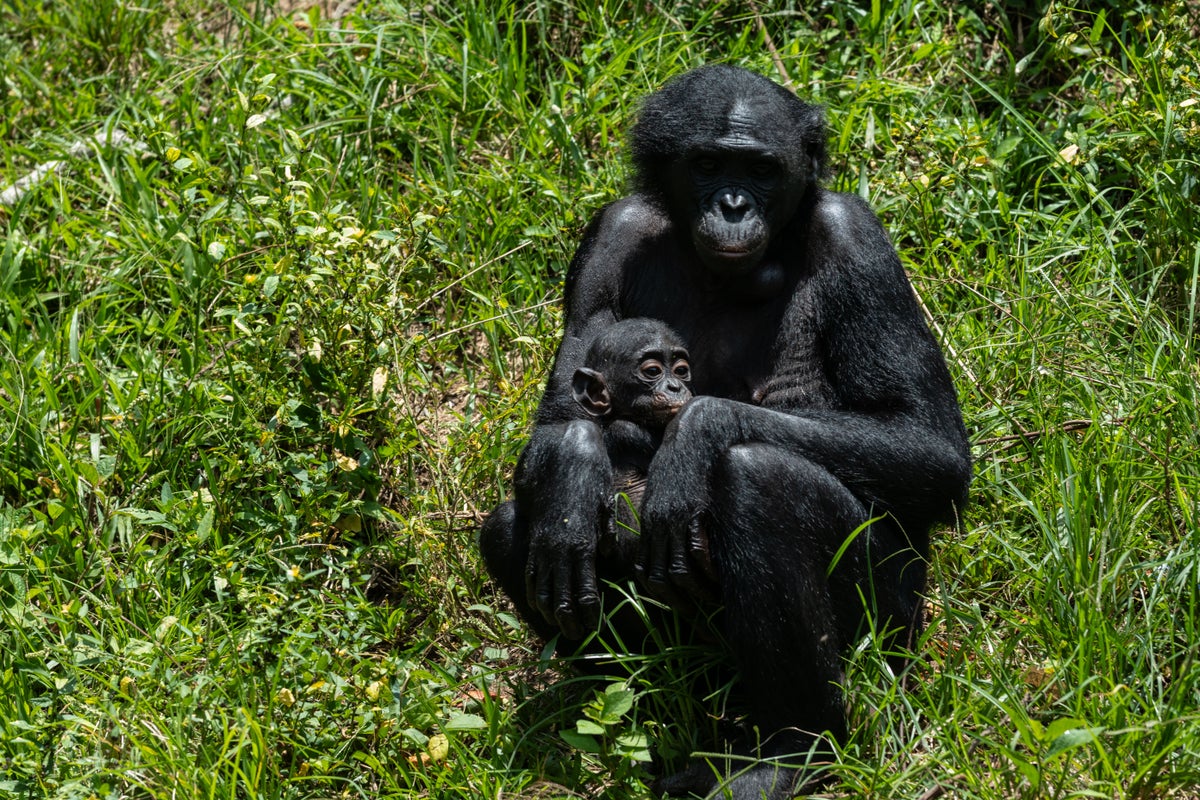
The humidity in the Congo never lets up. The mosquitoes are relentless. The politics are a minefield. But then you see a mama sitting in the grass, a tiny dark-furred infant clinging to her chest, and the noise of the world fades away.
In that moment, there is no "them" and "us." There is only the breath. There is only the heat. There is only the survival of a kin we were once too blind to recognize.
The gate stays open. The forest waits. The silence is no longer a void, but a breath held in anticipation.