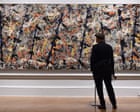
You rarely see federal politics, abstract masterpieces, and the music industry collide quite like this. Jackson Pollock’s legendary drip-painting Blue Poles is finally packing its bags for Western Australia, marking its first interstate trip in over two decades. At the same time, the Australian Recording Industry Association (ARIA) just drew a hard line in the sand against fully synthetic audio. These two massive cultural updates might seem unrelated, but they both point to a single urgent question: how do we value human art in an automated age?
The Journey West for Blue Poles
Let’s talk about the painting first. If you grew up hearing about Gough Whitlam’s controversial 1973 purchase of Blue Poles for $1.3 million, you know it occupies a mythic status in Australian cultural history. Today, it sits securely inside the National Gallery of Australia in Canberra, rarely moving anywhere because of its immense value and fragile nature.
That changes between April and September 2027. Prime Minister Anthony Albanese announced that the massive canvas will head to the Art Gallery of Western Australia in Perth. It is the first time the painting will leave Canberra for an interstate gallery since it traveled to Melbourne back in 2003.
Insured for hundreds of millions of dollars, hauling Blue Poles across the Nullarbor is no casual weekend road trip. It requires military-grade planning, massive climate-controlled crating, and nerves of steel. For art lovers in the west who have never shelled out for a flight to Canberra, this is a generational chance to stand in front of those chaotic, beautiful slashes of enamel, aluminum paint, and embedded glass.
Drawing the Line on Synthetic Beats
While museums are dusting off mid-century treasures, the commercial music world is scrambling to protect its future. ARIA just updated its code of practice to officially ban wholly AI-generated tracks from entering its official charts.
Under the new rules taking effect for charts starting August 31, completely automated songs created by algorithms scraping human catalogs are out. However, ARIA isn't living in the dark ages. The organization admits that generative AI can play a valid supporting role in production, provided the final product remains substantially human-made.
ARIA chief executive Annabelle Herd put it bluntly, noting that the charts must evolve to accommodate tools artists already use while safeguarding the core human effort behind music. It is a smart distinction. Using software to tune a vocal or generate a weird atmospheric synth pad is worlds apart from typing a prompt into a server and letting a machine churn out a chart-topping track using stolen artistic DNA.
Why These Stories Belong Together
Both of these developments highlight a collective cultural anxiety about authenticity.
When Blue Poles was bought in the 1970s, taxpayers screamed bloody murder. Critics called it a waste of public money on random paint splatters that a toddler could replicate. Decades later, it is a priceless national anchor. We recognize the raw, messy, human genius behind Pollock's physical labor.
Fast forward to 2026, and we face a new kind of panic. Instead of taxpayers wondering if a splatter painting counts as art, we have listeners wondering if the catchy track on their streaming feed was manufactured by a server farm in three seconds.
Protecting our cultural landscape means drawing boundaries. Whether it's funding regional gallery access so kids in Perth can experience a physical masterpiece, or ensuring music charts reward actual songwriters instead of prompt engineers, the goal is identical. We have to keep human blood, sweat, and vision at the center of culture.
Check your local gallery schedules for 2027 to plan your trip to Perth, and keep an eye on how streaming charts adapt to these new strict rules over the coming months.