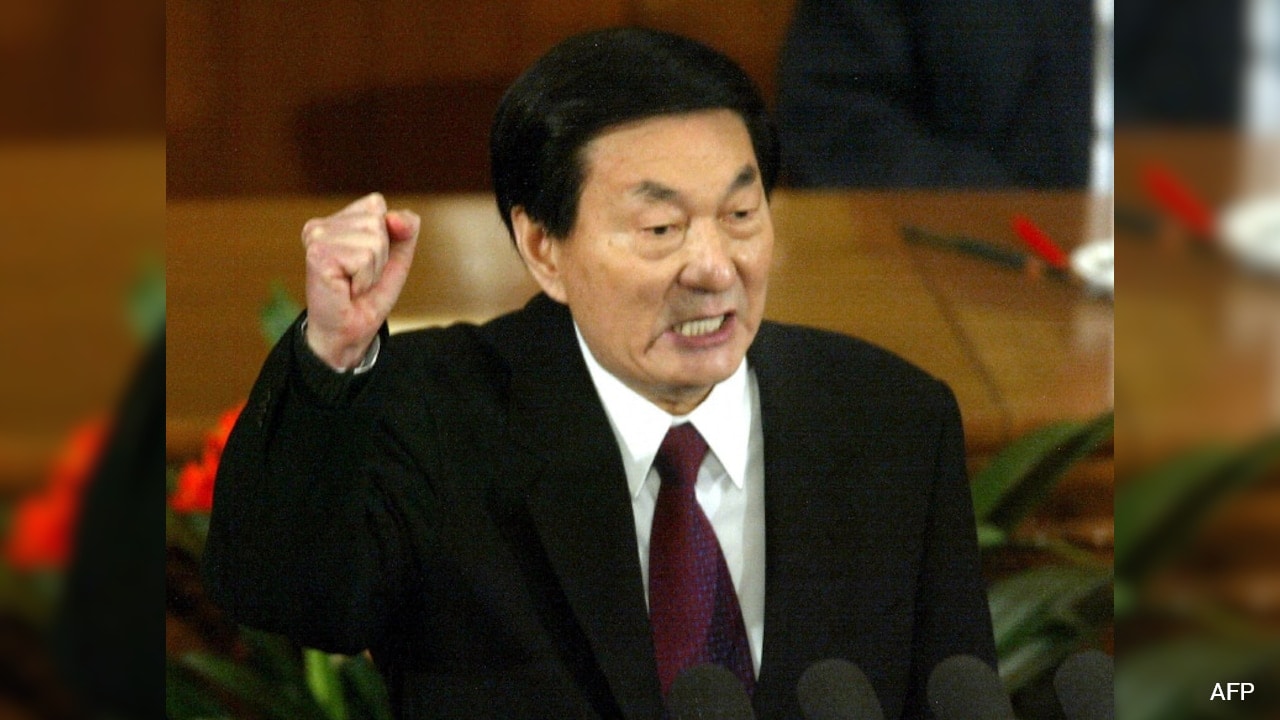
Zhu Rongji is dead at 97. The man who dragged the People's Republic of China into the World Trade Organization in 2001 has passed away, taking with him the final chapter of an aggressive economic pragmatism that Beijing has largely buried under layers of modern state control. History remembers him as the Iron Chancellor, a moniker earned through a rare combination of bureaucratic ruthlessness and a terrifying willingness to dismantle sacred cows to save the party from economic collapse.
When Zhu took the reins as Premier in 1998, China faced a compounding catastrophe. The Asian Financial Crisis was roaring across borders, domestic state-owned enterprises were bleeding public capital into a sea of non-performing loans, and international trade partners viewed Beijing as a volatile, closed outlier. Zhu did not negotiate with the inertia of the past. He crushed it. He bypassed ideological orthodoxy to force through the structural compromises required for WTO entry, a maneuver that unlocked global capital markets and transformed China into the manufacturing floor of the world.
Yet, looking back at his legacy from the vantage point of today's geopolitical fracturing reveals a stark truth. The architecture Zhu built to integrate China into the West is the exact system Beijing now weaponizes to challenge Western hegemony, while simultaneously turning its back on the market-driven principles he championed.
The Anatomy of the 1998 Crisis
To understand Zhu Rongji, you must understand the state of China's economy when he assumed executive power under President Jiang Zemin. The nation was staggering out of the 1990s with an industrial sector dominated by bloated state enterprises. These dinosaurs produced goods nobody wanted, accumulated massive debts with state-run banks, and paid wages through endless bailouts. The banking system itself was functionally insolvent, weighed down by mountains of bad debt that would have triggered a total collapse in any Western market.
Zhu diagnosed the disease with brutal clarity. In his famous dictum regarding state-owned enterprise reform, he declared that the government needed to "grasp the large, let go of the small."
This meant privatizing, merging, or liquidating tens of thousands of smaller municipal and provincial factories. It was an economic bloodbath. Millions of workers—known as xiagang or laid-off personnel—were stripped of the cradle-to-grave social welfare safety net known as the iron rice bowl. Pensions vanished, housing allowances evaporated, and industrial cities across the rust belt plunged into deep social unrest.
Zhu did not blink. He deployed police presence where protests threatened stability, but he refused to reverse course. He understood that without fiscal centralization and corporate accountability, China would implode from within. He consolidated tax collection away from unruly provinces and straight into Beijing's coffers, starving local governments of independent spendthrift habits and centralizing state capacity in a way Mao Zedong could only dream of achieving.
The WTO Gamble
With the domestic house violently ordered, Zhu turned his gaze outward. The crown jewel of his career was the bruising, high-stakes negotiation to bring China into the World Trade Organization. Washington and European capitals were deeply skeptical. They saw a totalitarian regime playing by its own mercantilist rules.
Zhu recognized that isolation was a death sentence for growth. He gambled that by binding China to global trade rules, he could force domestic industries to modernize or die.
The negotiations spanned years, culminating in tense late-night phone calls and diplomatic maneuvering that nearly derailed after the accidental NATO bombing of the Chinese embassy in Belgrade in 1999. But Zhu pushed past the political fallout. He understood that WTO accession would act as an external anchor. It would compel local bureaucrats to dismantle tariff walls, open telecommunications and banking sectors to foreign participation, and subject Chinese exports to international dispute mechanisms.
When the ink dried in Doha in 2001, critics warned that Zhu had sold out national sovereignty to foreign multinationals. They argued that foreign capital would swallow local enterprises whole.
They were catastrophically wrong. Instead of being consumed, Chinese industry used the WTO platform as a springboard. Exposed to international competition, domestic firms scaled at a ferocious pace, absorbed foreign technology transfers, and eventually outcompeted the very Western companies that had lobbied for their market access. Zhu had created a monster from the perspective of Western competitors, but from Beijing's perspective, he had engineered the greatest economic ascent in human history.
The Anti-Corruption Crusade
Zhu's authority was not derived from personal charm. He was notoriously abrasive, impatient with fools, and allergic to bureaucratic foot-dragging. Early in his tenure tackling the economic portfolio, he launched a merciless anti-corruption drive, famously demanding that subordinates prepare one hundred coffins—ninety-nine for corrupt officials and one for himself if he failed.
This wasn't mere political theater. Zhu targeted high-level financial crimes that threatened state solvency. When the Guangdong International Trust and Investment Corporation collapsed in 1998 with billions in foreign debt, foreign creditors expected a government bailout to save face. Zhu refused. He let the corporate giant fail and liquidated its assets, sending a shockwave through international financial markets that Beijing would no longer guarantee reckless speculative borrowing by provincial entities.
That willingness to impose short-term pain for long-term systemic health stands in stark contrast to the modern era of debt-fueled stimulus and property market life-support.
The Great Reversal
Today, the economic model Zhu fought so hard to construct is being systematically dismantled by his successors.
Under his watch, the private sector was given room to breathe, foreign investment was actively courted, and technocratic competence outweighed political sycophancy. The state maintained control of commanding heights like energy and finance, but a vibrant, chaotic, entrepreneurial underclass drove innovation and employment.
Fast forward to the current landscape. The pendulum has swung violently back toward state dominance. The private sector faces aggressive regulatory crackdowns, ideological compliance checks, and a financial system that once again prioritizes state-owned enterprises over nimble private startups. The WTO rules that Zhu embraced are now routinely circumvented through industrial subsidies, forced technology transfers, and strategic market closures.
Western politicians look back at Zhu's era with a mixture of nostalgia and bitterness, lamenting that the promises of political liberalization he hinted at during his famous 1998 press conference never materialized. He had teased that political reform must follow economic restructuring. It never did. The Communist Party took the wealth generated by his market reforms and used it to fortify authoritarian governance rather than dilute it.
The End of an Era
Zhu stepped down in 2003, fading into a quiet retirement where he famously practiced the erhu, a traditional Chinese two-stringed instrument, and avoided public commentary on current affairs. He left behind a China that was confident, wealthy, and integrated into the global nervous system.
Yet his death marks the passing of a distinct political mindset. The technocrats who rose through the ranks alongside him—engineers, economists, and pragmatists who understood global finance and international law—have been replaced by ideological enforcers. The problems Zhu solved through market opening and institutional discipline are now increasingly met with state coercion and national security decrees.
The Iron Chancellor proved that a centrally planned economy could be forced to speak the language of global capitalism. Whether modern Beijing can sustain that superpower status while silencing the very market forces he unleashed remains the defining question of our century.