Three miles above central Kansas, at thirty-six thousand feet, the air outside the cabin window is minus sixty degrees Fahrenheit, thin enough to starve a human brain of oxygen in seconds, and completely empty. Inside Row 14, a father is trying to keep a toddler from spilling apple juice onto an iPad. He is not thinking about radar sweeps. He is not thinking about tax policy, congressional appropriations, or the structural differences between public utilities and private corporations.
He assumes the sky is safe because the sky has always been safe.
Below him, inside a windowless, dimly lit room in Olathe, Kansas, a man named Marcus—let us invent Marcus for a moment, a hypothetical composite of the roughly fourteen thousand air traffic controllers who work the American airspace—is staring at a phosphor-green screen. Marcus has a lukewarm cup of coffee beside his keyboard and two hundred lives resting on the precise cadence of his voice. When he speaks into his headset, telling a pilot to descend to flight level two-four-zero and turn ten degrees left to avoid a building thunderhead over Missouri, he is not an employee of a private telecom conglomerate or a shareholder-owned infrastructure monopoly.
He works for you.
Most travelers do not realize how strange this is. If you board a flight in London, Frankfurt, Toronto, or Sydney, the person guiding your aircraft through the clouds, the concrete runway beneath your landing gear, and the radio beacons blinking through the fog are likely owned, operated, or financed by private corporations or self-funding commercial entities. In those countries, aviation infrastructure is treated like a toll road. You pay at the gate, the money goes into a corporate ledger, and the company builds the road.
In the United States, we built a different bargain. We decided, nearly a century ago, that the sky is a public commons, and that the American government would foot the bill to wire it, pave it, and police it. That quiet, largely invisible choice shapes every ticket you buy, every delay you endure on a rainy Tuesday in Newark, and the very reason small towns in Montana still have a lifeline to the rest of the world.
The Myth of the Self-Made Airline
We love stories about rugged individualism in American business. When we look at aviation, we see the gleaming liveries of Delta, United, American, and Southwest. We see billionaire founders, fierce fare wars, and private enterprise conquering the clouds.
It is a compelling illusion.
The truth is that a commercial airliner is useless without the colossal, invisible machine underneath it. An airplane is just a pressurized aluminum tube with wings until it connects to a network of runways, radar towers, satellite navigation arrays, weather stations, and human controllers. And in the United States, that entire nervous system is overwhelmingly funded and operated by the federal government through the Federal Aviation Administration.
Consider what happens the moment you purchase a three-hundred-dollar domestic plane ticket. Look closely at the fine print on your receipt, buried beneath the base fare. You will see a cluster of cryptic acronyms and small dollar figures: the Passenger Facility Charge, the September 11th Security Fee, the Federal Segment Tax, and the 7.5 percent U.S. Domestic Transportation Tax.
Those pennies and dollars do not go to the airline's CEO. They flow into a massive federal piggy bank known as the Airport and Airway Trust Fund. Created in 1970, this trust fund—supplemented by billions of dollars from general taxpayer revenues—is the financial heartbeat of American flight. Unlike other developed nations that spun off their air traffic control systems into private or quasi-private corporations during the deregulation waves of the 1980s and 1990s, the United States kept its hands firmly on the wheel.
Why did we refuse to let go?
To understand the answer, you have to understand the sheer, terrifying scale of the American sky. On any given day, the FAA handles more than forty-five thousand flights carrying nearly three million passengers across twenty-nine million square miles of airspace. That is more traffic, more weather volatility, and more complex geography than any private entity on earth has ever been asked to manage. When Congress debated privatizing air traffic control in 2017, the proposal collapsed not because Americans suddenly fell in love with government bureaucracy, but because rural lawmakers, private pilots, and defense officials looked at the map and realized what privatization actually meant.
What Happens When the Sky Becomes a Business
Let us step across the border to see the alternative. In 1996, Canada became the first major nation to fully privatize its air navigation system, handing over its skies to a non-profit, private corporation called Nav Canada. Soon after, the United Kingdom followed suit with NATS, creating a public-private partnership. Germany, Australia, and New Zealand built similar corporatized models.
On paper, these private systems look sleek. Freed from the annual budgeting circus of politicians, Nav Canada and NATS can borrow money on the open bond market, buy new technology without waiting for a legislative committee to approve a line item, and charge airlines directly for every mile flown through their airspace. When technology needs an upgrade, they buy it. When traffic surges, they adjust fees.
But business logic has a sharp edge. A private corporation answers to its balance sheet. A government answers—at least in theory—to the entire map.
Imagine a hypothetical regional carrier trying to run a daily twin-propeller flight from Billings, Montana, to a tiny municipal airstrip in Wolf Point, near the Canadian border. There are twelve passengers on board: a nurse heading to a clinic, a rancher picking up tractor parts, a college student going home for the weekend. Financially, that flight is a rounding error. In a purely user-funded, corporatized aviation system, maintaining the radar coverage, instrument landing systems, and runway asphalt for Wolf Point makes zero economic sense. A private operator would either slap astronomical user fees on that twelve-seat plane until the route died, or quietly let the rural infrastructure rust while pouring capital into lucrative hubs like London Heathrow or Toronto Pearson.
The American model refuses to do that math. Through programs like the Airport Improvement Program and Essential Air Service, the federal government deliberately cross-subsidizes the map. The taxes collected from a crowded business-class flight between New York and Los Angeles help pay for the runway lighting in rural Alaska, where roads do not exist and an airplane is the only ambulance.
I felt the weight of this invisible subsidy three winters ago, stranded in a tiny regional terminal in northern Michigan during a lake-effect blizzard. Outside, visibility had dropped to zero. The snow was blowing sideways, blinding and relentless. Inside, twenty of us sat on vinyl chairs, watching the departure board flicker. In a commercialized system, a small outpost like that is an expense to be minimized. Yet just beyond the frosted glass, federal snowplows were clearing a ten-thousand-foot runway built with federal grants, guided by federal instrument landing beacons that allowed a regional jet to drop safely out of a whiteout sky and carry us home. Nobody at the gate paid a toll to the plow driver. Nobody swiped a credit card to turn on the approach lights. The infrastructure was simply there, waiting like a lighthouse on a rocky coast.
The Price of Political Whiplash
Yet if the American government-funded model is a triumph of democratic access, it carries a quiet, chronic illness that every frequent flyer has felt in their bones.
You feel it when you are sitting on the tarmac in Chicago for two hours because thunderstorms in Atlanta have snarled the entire East Coast, and the air traffic control system cannot reroute planes fast enough. You feel it when you read a news alert about a near-miss on a foggy runway in Austin or San Francisco.
When the government funds the sky, the sky becomes a hostage to politics.
Private air navigation providers like Nav Canada fund their operations through steady, predictable user fees and multi-year bond issuances. They plan in decades. The FAA, by contrast, lives at the mercy of the United States Congress. Every few years, the agency must beg lawmakers for a multi-year reauthorization bill. When Washington gridlocks—as it routinely does—the FAA is forced to limp along on short-term continuing resolutions, sometimes for months or years at a time.
Try renovating your house when you only find out every thirty days whether you are allowed to buy lumber. Now imagine doing that with the nation's radar network.
This political whiplash is the primary reason the FAA's NextGen modernization program—an ambitious effort to transition American skies from 1950s ground-based radar to precision satellite tracking—has dragged on for two decades, burning through tens of billions of dollars while falling years behind schedule. Engineers cannot build a seamless digital airspace when their funding vanishes during a government shutdown.
During the thirty-five-day federal shutdown in early 2019, the cracks in America's public aviation model were laid bare for the entire world to see. Because air traffic controllers are deemed essential workers, Marcus and his fourteen thousand colleagues had to show up to work every day without a paycheck. They stared at their green screens, guiding millions of passengers through winter storms, while worrying about how to pay their mortgages or buy groceries. Eventually, a handful of exhausted controllers at East Coast facilities called in sick. Within hours, air traffic into LaGuardia Airport ground to a halt. Delays rippled across the continent like falling dominoes. The shutdown ended that very afternoon.
It was a sobering reminder of a fundamental vulnerability: when the government owns the sky, political dysfunction does not stay in Washington. It boards your flight.
Airports as Municipal Monuments
The divide between America and the rest of the world becomes even starker when your wheels touch the concrete.
Walk through the gleaming terminals of London Heathrow, Madrid-Barajas, or Sydney Airport, and you are walking through private real estate. Over the past three decades, governments across Europe, Asia, and Latin America realized that major airports are cash cows. They sold them off—either entirely or through long-term concessions—to global infrastructure funds, pension firms, and private operators. Those private owners make their money by turning terminals into high-end shopping malls, charging airlines steep landing fees, and extracting every possible cent from parking garages and duty-free luxury boutiques.
America never joined the airport privatization gold rush.
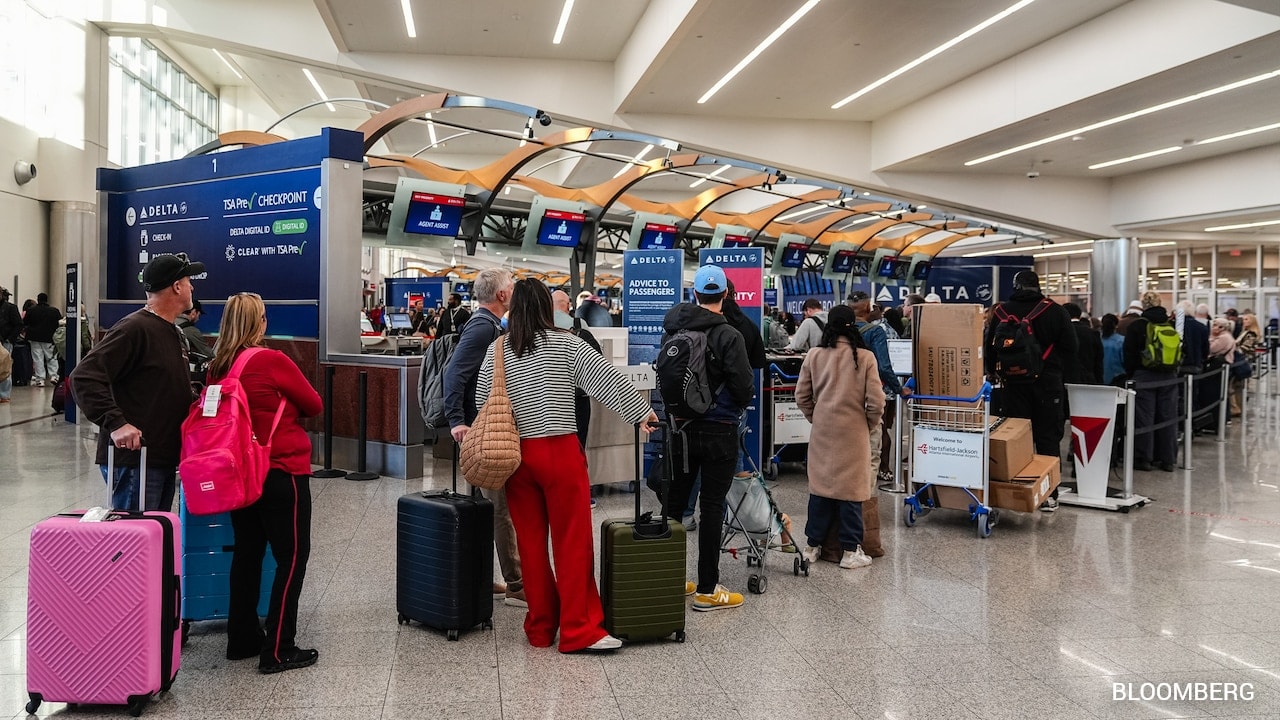
Out of the hundreds of commercial airports in the United States, almost every single one—from sprawling behemoths like Hartsfield-Jackson Atlanta to mid-sized hubs like Denver or Salt Lake City—is owned by a local city, county, or state government authority. Federal law makes it notoriously difficult for an American city to sell its airport to a private investor, largely because airlines fiercely oppose it. Airlines know that a city council wants lower fares and more flights to boost local tourism, whereas a private equity firm wants higher landing fees to boost quarterly dividends.
Instead, American airports rely on a uniquely hybrid financial engine. They raise money by issuing tax-exempt municipal bonds, collecting local passenger facility charges capped by Congress, leasing gate space to airlines, and drawing down billions of dollars in federal FAA grants.
This public ownership creates a fascinating paradox. On one hand, it keeps the cost of flying remarkably competitive in the United States. Airlines do not have to pass along the exorbitant, monopoly-priced landing fees that are common at privatized European hubs. On the other hand, because federal caps have kept local airport infrastructure fees artificially low for over twenty years, many American airports spent decades looking like decaying 1970s bus stations—cramped concourses, leaking roofs, and outdated baggage systems—while Doha, Singapore, and Zurich built architectural wonders. Only recently, fueled by massive federal infrastructure packages and creative municipal bond financing, have places like LaGuardia and Los Angeles International finally shed their concrete gloom.
The Invisible Subsidy in Your Carry-On
Critics of the American system often argue that taxpayers who never step foot on an airplane are unfairly subsidizing those who do. Why should a factory worker in Ohio who drives everywhere for vacation help fund the radar towers used by Wall Street bankers flying to London and billionaires flying Gulfstream jets to Aspen?
It is a fair question, and the math is genuinely messy.
While the Airport and Airway Trust Fund brings in roughly fifteen to twenty billion dollars a year from ticket taxes and aviation fuel levies, Congress routinely tops up the FAA's budget with billions more from the general treasury—money pulled from ordinary income taxes. Private corporate jets, which make up a substantial percentage of daily flights and demand just as much attention from air traffic controllers as a three-hundred-seat Boeing 777, pay only a tiny fraction of the system's operating costs through fuel taxes. In Europe, that private jet would be billed directly by the kilometer for the air traffic control services it consumes. In America, the commercial airline passenger—and the general taxpayer—quietly picks up the tab.
Yet if you zoom out from the ledger sheet, you begin to see why successive generations of American leaders have tolerated that imbalance.
In a country stretching three thousand miles from ocean to ocean, across mountain ranges and vast agricultural plains, aviation is not a luxury good. It is the interstate highway system of the sky. Without federally funded air infrastructure, the American economy would fracture into isolated coastal islands. Over half of all air cargo in the United States travels in the bellies of commercial passenger planes—medical isotopes that decay within hours, precision manufacturing components, overnight legal documents, fresh seafood. Every time an Amazon package arrives at your porch in forty-eight hours, or a hospital in Des Moines receives a specialized surgical implant before dawn, it is riding on the back of a publicly funded aviation network.
More than that, the American airspace is inextricably fused with national defense. Unlike smaller nations where military and civilian skies can be neatly separated, the FAA and the Pentagon operate as twin halves of a single organism. During the Cold War, radar stations were built to spot Soviet bombers and guide commercial airliners simultaneously. On the morning of September 11, 2001, it was a unified, federally controlled air traffic system that executed the most audacious operational feat in aviation history—grounding more than four thousand airborne planes across North America in just over two hours without a single accident. A fragmented network of private contractors could never have pulled that lever with such instantaneous, unquestioned authority.
The Quiet Bargain at Thirty-Six Thousand Feet
Back in Row 14, the turbulence over Missouri passes. The seatbelt sign chimes off with a soft, familiar ding. The father wipes up the spilled apple juice, closes the window shade against the blinding afternoon glare, and leans back to catch twenty minutes of sleep before the descent into Denver.
He will land on a concrete runway paid for by federal aviation grants, guided down an invisible electronic glide path maintained by federal technicians, cleared to touch down by a controller whose paycheck comes from the United States Treasury.
Is the American way of funding the sky the most efficient model on earth? No. It is slow, bureaucratic, vulnerable to the petty tantrums of partisan politics, and occasionally maddening to anyone stuck in a summer ground stop. If you want sleek corporate efficiency and glossy retail terminals, look to London or Toronto.
But efficiency is not the only virtue worth engineering into a nation.
The United States made a deliberate, stubborn choice to treat flight not merely as a commercial transaction between a buyer and a seller, but as a public right of way—a shared national artery that belongs equally to a megacity hub and a prairie town, to a cargo carrier and a regional commuter flight. Every time a plane lifts off into the American sky, it is riding on a quiet, century-old promise that the space above our heads belongs to all of us, and that we will bear the cost of keeping it safe together.
Down in the dark room in Olathe, Marcus takes a sip of his cold coffee, leans toward his microphone, and clears another flight through the clouds.